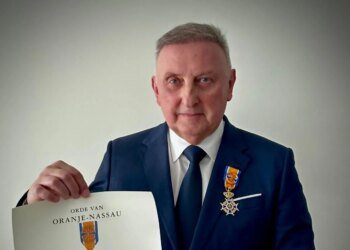
Regular member of the French Academy Alain Finkielkraut he said on Tuesday at the lecture “Israel, Europe, anti-Semitism” at the Croatian Academy of Sciences and Arts (HAZU) that he sympathizes with Israel but also condemns the anti-Palestinian statements of Netanyahu’s government officials.
I feel not only anger, but also shame. I feel co-responsible because people from my people say such things, he said, adding that the army should pay more attention to civilians.
He noted that he is being told that he is leaving his community, but he is not ashamed of Israel. I am ashamed of those who claim that there are no innocents in Gaza, he said, adding that this is a shame he shares with many Israelis.
He emphasized that he never stopped being an Israeli, the only question is what kind. Israel is divided: on one side are those who seek justice, and on the other are the followers Netanyahu who introduced irresponsible people into the government, he said.
“I understand very well the extent of the trauma of October 7 and I understand very well that Israel responded then with war,” Finkielkraut said. He assessed such a view as horrible and added that a large part of the Israeli population disputes such a vision.
He pointed out that Netanyahu’s opponents are patriots, especially those who oppose fanatics, such as Itamar Ben-Gvir and Bezalel Smotrich.
The insurgents in the Warsaw Ghetto had no choice to fight or lay down their arms because if they had laid down their arms they would have been killed simply and immediately, said Finkielkraut and added that it was not like that with Hamas in Gaza, because since 2005 Gaza was no longer an occupied territory.
Hamas, he emphasized, still had the choice to lay down its arms, but the difference between it and the Ghetto insurgents is no longer visible, so now they are suddenly talking about genocide, which is an accusation that has become established in a large part of Europe.
He added that this is the case even in Croatia. I am familiar with the controversy that pitted the President of the Republic against the Ambassador of Israel in Croatia. The latter asked to close the Iranian embassy, which was a nest of terrorists, he noted and added that the response of the current Croatian president was extreme.
President Milanović is nostalgic for Pavelić and Ustasha, and it comes, let’s put it that way, from the left, he said.
He assessed that this is a major mutation of anti-Semitism, which we have been facing since 1967, and which found its refuge after the Second World War.
He emphasized that some Israelis interpreted the 1967 victory as a divine sign. The consciousness of some Israelis has ceased to be secular; they believe that God gave this land to Abraham and his descendants, he said and added that it is a horror and a strategic mistake because some see an opportunity to cleanse the land of Palestinians in the West Bank and Gaza.
He recalled that since 1967 there had been conflicts and retreats. Israel made peace with Egypt, he said, adding that when they withdrew from Lebanon, they got the pro-Iran militia Hezbollah, and when they withdrew from Gaza, they got Hamas.
He believes that this is why some in Israel believe that there is no other way than force, because yielding would bring terror to their doorstep. This fear for security forces many to remain silent and leave power to ideologues, he said.
He assessed that he must fight against anti-Semitism in the educational world and against those who threaten the country and Judaism in Israel itself.
“I advocate a Palestinian state or confederation because it is historically and geographically logical,” he said, adding that the alternative is partition – either ethnic cleansing or mutual brutalization of both peoples.
Alain Finkielkraut (1949), a French philosopher and journalist taught philosophy and the history of ideas at the École polytechnique in Paris. He is a regular member of the French Academy (immortel de l’Académie française) and a corresponding member of HAZU since 1992. He edited the magazine Le Messager européen (The European Messenger), after which he was the host of the radio contact show Répliques.
The most important is his philosophical contribution to the critique of modernity and modernity, especially to the critique of progressivism, the understanding of human rights, and pointing out the problems in the modern understanding of culture. During the 1990s, Alain Finkielkraut denounced the regime in European public and intellectual circles Slobodan Milosevic and Serbian aggression and stood up for the independence and international recognition of Croatia and defended the justice of the Homeland War.