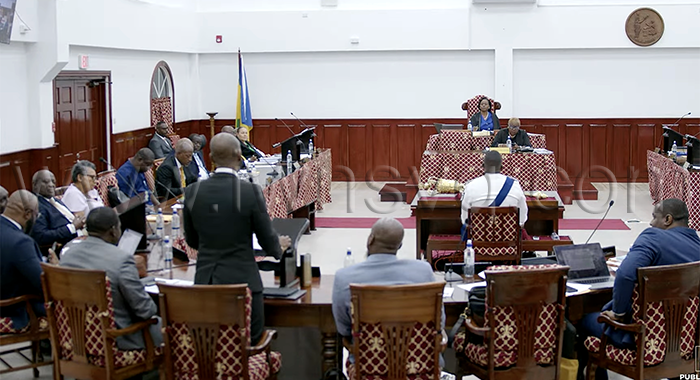
Two pieces of legislation aimed at improving the financial security of some of the lowest-paid public service workers have been in Parliament and sent to a select committee for detailed examination and wider public input.
The bills are the Daily Paid and Minor Salaried Officers (Compassionate Gratuity) Bill 2026 and the Pensions Amendment Bill 2026, both piloted by Deputy Prime Minister St. Clair Leacock, who has ministerial responsibility for the Public Service.
Leacock said the Compassionate Gratuity Bill seeks to provide for the grant of compassionate gratuity to daily, paid and minor salaried officers in the public sector upon retirement or death in service.
He told the Parliament that if it were left to him alone, he would have proceeded immediately to debate and pass the bill into law, citing the number of workers who stand to benefit.
“Left to myself, we would have proceeded today to share the goodies of this great bill to our deserving public servants, some 2,831 of them in grades M and L and grades one and two, who can do with this relief,” he said.

However, he explained that the Government had decided to give the public more time and space to engage with the proposals.
“But it is the considered opinion of the Honourable Prime Minister and our colleagues that to the extent that this important bill that will grant relief to nearly 3,000 of our public servants, we allow for more public listening and interest in the subject matter,” Leacock told Parliament.
He said that from the government side, he will be joined on the select committee by Prime Minister Godwin Friday; Attorney General Louise Mithcell; Minister of Agriculture, Forestry, and Rural Transformation, Israel Bruce; Minister of the Family and Gender Affairs, Persons with Disability, and Labour, Laverne Gibson-Velox; Minister of Housing, Land Management, Urban Development, and Informal Settlement Upgrading, Andrew John and senators Jemalie John and Chieftan Neptune.
The three members of the opposition, Opposition Leader Ralph Gonsalves and Senators Carlos James and Keisal Peters will also sit on the select committee.
Meanwhile, Leacock also told parliament that the Pensions Amendment Bill, which will increase the retirement age, will also go to a select committee.
The bill provides for the age of compulsory retirement for an officer holding a non‑pensionable office to be increased to 65 years, with the option to elect to retire on or after attaining age 60.
Leacock framed the measure as a response to recurring appeals from public servants approaching the traditional retirement age.
“Simply put, every week we have coming before the Cabinet of this country public servants who attain the age of 60 and can’t take care of themselves between that and the retirement age, asking for extension of service,” Leacock said.
“Perhaps, when we set this policy position, the private sector will fall in line, so that those people who now have to retire at age 60 and sacrifice substantive portions of the pension and so on and so forth… they don’t get pension, but they ask the question, ‘How do I live for the next five years?’”
Leacock said the bill is intended to provide a practical answer.
“We are providing them an avenue, another wonderful piece of legislation that builds a government, a country, the people from the ground up, from the bottom up, a new vision for the development of [the country],” he said.
The select committee will have the same members as with the Compassionate Gratuity Bill.
Leacock repeatedly portrayed the legislative package as part of a broader effort to uplift vulnerable categories of public servants:
“Another wonderful piece of legislation that builds a government [and] a country [for] the people from the ground up, from the bottom up,” he said, promising more detailed debate when the bills return to Parliament for debate.