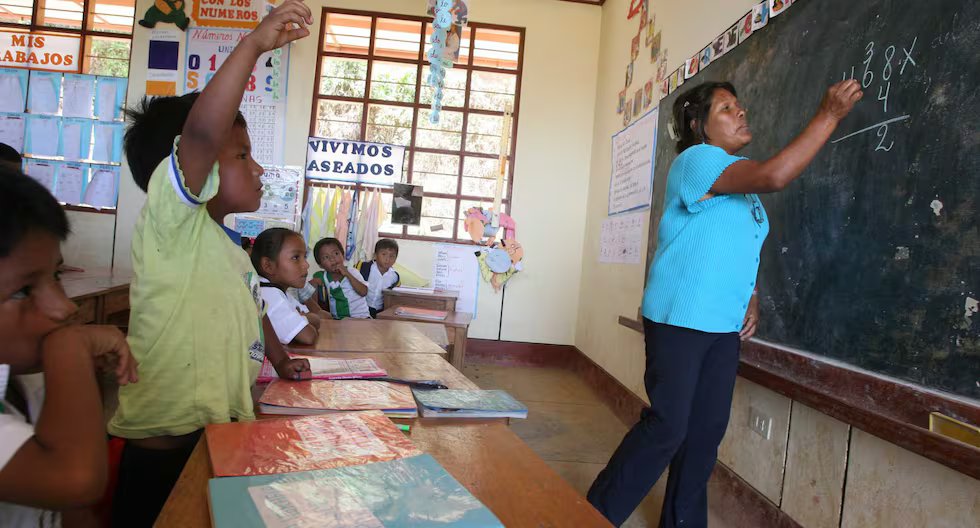
Although age is not necessarily a determining factor, 38% of rural educational facilities and 35% in cities are more than 25 years old, according to the Minedu Planning Directorate.
Rural schools concentrate nearly two million students. However, the proportion grows within the country and varies according to geographical areas. For example, Cajamarca, Loreto, Piura, La Libertad and Cusco concentrate the largest school population in this area. Four out of every 10 students live and receive classes in these departments.
Despite this high concentration of students, in 2025 there were 8,989 schools that needed to be completely replaced in those regions (37% of the schools in poor condition in the country). The material deficiencies of the classrooms affect 310,223 initial, primary and secondary students in these areas.
The diagnosis
Material deficiencies in rural areas have a significant impact on learning, says Sergio Pinto, head of education projects at Es Hoy, a movement of business leaders that contributes to educational development projects.
“The deterioration of infrastructure in rural schools is the result of failures in the management and distribution of resources at the national and regional scale. But the discussion should not focus only on infrastructure: the gap in rural education is even greater due to quality aspects and the lack of relevance to the characteristics of each region”he explained.
Indeed, in rural areas, educational achievement and attendance indicators are significantly below those recorded in urban areas.. According to the 2024 Educational Census, 17% of fourth-grade students in rural schools registered a satisfactory level in reading, while 16% had it in mathematics. Urban schools doubled these figures (36% and 32%, respectively).
53% of children and adolescents between 5 and 11 years old work, while 11% of adolescents between 15 and 17 years old are mothers or are pregnant for the first time. In cities, these figures drop to 14% and 3%.
For Mariana La Riva Quispe, senior project analyst at Ruralia, population dispersion and the long distances that students and teachers have to travel to study centers represent an additional difficulty. “Many regional directorates of education and UGEL in rural areas cannot make visits or accompaniment effective, due to distances and scarce resources”he added.
For four years, Eshoy, through its Ruralia program, has been articulating projects (state, private and civil society) aimed at improving rural education. According to the organization, to date there are 431 projects that would benefit more than 2 million people.
The proposals
‘We learn’one of the educational programs supported by Ruralia, seeks to strengthen learning in mathematics and communication of primary school students through the use of a app interactive that is available for free. Santiago Cueto, principal researcher at Grade and who leads the project, explained that, last year alone, it was used by more than 100,000 students and 5,000 teachers from public schools.
“The Peruvian system is highly inequitable, the best opportunities to learn will be found in areas where there are better socioeconomic conditions. The ‘Apprendemos’ program provides these opportunities in urban and rural areas alike, but so that it can be used more intensively in rural areas, we have made it possible to use it from any device. It was born in 2020 with the pandemic, going from being a small program to being offered on a national scale”he explained.