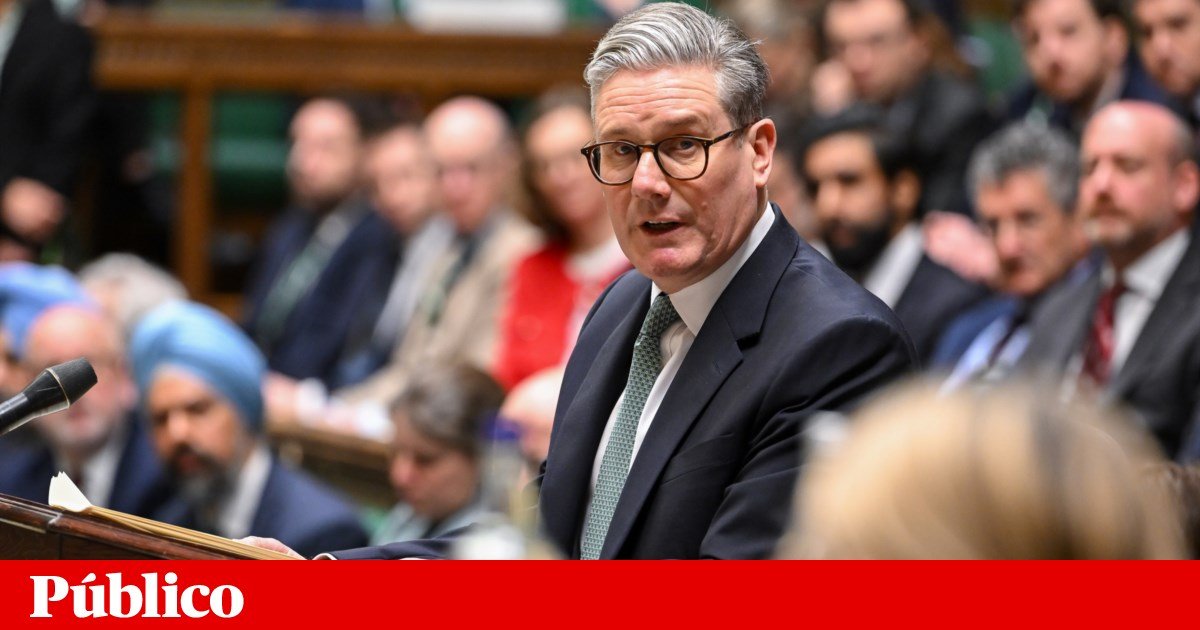
The majority of the Labor Party in the House of Commons of the United Kingdom Parliament failed this Tuesday a motion presented by the Conservative Party, and supported by other opposition parties, which wanted the Prime Minister, Keir Starmer, to be called to give statements in a parliamentary committee for allegedly having “misled” the deputies, in the various interventions he made on the nomination process from Peter Mandelson to the country’s ambassador to the United States.
Despite the favorable vote of 15 Labor MPs, namely from its left wing, the motion, headed by the Conservative leader, Kemi Badenoch, and signed by parliamentarians from the Liberal Democrats, the Scottish National Party and the Democratic Unionist Party, among others, was rejected, by 335 votes to 223.
Starmer and the Government have been under fire not only for revealing, in September last year, connections and possible sharing of information confidential talks between Mandelson and the North American sexual predator Jeffrey Epsteinbut also due to the fact that the former minister was appointed to the position after the Security Assessment Service (UKSV, in its original acronym) did not recommend the necessary insurance authorization to exercise it.
The Prime Minister accused the civilian body of the Ministry of Foreign Affairs of having “deliberately omitted” and overtook the UKSV “lead” and moved away Olly Robbinsthe ministry’s top civil servant, who admitted that he had not informed Starmer or any other minister about the position of that government agency.
Clarifying, thus, that the UKSV’s non-recommendation was not due to the relations between Mandelson and Epstein – there are ongoing investigations into the former ambassador’s links with companies in China and Russia – Robbins nevertheless told Parliament that he was the target of “pressure” from Downing Street to speed up the administrative process for his appointment.
This Tuesday, Morgan McSweeneyformer chief of staff to the prime minister, who resigned in February, assuming “all responsibilities” for his role in the process of choosing Peter Mandelson for ambassador to Washington, he confirmed to a parliamentary committee the existence of these “pressures”, but rejected the idea that the objective was to overcome bureaucratic or even security procedures.
“Mandelson’s appointment as ambassador was a serious error of assessment. I advised the Prime Minister to support this appointment and I made a mistake in doing so”, he began by saying, revealing that he explained to Starmer that there were “pros and cons” in a choice that was intended to be the most appropriate to deal with the Donald Trump Administration.
“What I did not do was supervise the national security check, ask employees to ignore procedures, request that steps be skipped, nor communicate, explicitly or implicitly, that the checks must be approved at all costs,” he assured.
The Government guarantees that Keir Starmer has been completely transparent about the case, rejects the opposition’s accusations that the Prime Minister is blaming the Public Administration and his advisors, and says that the Conservative Party attempted a “desperate political maneuver” with the motion presented and voted on this Tuesday to obtain electoral gains in the English local councils and in the Scottish and Welsh legislatures next week (7 May).
According to polls, the Reform UKNigel Farage’s radical right-wing and populist party, should be able to elect the largest number of municipalities in the elections in England, and compete, with the Plaid Cymruleft-wing independentist, victory in the elections for the Parliament of Wales.
Opinion studies point to significant losses for Labour, particularly in the London region and in Welsh territory, which, if confirmed, should put even more pressure on a Government and a weakened prime minister by the “Mandelson case”, by other political scandals and by the poor performance of the British economy.