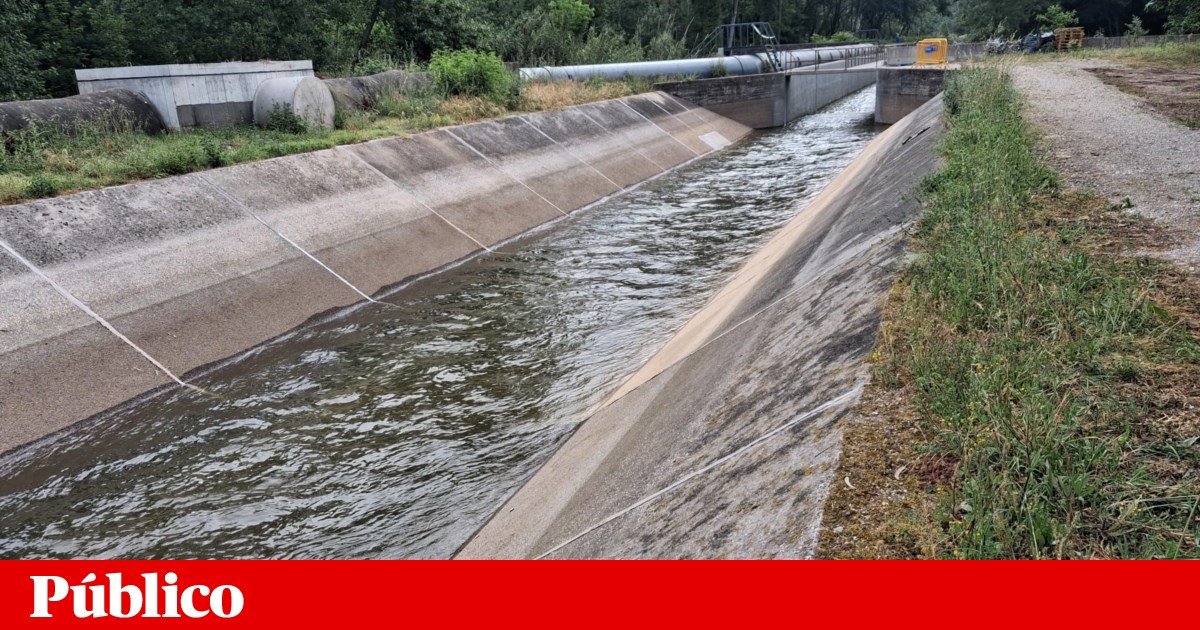
Less than three months were enough to complete the restoration of the Mondego irrigation canal, strictly fulfilling the promise of the Portuguese Environment Agency (APA), last February: on May 1st the work would be ready. The unusual record elevates the fact to the category of news and highlight. “We are very happy, for the work itself, but also because it is rare for this to happen”, the Mayor of Coimbra, Ana Abrunhosa, told PÚBLICO, on the day she received confirmation from APA that the project is completed, “with the final adjustment and finishing works currently taking place”. But since this Tuesday, water has been flowing in the general conductor channel on the right bank of the Mondego River, allowing supply to the Bolão and São Martinho irrigation blocks, thus safeguarding the irrigation campaign in the region.
The president of APA, Pimenta Machado, also admits that “it is not normal for us to meet deadlines like this in Portugal”, but this time the promise he made, alongside the Minister of the Environmentafter the storms that caused the Mondego to burst the dike put below the A1it will indeed be fulfilled. “We know well what we went through with this storm train. It was an exceptional year, which caused a lot of damage, but despite everything, good management was achieved. And there was now a very important phase, which was this: learning from the storm and recovering what was damaged”, states the president of APA, referring to the region of most affected municipalities: Coimbra, Soure, Montemor-o-Velho and Figueira da Foz.
“Today, with particular pleasure, the first water to circulate in the canal was placed”, he tells PÚBLICO, remembering that the two irrigation blocks in question, supplied by the canal, “are very relevant”. “It was an incredible job, with many resources mobilized to the location. And we did our best”, he concludes.
“I owe a word of great respect and consideration to APA because it fulfilled what it promised, and because this allows families to resume economic activity in that area, guaranteeing their income, their livelihood”, highlights the mayor of Coimbra. “This way, farmers have the guarantee that they can start the season with crops that require a lot of water, such as corn and rice”, he added.
It is true that, with the recovery of the canal, only part of the problem of the Mondego river basin will be resolved. “It is very important that there is maintenance, that all that vegetation that obstructs the siphons is cut, and that, upstream, the Mondego River is desilted”, says the Mayor of Coimbra, who never tires of remembering that “in the urban part, the Mondego River is completely silted up and therefore, in a heavy rain, there will be floods if we do not remove all that sand”. It is necessary to stabilize the banks of the river – “which are all destroyed” – and also move towards intervention near the mouth of the Ceira River. There, in the Portela area, the water ran at such a speed that the banks of the Mondego River were excavated by around 30 to 40 meters. “But the work is done in phases, and this was just the first phase”, says Ana Abrunhosa, who has already signed an inter-administrative contract to intervene in Parque Verde, on the right and left banks of the Mondego.