The arrival to Ecuador of a variety resistant to Fusarium race 4 seems to have good expectations. This once the Minister of Agriculture, Livestock and Fisheries, Juan Carlos Vega, confirmed the interest on the part of the Government in supporting the process to allow its importation.
This is the so-called Queensland QCAV-4, developed by the Queensland University of Technology (QUT), and which was approved in 2024 for production and consumption, being the first transgenic banana variety with commercial authorization in the world. The interest in its importation to Ecuador comes from the private sector.
José Antonio Hidalgo, executive director of the Ecuadorian Association of Banana Exporters (AEBE), explained that the transgenic part of the Queensland QCAV-4 lies in the fact that in the laboratory a specific gene from another plant (a resistant wild banana) was incorporated to give it a direct defense against the Fusarium race 4, which was detected in Ecuador in September of last year, and is currently contained in a plantation in the province of El Oro.
However, this type of materials have constitutional restrictions in Ecuador. For this reason, a different protocol is needed from other varieties that are already being studied in the country, such as Formosana 218 and GAL from Israel, which are the result of conventional breeding (also called traditional genetic improvement). That is, they are obtained through crossing, selection and evaluation of plants over time, without inserting genes in the laboratory.
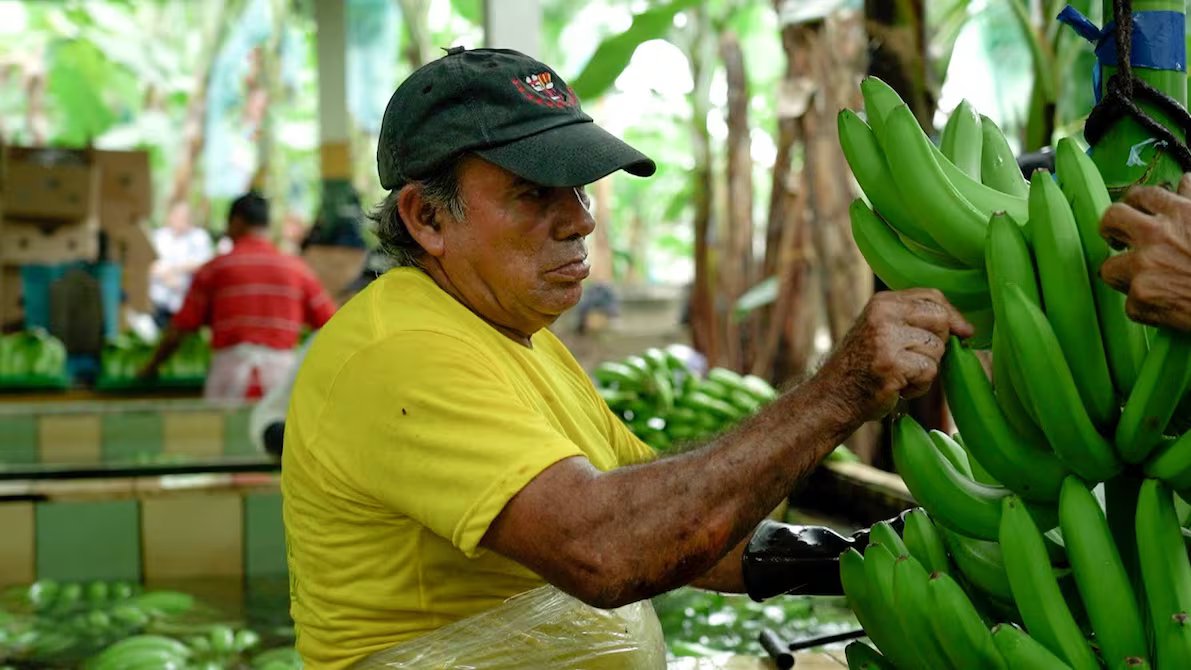
For Minister Vega, the possibility of importing this material is a very important issue due to the phytosanitary risk that Foc TR4 represents for the 220,000 hectares of bananas that the country, which is the main exporter in the world, has.
He acknowledged that because it is genetically modified, it has constitutional restrictions in Ecuador, but revealed that “the way is being seen through a special decision that will correspond to the president (Daniel Noboa) to also bring these materials, evaluate it in the different banana-growing areas of the country and in this way already have materials that are tolerant, hopefully, resistant to this difficult pest.”
In addition, Minister Vega highlighted that important exchanges are maintained with research centers in Colombia; with the FHIA -Honduran Agricultural Research Foundation- in Honduras and with the Brazilian Agricultural Research Company (Embrapa). “In the case of the agreement with Embrapa, we received non-refundable financing from CAF – Development Bank of Latin America and the Caribbean – and that was signed when we were in Brasilia,” he said.
He also highlighted the work carried out since the detection of the fungus in national territory. “The first actions that have been carried out with Agrocalidad are to isolate the area and first prevent the pest from continuing to spread in the province of El Oro and in the rest of the banana-growing areas of the country, but at the same time in cooperation with banana unions, with the Iniap -National Institute of Agricultural Research-, and with the technical assistance of Embrapa, the different materials that have this potential are being evaluated,” said Minister Vega.
What does the Constitution say about GMOs?
Article 401 of the Constitution states: Ecuador is declared free of transgenic crops and seeds. Exceptionally, and only in cases of national interest duly substantiated by the Presidency of the Republic and approved by the National Assembly, genetically modified seeds and crops may be introduced.
The State will regulate under strict biosafety standards the use and development of modern biotechnology and its products, as well as its experimentation, use and commercialization. The application of risky or experimental biotechnologies is prohibited. (YO)