-
From:
Aunt Cela

- April 27, 2026 00:00
- Share to:
How the novel was published in Tirana. Memory issues. A collaboration with Kadare.
Over time, no one is protected from forgetfulness, which causes memory loss. Prone to losing is especially the spoken word. That is why it is often heard that the spoken word flies, while the written word remains.
It was not by chance that I came across this topic. Perhaps everyone, in their own way, is confronted throughout life with the secret and unstoppable decline of memory. Recently, I also happened to be in front of a surprise, which almost left my mind. Of course, narratives of this nature do not constitute Literary History itself. But they prove how history was lived, its stages and everyday life, for which the public is always interested. I am narrating one such episode below. It is a significant case with a widely known personality. But, in the beginning, this is how Rexhep Qosja himself remembers it. Dha he remembers it in writing, so it can be quoted verbatim:
“18.8.1987
The political-social and cultural newspaper of Tirana ‘Drita’, published a long review, on three of its pages, about my novel ‘Death comes to me from such eyes’, written by the undoubtedly very talented prose writer, Zija Çela. I do not know the author of this review, I have never met him, even though I was many times in Albania before 1981. The review was written with dedication, love, culture and critical-literary talent. The look makes the reader very curious to read the novel – only rare critics know how to write like that. Zija Çela raises my creativity and intellectual ethics. It can be seen from the look that Zija Çela has also read ‘The Morphology of a Campaign’. I don’t know when and how I can return this brotherly devotion to the talented prose writer Zija Çela. His view proves that my critical, theoretical, historical-literary, journalistic and literary works are becoming nationwide and are thus becoming nationwide that they have started to be read and, for sure, will be read more and more by readers in state Albania. I am not a complacent creator, no, by no means; I am a creator aware of the shortcomings of my creativity, but, nevertheless, I can say that all the value and importance of my work will be fully recognized and will be appreciated correctly, as much as they deserve, only after this Diary is also known, of course, if fate wants it and it is preserved and one day it arrives in the hands of readers. But that will happen late, maybe only after my death.”
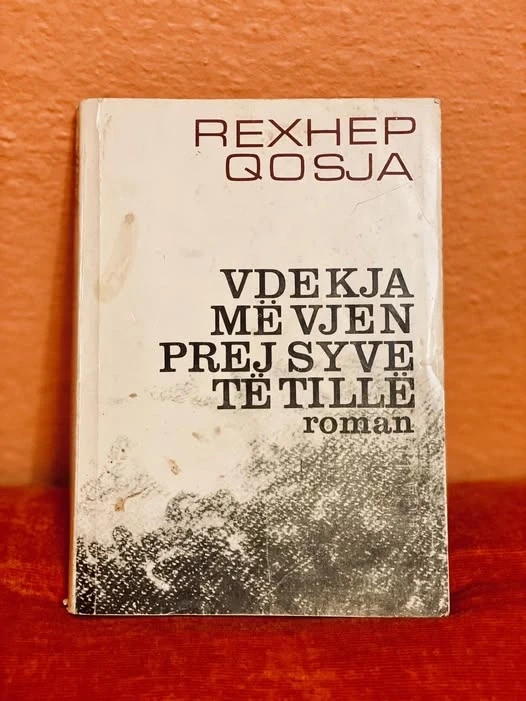
Fate wanted the best, the diary “Witness in historical times” arrived in the hands of the reader in the author’s lifetime. It was published in VIII volumes by “Toena”. While the above quote belongs to Diary VI, page 374. This episode revived my memory, giving me reason to tell how the novel “Death comes to me from such eyes” was published in Tirana.
At that time I was working in the newspaper “Drita”. One day Ismail Kadare came to the editorial office, who had read Qosje’s novel, published in Pristina by “Rilindja”, in 1974. He had come with the good wish that the book would be published in Tirana as well. We are dividing the work, he told me intimately, I am writing a positive review for “Naim Frashër”, you then ask to be the editor of the novel. As we said, so we did.
It is assumed that between Tirana and Pristina at that time there were significant differences in the field of publications, all Western authors were published there, who were anathema as “decadent”. Academician Rexhep Qosja, distinguished in the field of Letters, among others, was very courageous in defending the interests of Kosovo and the national issue. The interviews he gave to the foreign press and which created an international echo, we published from time to time in “Drita”.
The author had defined the literary genre of that book through a hypothetical proposal: “Thirteen stories that could make a novel”. Without getting into the content yet, this is where the confrontation with our schematic literary criticism begins. But too schematic and aggressive, ideologized to the point of oversaturation and suffocation of the freedom of art. (And how is it possible, where does Marxist-Leninist aesthetics and the method of socialist realism say that thirteen stories can make a novel?! They can do one in water!..) Qosje’s novel, giving the picture of that time in a conventional city, directed the whole blade to Danjolli i Sherka, the servant of the foreign invaders, whose eyes watched him to such a degree that Xhezair of Xhika (the protagonist) could death would come to him. I loved this work from the first reading and it was worth facing the official criticism.
As an editor, I no longer remember the details, except for a few lines that I had to remove. A bullet penetrates the window in the protagonist’s studio, hits the picture of Mao Zedong on the wall and knocks him to the ground. After removing these lines, I hoped that I “saved” the whole work, which I submitted to “Naim Frashëri”. Thus, probably, both initiators lost their minds.
But wait and wait, the publication is looking for! See you again. Ismaili had learned (he could not escape without the knowledge of the capital’s “whistleblowers”) that, after he had read it, the deputy director of the publishing house had put the manuscript in the drawer, being against it. I had to immediately tap him as the editor of the book. What a wicked reading he had made! The carnage started from start to finish. (For example, “Fatness,” the chapter story that opened the book, had to be removed entirely.) But the main objection was to the entire work. According to the deputy director, the novel could not be published because it was against (!) the Kosovar intelligentsia.
I saw that he didn’t eat wedges with arguments and, as Ismail and I discussed, we had to try some kind of intervention somewhere above. But who should we turn to?
I made this intervention to Mehmet Karakushi, who covered culture in the Central Committee. Karakushi was from a village somewhere near Qafa e Prushi, on the border with Kosovo. We had heard each other during the years that I had worked as a teacher in Has, and I had even gotten to know my wife’s people (Pogajt) closely in Krumë. And this humane man, regardless of the party position and the political line he defended, kindly and in good faith opened the way for publication with a phone call. And how, how would the book be published, abused and perplexed? No, on the contrary, without affecting the full version that I had submitted to the editors.
Then we took things to the end. I did the writing in “Drita”. And in my files I found it these days (2018). It bears the title “In the name of love for man, homeland and beauty”. It was published on July 26, 1987, on pages 6, 7 and 10 of the newspaper. To be honest, I hadn’t read “The Morphology of a Campaign” at the time. Then and now, I enjoy the debate of ideas among colleagues, but on the border that excludes grudges, temper tantrums and insults towards each other. However, in order to defend the publication of the novel in Tirana, among other things, I faced those criticisms that had been “deposited” by the official of the publishing house and that could find the support of the militants of the pen.
However, the “happy ending” does not end there. Ismail advanced the “strategic aim”, that of humanity as a colleague for a colleague, but especially the patriotic aim. He recommended it to France and the novel was published there. French critics welcomed it and there were many articles. It is assumed that, speaking about the author from Pristina, Kosovo must have been mentioned. At that time, Prof. Remzi Pernaska made a summary from the French press, bringing the citations of the evaluations together with the names that had signed. We immediately gave it space in the newspaper. I remember that the professor, I don’t know why, on that alla-french page, he also included an evaluation of my writing.
After two thousand, I visited Rexhep Qosje’s house. Over coffee, we exchanged ideas, we agreed and, on certain issues, we had opposing opinions. But I remember that the owner of the house gave me books, then escorted me to the door of the courtyard, where we parted amicably.
I am not sure how many years passed after that, when we “met” again at the book fair in Skopje. Our publisher, Mrs. Irena Toçi, had put our two posters on the “Toena” stand. As if the names weren’t enough, she had taken care that each one had the “Honour of the Nation” written on them. We had each followed our own path and, finally, there was a point where the paths joined. We were face to face, in such a way that we saw eye to eye and it seemed to me that we were talking to each other. I didn’t know then, but now I’m allowed to imagine that Rexhep Qosja was murmuring something to me about his old hostage: “I don’t know, Zija Çela, when and how I can return that brotherly devotion of yours.” While I, to calm him down, I also whispered: “I thank you for the gratitude, Rexhep i Dashtun, but don’t worry. I have had to express myself with a meal, and even repeat it time and time again: When I have the opportunity to do something good, I don’t do it with the hope that it will be returned to me, but with the conviction to become better myself.”
Thus, over time, memory suffers loss, and even risks slowly disintegrating. Diaries and memos generally record it. Those of us who lived through part of the history of literature are worth witnessing in writing. The writing remains. And it remains especially when objectivity is not shocked by each other’s eyes.
This article was published for the first time on Koha.net in April 2018. It is published in honor of academician Rexhep Qosje.