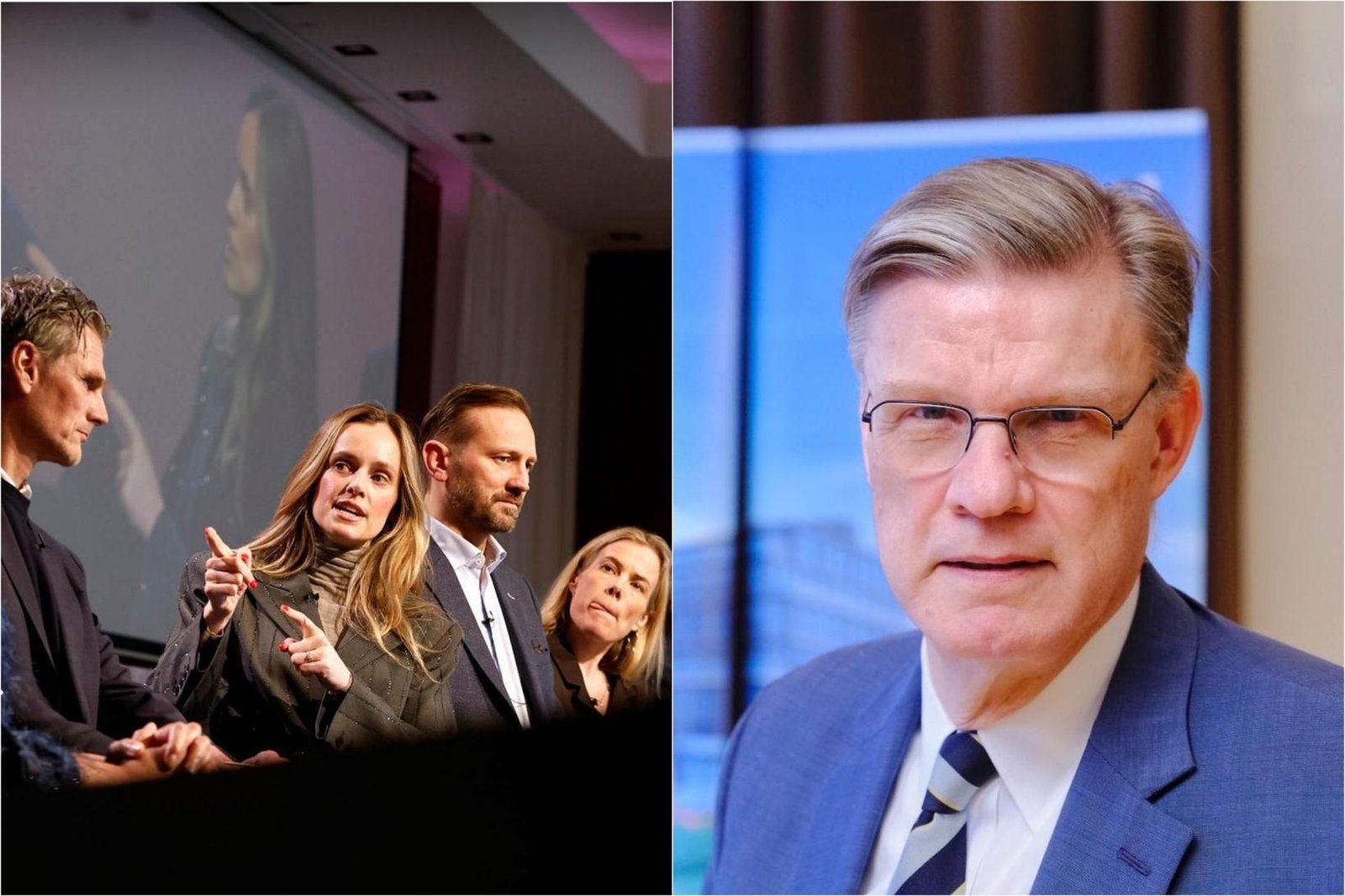
Árni M. Mathiesen, former minister and former chairman of the board of Betri samgang hf., allows himself to be optimistic that the eternal delays that have characterized transport projects in the capital area will be resolved in the next term.
Árni says that there are probably three main reasons for the major delays in the construction of the necessary transport improvements, and outlines them in an interview with mbl.is.
Conference on transport issues in the capital area with the title Greiðari líð – ideas wanted! was held today, and Árni was among those who where they shed light on the state of transportation in the city.
He also observed the responses of the leading candidates running in Reykjavík in the upcoming municipal elections, all of whom expressed dissatisfaction with the state of transportation in the capital area, and allows himself to be optimistic based on their responses.

Gets caught up too much
“There is, on the one hand, the fact that the costs will always be higher than planned, and then that all the preparation time regarding construction has become great, and as a result it is easy for people to have an influence on delaying construction that they don’t think about.”
Thus, controversial projects are particularly vulnerable to delays.
In the end, Árni says the delays may lie in the fact that projects such as the transport agreement for the capital area are being used to achieve other ideological goals, such as opposition to the private car, by reducing the number of lanes and parking spaces and slowing down the traffic speed.
“So maybe it can also be said that compared to this, we have moved too much,” he says.
Allow yourself to be optimistic
Árni says, however, that there seems to be a solution to this situation. “Based on what was said at the meeting, it seems that all the political candidates who were there want to improve transportation, although there may not be a complete consensus on how to do it.”
At least he allows himself to be optimistic that improved transportation is ahead.
“One can be optimistic that the candidates are expressing what they really want to do, and that their minds are set on following this revised plan from 2024.”
There must be agreement on the plans
In order for future projects to proceed quickly and smoothly, there needs to be consensus about them, and Árni mentions in that context the Suðurlandsbrautin, which has been the scene of controversial construction plans and one of the root causes of the meeting.
“It can be said that maybe Suðurlandsbrautin is the root cause of the meeting. There is talk about the need to reduce the number of lanes because of the Borgarlína, but that is not the case,” he says, adding that the Borgarlína can be installed along with the lanes that are there today.
He also says that the idea of reducing the number of lanes is older than the decisions about Borgarlína and the later explanation that the number of lanes needs to be reduced because of Borgarlína.
“For the next few years, the financing of the transport plan is available, and from 2030 onwards it is assumed that there will be fees, even though it has not been finalized how exactly it will be, so you have to hope that it will be done in time or that other funds will come instead.”