
The Competition Authority has decided to close the preliminary investigation against two of the largest actors of the private hospital market in the country, American Hospital, otherwise known as the American Hospital and International Hospital or as it is better known Hygeia Hospital, but the way this process has been handled raises more questions than answers. The decision to open the preliminary investigation was taken in April 2025. While the decision to close the procedure, which was consulted by ekofin.al, was taken in July 2025, it was made public only recently on the official website of the Competition Authority, seriously questioning the transparency and accountability of this authority to the public and the market.
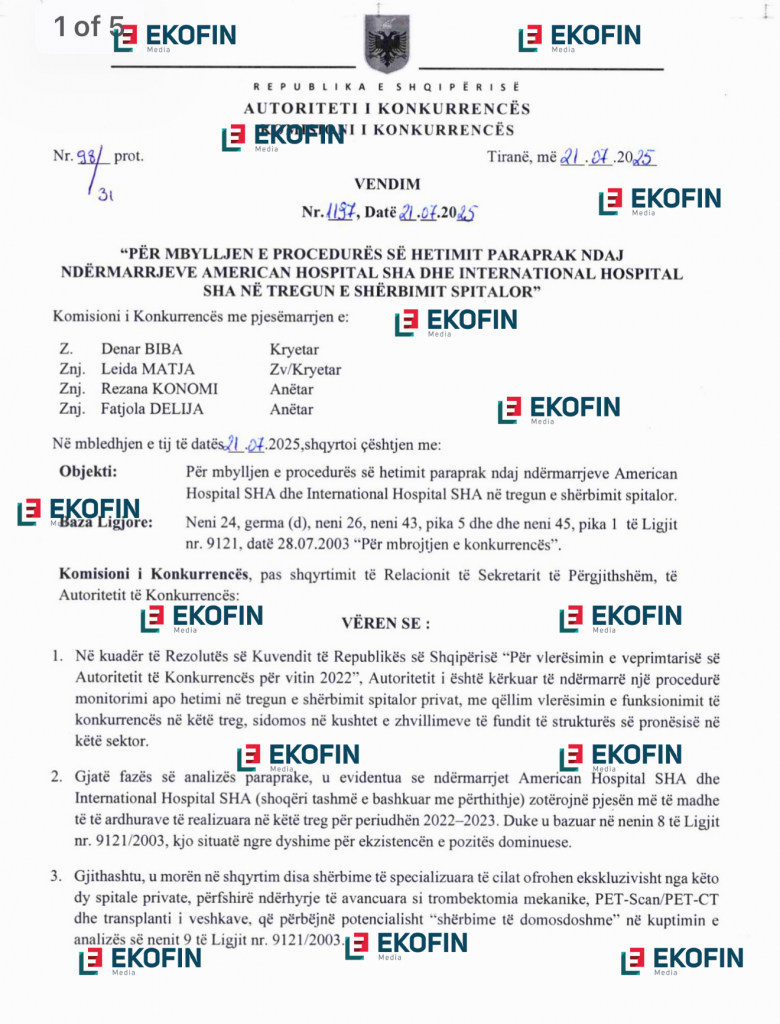
In the report available to ekofin.al, the Competition Commission clearly admits that these two companies have a dominant role in the market of private hospital services in Albania. According to the analysis, they own a significant share of the market and, most importantly, offer advanced and exclusive services that are not even found in the public sector. These are specialized interventions such as mechanical thrombectomy, kidney transplants or advanced diagnostic technologies such as PET-CT, which according to the Competition Commission constitute “necessary services” in the sense of the competition law.
So we have a clear finding: the market is concentrated, services are differentiated and entry barriers are high, whether due to technological costs, lack of qualified staff or sectoral regulation. Under such conditions, any competition handbook would suggest increased attention to the risk of abuse of a dominant position.
However, in a twist that makes the whole analysis contradictory, the Competition Authority concludes that, despite this dominant position, there is no evidence of abusive behaviour. The main argument is that the prices for services covered by the Mandatory Healthcare Insurance Fund are transparent and equal for patients, while the companies themselves have also applied flexible pricing policies and discounts for certain categories of patients.
The Competition even goes further with the following wording.

This logic raises several fundamental problems. First, the fact that prices are regulated or partially financed by the state does not automatically exclude the possibility of abuse in other market segments, especially in private services or those not covered by public schemes. Secondly, the Competition Authority itself admits that in many cases there are no real alternatives in the domestic market and patients are forced to turn to these structures, which further strengthens their dominant position.
Even more problematic is the fact that some of these services are financed by public funds through contracts with FSDKSH, creating a situation where a private operator benefits from public resources, while real competition remains limited. The document itself acknowledges that this mechanism provides a steady flow of patients and significant revenue to the dominant operator. Although in the report, the Competition Commission has taken care to hide the figures, it seems clear that both private hospitals are not only in donor positions, offer exclusive services, but also benefit from significant income, a good part from the state budget, in addition to citizens’ money.
On the other hand, the Authority justifies the lack of competition with the fact that the market is “regional”, since patients can choose to be treated in other countries such as Turkey or countries in the region. This argument is highly controversial, bordering on the ridiculous, as moving abroad for health treatment is not a realistic option for most patients, due to costs and other practical barriers.
The decision of the Competition Authority is to close the investigation and establish a one-year monitoring period for the conduct of these companies. But this solution looks more like a “wash your hands solution”, more of an administrative compromise than a strong response to a market that the institution itself describes as concentrated and with high barriers to entry.
This whole situation is aggravated by the fact that the decision has been kept out of the public eye for months. The late publication of such an important document not only damages trust in the institution, in which Denar Biba was recently re-elected for a second term, but also creates doubts about how sensitive issues affecting critical sectors such as health are handled.
In practice, we have a paradox: the Competition Authority accepts the existence of a dominant position and exclusive services, but at the same time dilutes the risk, relying on procedural and social arguments. For an institution whose mission is to protect competition and the consumer, this approach seems more like an avoidance of responsibility than an in-depth analysis of the market. /ecofin.al