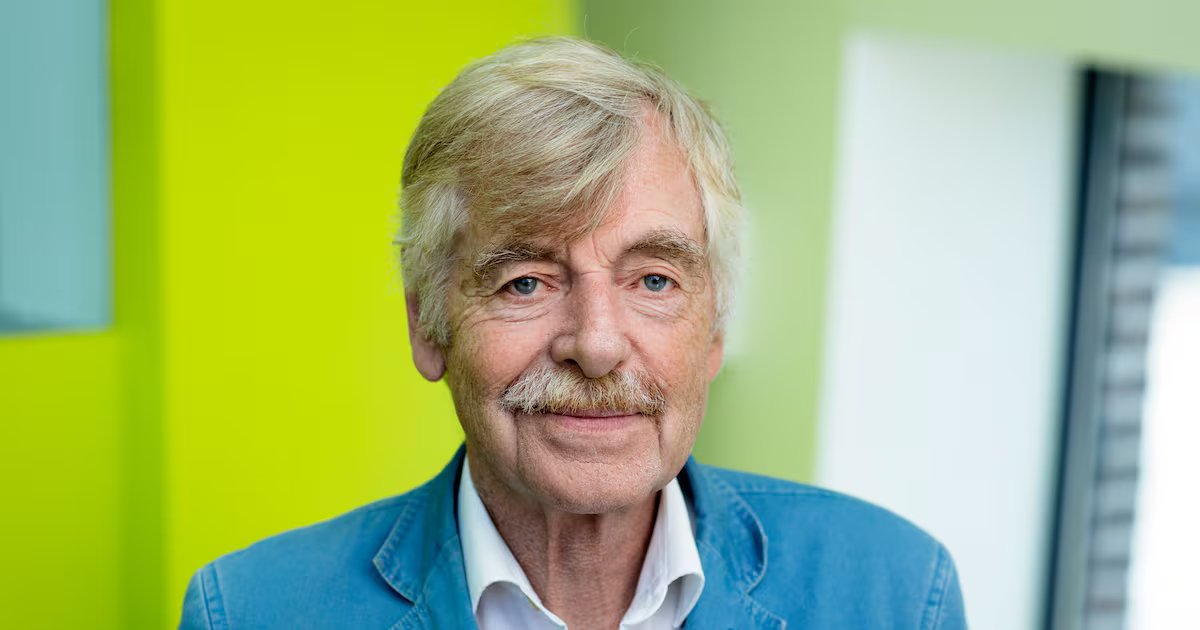
Born: Born: July 13th, 1946
Died: April 7th, 2026
Seán Ó Laoire, who has died a few months before reaching the age of 80, was a genial, generous and radiant titan of Irish architecture, master-planning and urban design for more than four decades. A Dubliner to his fingertips, he took real delight in drawing up master-plans for the regeneration of run-down areas of the city, starting with the Custom House Docks in 1987.
That memorable planning scheme, which led to the creation of the International Financial Services Centre, was peppered with literary quotes, such as Brendan Behan’s definition of a city as “a place where you are least likely to be bitten by a wild sheep”. Ó Laoire also worked on the original master-plan for what became Belfast’s Titanic Quarter, and is credited with coining its name.
Eldest son of Dónal Ó Laoire, who taught Irish at St Vincent’s CBS secondary school in Glasnevin, he grew up in what became a large family on Grove Road, in the Ballygall area of Finglas. He went to Coláiste Mhuire on Parnell Square, where he was encouraged to study architecture by his art teacher, borrowing books about buildings from Phibsboro Library on his way home.
In 1968, Ó Laoire was among the leaders – along with Ruairí Quinn and Duncan Stewart – of the first student revolt in Ireland, when architecture students occupied their school at UCD in Earlsfort Terrace, and ultimately got rid of its head, Desmond FitzGerald. After graduating in 1970, he went to University of California, Berkeley – another hotbed of student radicalism.
On returning to Ireland, he lectured at Bolton Street School of Architecture before co-founding Murray Ó Laoire Associates with fellow UCD graduate Hugh Murray in 1979, setting up practice in Limerick, then very much down in the dumps. Early commissions included restoration of the city’s Potato Market, with a new pedestrian bridge linking it to Custom House Quay.
[ So the boom was a disaster for Irish architecture? Think againOpens in new window ]
“Limerick was a bomb site, but Seán Ó Laoire was talking about it as a place where magic could happen, and his idealism was inspirational,” architectural historian Shane O’Toole recalls. “He was a complete urbanite. At a time when architects were focused on buildings as objects, he was the first person I met who spoke about the importance of the city, that grander thing.”
Murray Ó Laoire’s projects in Limerick included the container-like visitor centre at King John’s Castle; the gold medal-winning Tourism Information Office at Arthur’s Quay Park, which subsequently fell into disuse; the Tailteann sports hall at Mary Immaculate College, the high-rise Clarion Hotel on the River Shannon, and Thomond Park, cauldron of Munster Rugby.
As well as being a mentor to many younger professionals, Seán Ó Laoire will be remembered as the RIAI president who finally got registration of the title ‘architect’ over the line
In Dublin, Seán Ó Laoire worked with TCD’s Tim Cooper on the Green Building in Temple Bar, pioneering environmental technologies. It became the first building with solar panels to be connected to the national grid in 2006, but three rooftop wind turbines had to be decommissioned years earlier due to them causing vibrations in the penthouse apartments: a learning experience.
In 1996, at the Imaginaire Irlandais cultural festival in Paris, Ó Laoire delivered a memorable lecture – entirely in French – on the theme “Building on the Edge of Europe”. He also served as a board member of both the National College of Art and Design in Dublin and the National Sculpture Factory in Cork, and contributed to Belltable in Limerick and Triskel in Cork.
[ Architects’ contribution must be recognisedOpens in new window ]
Murray Ó Laoire designed the Irish pavilion at Hanover Expo in 2000, with a double wall of polished black Kilkenny limestone on one side and a wall of gabions – loose stones packed tightly together in wire cages – on the other, projecting a modern image of Ireland. Idealistically, it was to be dismantled and brought home for re-erection at an unspecified location, but this never happened.
The practice grew into a leading international firm, employing up to 280 staff at its peak, drawn from so many countries that its Fumbally Court headquarters in the Liberties was a real melting pot, with studios in Cork, Limerick, Aachen, Moscow, Warsaw, Bratislava and Barbados. Former colleagues have described Seán Ó Laoire as a wonderful boss who was great fun to work with.
He was president of the Royal Institute of the Architects of Ireland (RIAI) in 2008-2009 when the crash came, and struggled to protect as many jobs as possible. But this was to no avail, as Murray Ó Laoire went into liquidation in April 2010 with debts of €8 million. Several of his fellow directors then set up a successor, MOLA Architecture, retaining Ó Laoire as a consultant.
One of his projects was to draft Dublin City Council’s 2012 local area plan for George’s Quay, which included provision for a 22-storey office tower at Tara Street Dart station. Ronan Group Real Estate got planning permission for such a scheme in 2021, but did not proceed with it. An unintended outcome was the dark tower built by Marlet directly opposite, which was not part of the plan.
As well as being a mentor to many younger professionals, Ó Laoire will be remembered as the RIAI president who finally got registration of the title “architect” over the line. It was, as he said in 2009, “the culmination of a long and hard fought battle to have professional standards set and so protect the public”. Until then, incredibly, anyone could call themselves an architect.
Ó Laoire had a particularly special bond with his only child Marcus, who became a social media content creator and DJ and who used to introduce him to friends as “the Dadlad”. As BigO copywriter Shannon Duvall noted, “the care between them, humour, affection and genuine regard for one another has been such a joy to witness over the years”. At the funeral, Marcus said he had lost his best friend.
He is survived by Marcus and his fiancee Rachael and their six-month-old daughter Sylvie, along with sisters Máire, Treasa, Áine, Carmel and Siobhán; brothers Dónal, Stiofán, Breandán and Pádraig, brothers-in-law, sisters-in-law, nephews, nieces, relatives and his very wide circle of friends.