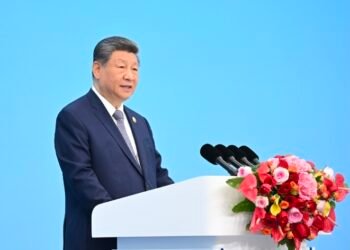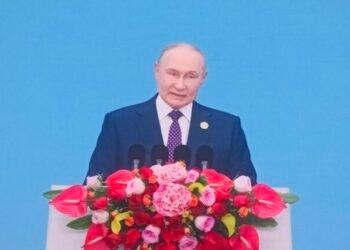
More than two thousand political and business delegates from thirty-four economies gathered in Shenzhen on Tuesday for the official opening of the Apec CEO Summit 2026. Participants represent the twenty-one economies of the Asia-Pacific Economic Cooperation (Apec) alliance and thirteen economies beyond. Participants include representatives from 115 companies from the Fortune Global 500.
Text and image Ivan Cairo
The two-day meeting focuses on regional economic cooperation, technological innovation and sustainable development. Initial discussions made it clear that despite increasing geopolitical tensions, companies continue to look for opportunities to expand trade, investment and technological cooperation.
“Trade is not a matter where one side wins and the other loses. Trade benefits both parties“
Jeffrey Sachs
The summit, with the theme ‘To Prosper and Win the Future Together’, opened at the Qianhai International Convention Center. Ren Hongbin, chairman of the China Council for the Promotion of International Trade (CCPIT) and chairman of the CEO Summit, expressed hope at the opening that the talks will generate new ideas and broad agreement. The dialogue should contribute to a stronger Asia-Pacific community and give new impetus to economic growth, he said.
The summit is part of the Apec Economic Leaders’ Week, which continues on Wednesday with the meeting of government leaders. A special outcome of the CEO Summit should be the Shenzhen Initiative. It is the first time in the meeting’s thirty-year history that such an initiative has been released as an official document.
Trust is necessary for trade
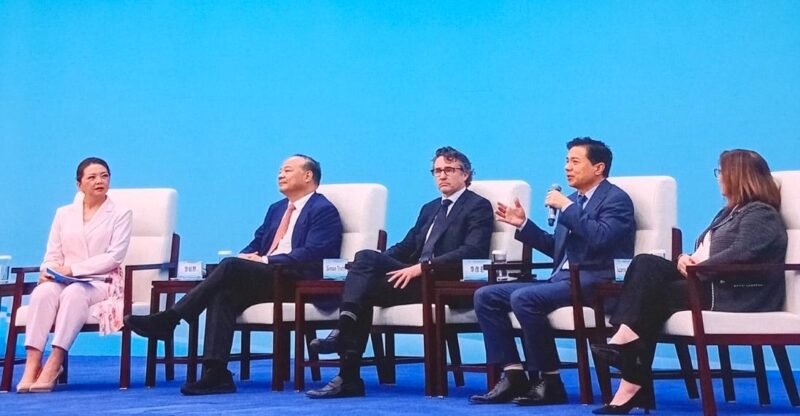
In the first business dialogue on the new economic relationships and cooperation opportunities in the Asia-Pacific region, Robin Zeng from battery producer CATL, Simon Trott from mining group Rio Tinto, Robin Li from technology company Baidu and Suzanne Clark from the US Chamber of Commerce, among others, spoke.
The speakers emphasized that international cooperation remains necessary, despite trade conflicts and geopolitical uncertainty. Clark pointed out that American companies need long-term relationships with local partners. “It starts with human relationships,” she said, adding that companies must be able to rely on partnerships that will last even in the face of political change.
Trott warned of the increasing need for raw materials. He predicts that between now and 2050, more copper will be needed than has been mined since the time of the Phoenicians. Trust is an indispensable condition. “Trust is probably the cheapest production factor we have. Without it, supply chains will fall apart,” said the Rio Tinto CEO.
AI must deliver economic value
The first thematic discussion focused on regional connectivity and improving transport, trade and logistics links. UPS CEO Carol Tomé pointed out that international supply chains are increasingly adapting to changing market conditions. She said her company has experienced more disruptions in recent years than in UPS’s one hundred and nineteen year history. She warned that resilience is not the same as complete self-sufficiency. International cooperation and common standards remain necessary.
The second discussion focused on the development of an open and inclusive artificial intelligence ecosystem (AI). This included the availability of computing power, investments in technology and its practical application AI.
Baidu CEO Robin Li warned that the large investments in artificial intelligence are not yet yielding sufficient financial results. If companies fail to convert their investments into higher revenues and profits, the fear of a AIbubble become a reality. Li states that the true value of AI only becomes visible when the technology is used in concrete applications.
“Chen also said there is broad support among participating economies for China’s proposals. The talks will focus on trade, regional connectivity and innovation, among other things.”
Green technology as a growth engine
The third panel discussion covered sustainable development in the Asia-Pacific region. Representatives from the automotive industry, financial sector and international organizations spoke about energy transition, emission reduction and investments in green technology.
BYD Chairman Wang Chuanfu pointed to the development of China’s electric car sector. About two-thirds of global production of new energy vehicles comes from China, he said. Shenzhen completely replaced its public buses and taxis with electric vehicles years ago. Wang said this has helped improve air quality in the city.
American economist Jeffrey Sachs, professor at Columbia University, also emphasized the importance of international cooperation. He rejected the idea that China’s economic growth comes at the expense of other countries. “Trade is not an issue where one side wins and the other loses. Trade benefits both sides.” Chinese economic growth and technological innovation can actually contribute to the global green transformation, he said.
Consultation on agreements for APEC summit
In addition to the CEO Summit, a press briefing also took place on Tuesday at the Apec Media Center. Chen Xu, Chairman of the Apec Senior Officials’ Meeting 2026, briefed journalists on the preparations for the thirty-third Apec Economic Leaders’ Meeting and the achievements of the Chinese presidency year. He announced that negotiations on the final documents of the upcoming leaders’ meeting have now begun.
Chen also said there is broad support for China’s proposals among participating economies. The discussions focus, among other things, on trade, regional connectivity and innovation. China has organized more than three hundred Apec meetings and activities in sixteen cities in the past year. According to Chen, agreements and cooperation results have been achieved in various areas.
The CEO Summit continues on Wednesday (today). President Xi Jinping of China will then give a speech. His American colleague Donald Trump and President Vladimir Putin (Russia) arrive on Wednesday. The outcomes of the discussions between the business community should help guide the economic cooperation that the Apec leaders discuss during their meeting.