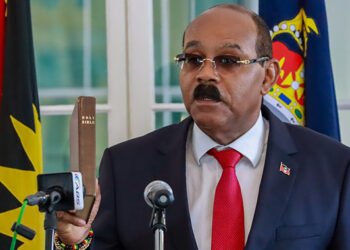
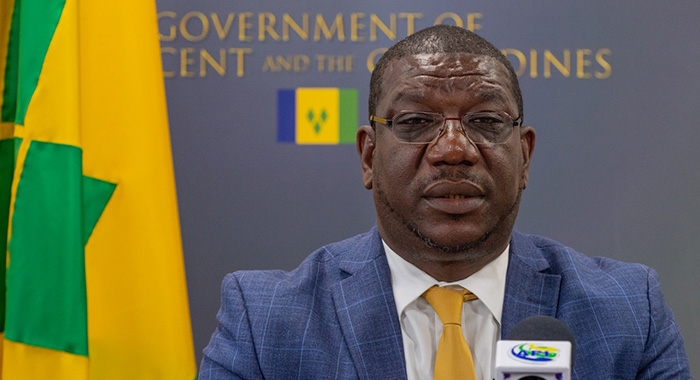
Minister of Agriculture, Israel Bruce, says a visit to Nigeria has shown him that the Giant African Snail, the eradication of which the government has allocated EC#7 million over the next three years, can generate income rather than be a drain on tax dollars.
Speaking at a press conference in Kingstown on Tuesday, Bruce noted that he was still alive and well, more than a week after consuming the snail in Abuja.
As he broached the topic, he noted that he was about to speak about something “you might find a little bit off”.
He noted that during the Budget Debate in January, he spoke about the presence of the Giant African Snail in St. Vincent and the Grenadines (SVG) and its ability to devastate the agricultural sector.
“That capacity has not been extinguished. We still have that challenge,” Bruce said.

He said that after the budget, he told Cabinet that the country would need some EC$7 million to assist in fighting the Giant African Snail.
“We’ve started some additional work subsequent to budget, but we’ve devised a three-year plan that was going to cost us approximately $7 million in that three-year cycle to fight the snail,” Bruce said.
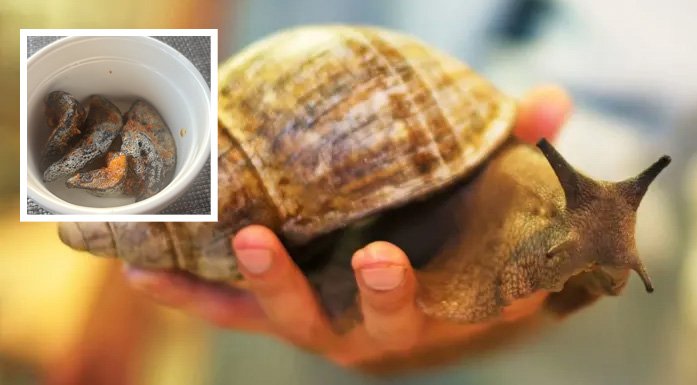
He said while in Nigeria, he saw snails on the menu at a hotel restaurant, so he asked a member of the kitchen staff whether the snail on the menu was the Giant African Snail.
“And the answer was in the affirmative, yes,” Bruce said.
He said that that morning he had received a photograph of a Giant African Snail on the compound of the Ministry of Agriculture, Forest, and Rural Transformation in Kingstown.
“So I quickly ran to my phone, unlocked it, pulled up that photograph, showed it to the kitchen staff, the ladies cooking, and I asked, ‘Is this the snail that you’re talking about? Because this is what we have in St. Vincent.’ And she confirmed, ‘Yes, that is the snail.’”
Bruce said he ordered Giant African Snails.
“And in the space of 15 minutes, I had a small portion that was presented, already grilled, and, quite naturally, I sampled it. Now, the issue here is not my sampling of the snail, which is the same snail that they’ve accepted that we have here.
“The issue is, what are the possibilities for us? Can we save the taxpayers of this country $7 million over the next three years trying to eradicate or minimise the impact of this snail, whilst there are possibilities to harvest them, follow the necessary protocol to clean and prep them and transship them, if not directly to Nigeria, where, and I must say this, I was told that that meat is a delicacy and that it is very expensive … and it’s a delicacy.”
Bruce said there was “a very large Nigerian population” in SVG.
“I am saying, look at it for what it’s worth. Probably it’s a business opportunity for Vincentians, maybe Nigerians who’re living here, who might be able to purchase, clean, package and find their easiest route back to Nigeria.”
The agriculture minister said there is a “massive” Nigerian population in the United States.
“… and if it’s a delicacy for them and they’re willing to consume, … I see no reason why I should not protect $7million of taxpayers’ money buying baits and doing everything else to try to destroy them when there’s a possibility of earning.”
He said he knew some people squirmed when they saw the video of him eating snails in Nigeria.
“But from my own sampling, I can tell you it has a taste like regular conch. So, once it is clean and it is prepared properly, de-poisoned, what have you, it’s good for consumption.
“I’ve returned a week since, and I am still here. So, it means, therefore, that that delicacy is something that could save us millions,” Bruce said.