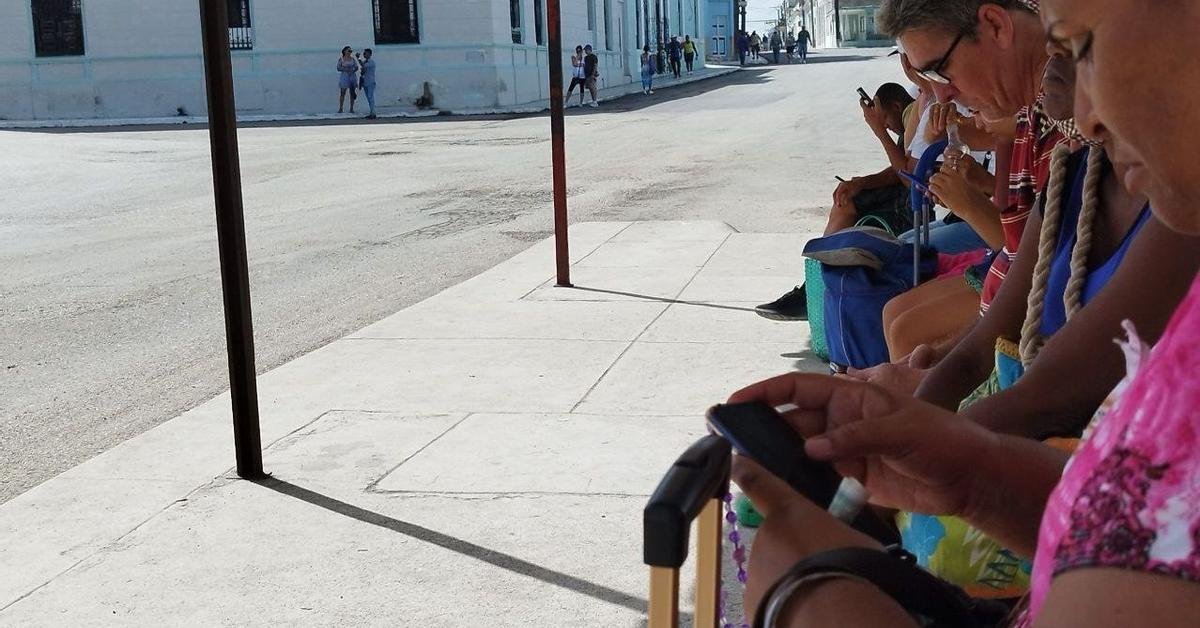
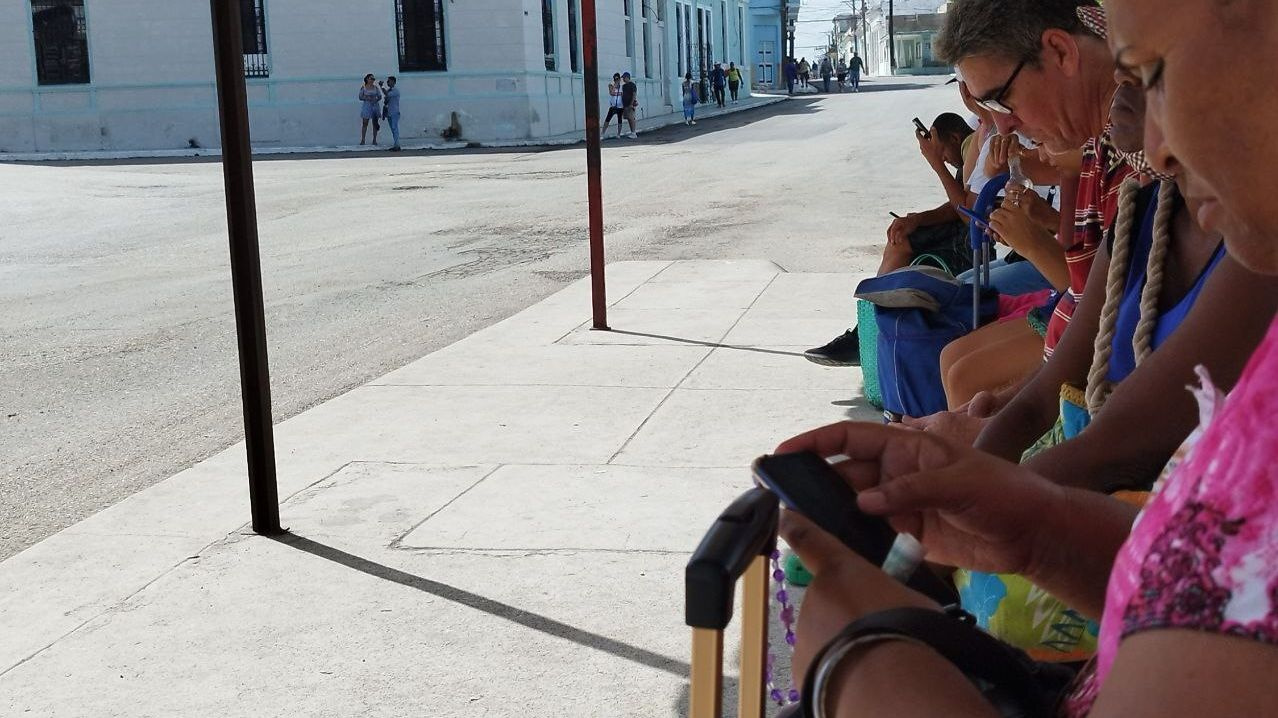
Havana/Even knowing what time it is has become a problem in Cuba. This Sunday, numerous smartphones and computers woke up one hour less than the official time, after automatically applying the change to winter time. The Government had decided, however, to keep the clocks forward to try to alleviate the electricity crisis. The result has been a tremendous technological mess, with users searching for instructions, modifying settings and asking for help to get their devices to obey authorities.
In Luyanó, a neighborhood in Havana, a neighbor assures that older people are among the most affected. “The elderly people in the neighborhood who don’t know how to use the telephone are crazy about the time change,” he tells 14ymedio. She herself has had to become an improvised technician: “I already fixed mine and my mother’s.”
Given the avalanche of complaints, Etecsa came out this Sunday to give explanations. In a statement published on Facebook, the company assures that its technicians have worked in recent days to adapt the telecommunications systems and that the process was completed “satisfactorily.” However, he acknowledges that many phones did automatically change the time because their operating systems retained the previous programming. Their recommendation is to turn off the automatic setting and manually set the clock forward sixty minutes.
“Of the eight devices I have at home, I had to change the time manually on all eight of them!”
But the difficulties do not end with finding the right configuration. “Houston, we have a problem!” says another user ironically. “I think that the time change was carried out ‘satisfactorily’ needs an urgent review, because of the eight devices I have at home, I had to change the time manually on all eight of them!”
From Sancti Spíritus, a resident explains that she left her Xiaomi phone configured the night before, following the instructions, but the device also woke up with the wrong time. “I had to put my foot in it,” he summarizes.
The explanations have not managed to quell the protests. Under Etecsa’s own statement, complaints have accumulated from users who claim to have been left without a mobile data connection, especially through the 4G network. “I called Customer Service and they told me that I should reconfigure the Nauta APN and restart the phone. I did it and I still have problems,” says Sergio David Roche Díaz.
Another Internet user provides a striking detail: “I have two lines on the same cell phone, and on one, everything is fine, on the other, no.” Complaints also appear about certain Cubacel numbers and Samsung models, which cannot access the web browsing service this Sunday. Some recommend temporarily switching to the 3G network, while others say they cannot connect using that technology either.
In a specific notice for Cuba, Google acknowledges that the decision was announced too late to update Android before November 1
“I have done thousands of tests and my phone cannot connect. Only because of tethering,” writes Yulieta Hernández Díaz. For her part, Elaine de Cárdenas Riol states that she cannot use Transfermóvil either.
The situation had been warned by this newspaper on Friday. Even Google had warned of the problem. In a specific notice for Cuba, the company acknowledges that the decision was announced too late to update Android before November 1. As a workaround, he recommends selecting a time zone that remains in UTC-4, such as the Dominican Republic or Puerto Rico.
The problem reached those responsible for international time systems. On October 24, a user identified as Tuenvio sent an urgent request to the IANA public list to warn of the Cuban decision. Two days later, specialist Tim Parenti confirmed that he had located the official announcement, but warned of difficulties in distributing the update on time. The new version of the database was published on October 27. Microsoft has also announced a fix for Windows during November.
The Government estimates that maintaining daylight saving time will avoid an increase of 126 megawatts in electricity demand during the evening peak. The measure will last until November 2027 and requires delaying entry to schools and workplaces by half an hour during the winter. For several weeks, furthermore, the sun will not rise in Havana until after eight in the morning.
Morocco’s experience offers a warning
The decision has precedents. In 2004, during another serious energy crisis, Fidel Castro’s government extended daylight saving time and modified school and work days.
Morocco’s experience offers a cautionary tale. In 2018, the North African country decided to permanently maintain daylight saving time, also with the argument of saving electricity. However, after almost eight years of controversies over dark mornings and sleep disturbances, the Government backed down on September 20. An analysis published in April 2026 estimated that electricity savings barely represented between 0.3% and 0.5% of national consumption. The Minister of Energy Transition herself had acknowledged that during the winter there was no significant reduction in demand attributable to the measure.
In Holguín, a resident interprets what happened as another example of official decisions that end up complicating daily life. “Their thing is to pretend that they work. They spend the year inventing measures so that one believes that they do something, but the measures turn out to bring more problems, like the happy Ordering Task,” he tells this newspaper. “Then come the rectifications, and more measures. This will never end.”
Yanet Durán García, for her part, reproaches the institutions for not having informed the population sufficiently in advance, especially the elderly. “Do not continue leaving the people to resolve themselves as they can, when they are their obligations,” he protests after dedicating the morning to helping several neighbors.
But perhaps it is Mercedes Fundora Carrasco who best summarizes the state of mind of many Cubans. “For my part, I don’t care about any schedule if we no longer have a schedule and if there is one, it’s half the time,” he writes on Facebook. “I can change my phone whenever I want,” he adds, before remembering that many workdays no longer even last eight hours. For many, the real problem is not that the phone is an hour late, but that daily life has long since stopped functioning normally.