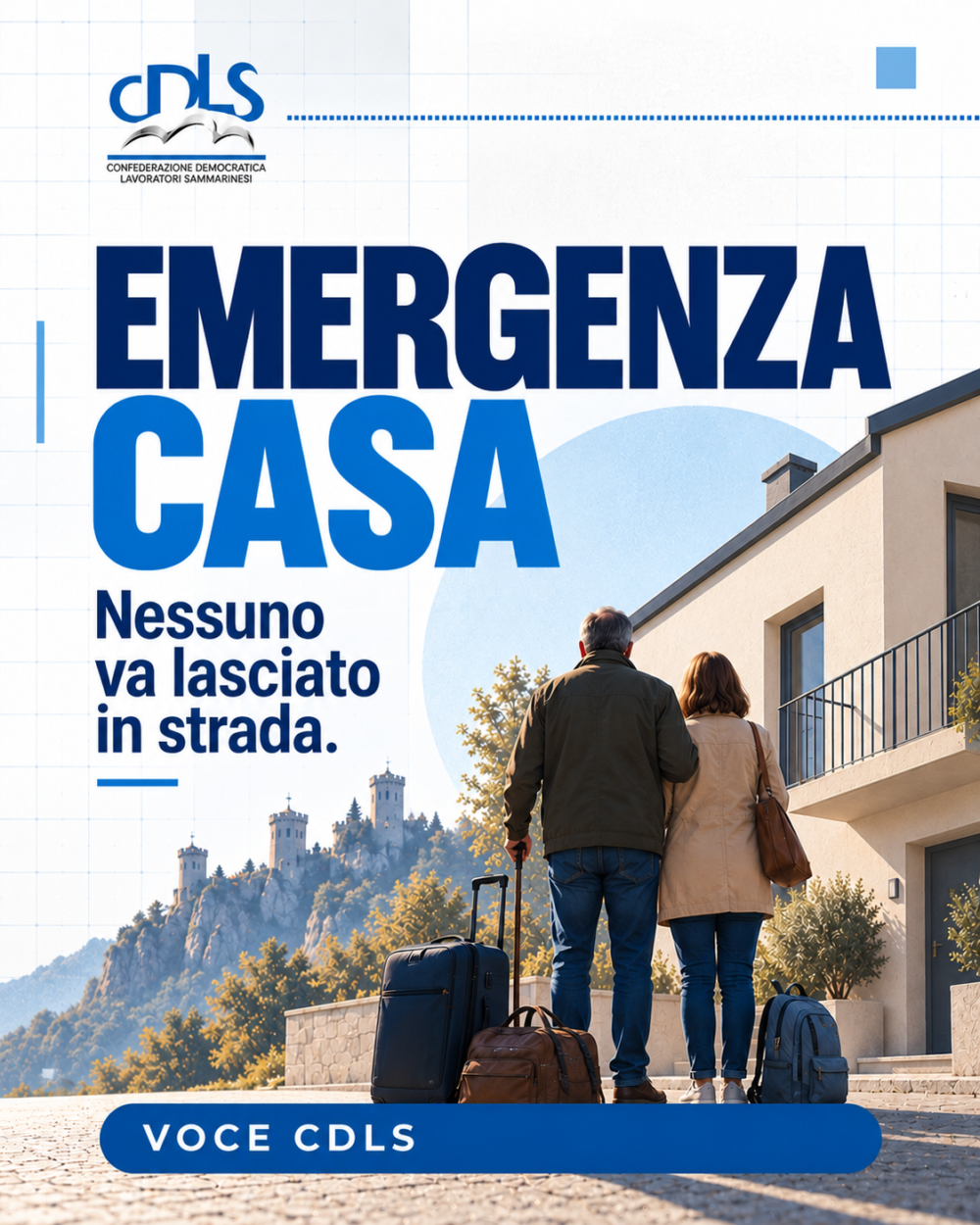
SAN MARINO – Behind the 14 evictions announced in social housing there are families and people in conditions of economic, health and social fragility. The Democratic Confederation of San Marino Workers (CDLS) asks the institutions to re-evaluate individual situations before implementing the measures and to identify sustainable housing solutions.
Among the cases reported by the union is that of a couple in which both spouses live with disabilities. The wife receives a disability pension, while the husband, followed by social services, is included in a therapeutic recovery process which provides a compensation of a few hundred euros. Despite the worsening of their economic and family conditions, the couple continues to receive requests for housing release.
Another situation involves an 80-year-old woman who has lived in public housing for decades. Left alone after painful family events, she risks losing her home because her pension exceeds the income limits established by law. A case that raises questions about the possibility of adequately evaluating personal conditions and the concrete difficulties of finding new accommodation in old age.
The CDLS also refers to the situation of female workers left alone after the loss of their partner, forced to independently support family expenses and deal with the job insecurity of their children. Different events, united by the difficulty of reconciling formally available income with actual expenses and needs.
According to the union, these situations demonstrate that vulnerability can change over time and cannot be measured solely on the basis of income. Health problems, reductions in income and new care needs can profoundly change the conditions of a family unit.
Further complicating the picture is the cost of housing on the private market. Some of the families involved would have encountered rent requests of up to 1,000 euros per month, to which are added security deposits, any agency commissions and advance payments on rent.
Furthermore, the availability of social housing in San Marino remains limited. According to data reported by the CDLS, the public assets intended for this purpose include around 70 homes, mainly small in size, around 50 square metres, not always adequate for the needs of larger families.
The union recognizes the need to manage public assets fairly, also guaranteeing those awaiting assignment the possibility of accessing a home. However, it underlines that the protection of families already assigned and the needs of new applicants should not be opposed. Without an increase in housing supply and affordable alternatives, the risk is that the hardship will simply be transferred from one family unit to another.
For this reason, the CDLS asks for a re-evaluation of the economic, family and social conditions of the people affected by the measures, with the involvement of the competent services. In cases of proven fragility, it proposes to identify concrete solutions and to evaluate, within the limits permitted by law, a deferral of the release of housing.
The request also concerns the updating of the criteria for social housing and the strengthening of the public offer through planning and investments suited to the different housing needs.
Finally, the Confederation calls for an urgent discussion with the institutions to address individual situations and define sustainable support paths. The objective is to prevent the execution of evictions from leaving families without concretely accessible accommodation.