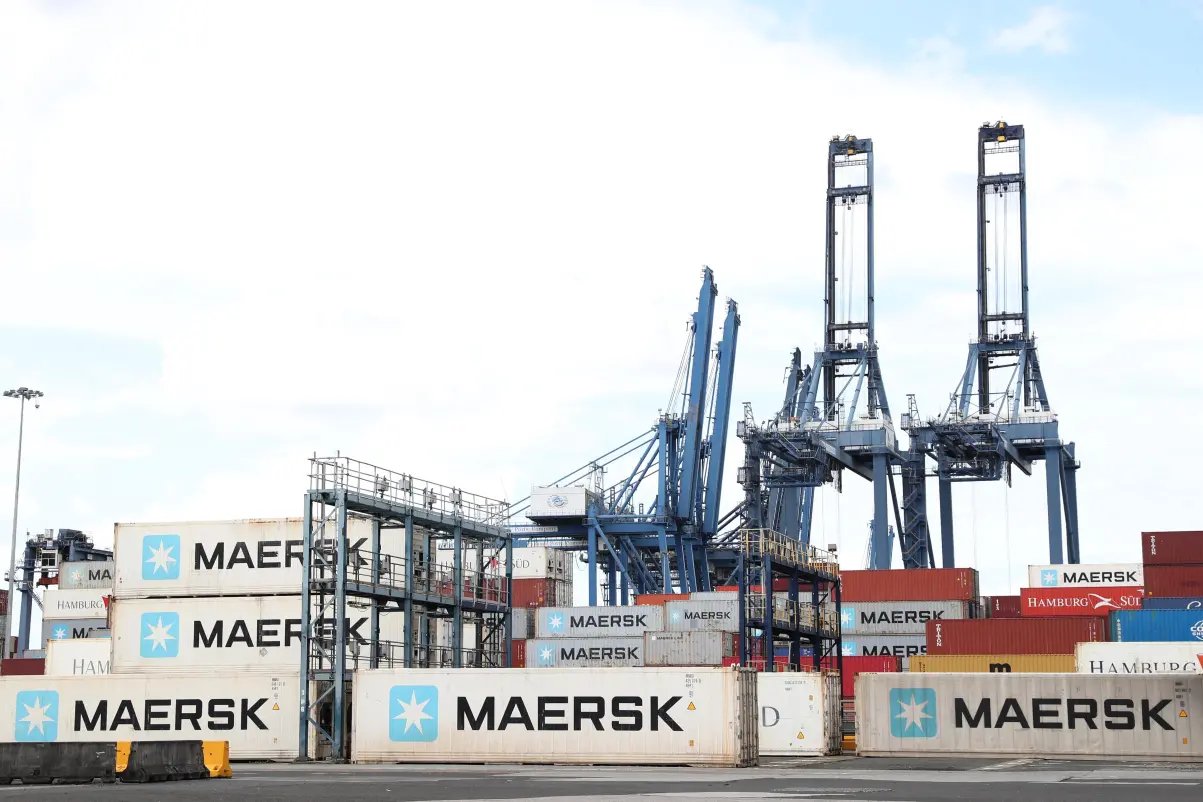
Nine months after the Supreme Court of Justice (CSJ) declared the unconstitutionality of the law contract that granted Panama Ports Company (PPC) the concession of the ports of Balboa and Cristóbal, the AP Moller-Maersk Group ratified its interest in competing for the permanent administration of Panamanian port infrastructure.
Currently, the Danish group temporarily operates the port of Balboa through its subsidiary APM Terminals Panama, through a transitional contract of up to 18 months approved by the Cabinet Council last February, while Terminal Investment Limited (TiL), of MSC, manages the port of Cristóbal under a similar scheme.
With the transition period underway, the maritime multinational not only aims to consolidate its presence in Balboa, but also plans to extend its operational footprint to other strategic projects in the national geography.
“I think that the Panamanian Government has to really define when (it will carry out the tender for the concession). Maersk has believed in Panama all its life. Of course APM Terminals sees Panama as a nerve center for our operations and, when the opportunity opens, we will be present,” said Antonio Domínguez, president of Maersk for Latin America and the Caribbean, in response to the question about whether there is possible interest from the Danish company in participating in the port operation concession.
The senior manager emphasized that the corporation’s interest goes beyond the current situation and encompasses new developments on an international scale on both banks of the Canal. “I believe that Panama has at this moment the opportunity of Corozal, the opportunity of Telfers (island) and there are many opportunities. We are as always, we are here for 100 years and we want to be here for 100 more years,” Domínguez highlighted.
The Panama Canal Authority (ACP) expects to award concessions towards the end of 2027 to develop the port terminals of Corozal, in the Pacific, and Telfers Island, in the Atlantic, whose preliminary joint investment would reach $2.6 billion.
Regarding the management carried out to date by the Maersk subsidiary, APM Terminals Panama, in the port of Balboa, through the temporary figure, Domínguez explained that the group’s priority has been to guarantee the operational continuity and stability of the country’s logistics platform. “Naturally, what we are doing is operating for 18 months as requested by the Panamanian Government; it is not a concession. For now it has been a very good experience. We have kept the operation going, which was the most important thing. Our job was to protect the hub logistics of Panama and we believe that we have done it well,” he assured.
Regarding the role of the Panamanian logistics platform in the face of interruptions in the global supply chain, the manager pointed out that companies are looking for strategic alternatives near their main markets.
“What many of the companies have told us is: I need to have a second route. I need to have a place where I can add value to my imports. I need to have a place that is closer to my main consumer market: the United States. I need to have a country where I can add value with processes, where there can be short transit times, where I can have access to both coasts, the Pacific, the Atlantic, the Caribbean. Panama does check to all those needs. That is what Panama has done at this moment,” explained Domínguez.
In relation to Maersk’s global strategy to consolidate itself as a logistics integrator end-to-end Since 2018, he indicated that the firm has expanded its operations into air transportation, warehouses and communication services. Likewise, when referring to the country’s port infrastructure, he indicated: “Panama, as is known, I have said it many times, Panama has a great opportunity. Panama expanded its Canal. We have clearly said that we are behind in port matters and from our point of view it is to continue motivating the Panamanian authorities to move forward with this roadmap that they have to bring more capacity to the country. We need more capacity than we have.”
Addressing the situation of international maritime trade, Domínguez attributed the pressures on freight rates to climatic factors in Asia and geopolitical tensions in the Middle East.
“In recent months, it is not only a lack of space, but we have a lot of environmental impact. We have a very high typhoon season at the moment, in Asia, which is canceling many ships leaving there, in many ports (…). (For example) the port of Shanghai (in Peru) is almost 12 days late. Everything has an immediate impact on the freight rates that are at this moment,” he said.
He added that the rise in transportation costs affects on a global scale. “It surely impacts the entire world. If you realize, we have the impact of the climate (the typhoons in China), the impact of the war in the Middle East. The entire global logistics system is collapsed. We have a moment in which even the price of the bunker has risen (…). We are in the middle of what solution there is. The client has less of a vision in the price and more of a vision of looking for a solution.”
Asked about the exact fluctuation in freight rates, the Maersk representative explained that the data varies depending on the region and context. “It really depends on the country. If you see the latest reports, it varies from country to country. Perhaps much more the impact in the Middle East due to the fact of the war, due to the complete closure of the Strait (of Hormuz). We have the problem of the Red Sea, pirates attacking. It is very difficult to model a figure because it is so changing (…). What is confirmed is what Maersk has always said, that maritime transport is 100% based on supply and demand,” he expressed.
Regarding the corporation’s income, he indicated that the annual projections have been adjusted upwards. “In our contribution and our results statements (…) we have been increasing our vision of resources or income per year on the rise (…). I think that at this moment we are above what we had said in the (previous) report. I think the last one will come out in a couple of days, which is when we will have the exact figure. We are waiting.”
Finally, regarding the operational management of the Panama Canal in the face of climatic variations such as the El Niño phenomenon, the manager expressed support for the entity’s preventive measures.
“The Panama Canal has always been very responsible. We believe that they always go ahead and make the decisions. Of course, the company that uses the Panama Canal is concerned about the effects of El Niño, but we trust that they see things in the long term,” he said.
Likewise, regarding the recent expansion of the Long-Term Slot Allocation (LoTSA) program towards the Panamax locks to ensure transits between January and April 2027, Domínguez concluded: “What the Panama Canal is doing is keeping the flow intact with the countries of the world with this measure. That at this moment has a lot of weight. I congratulate you for that decision.”