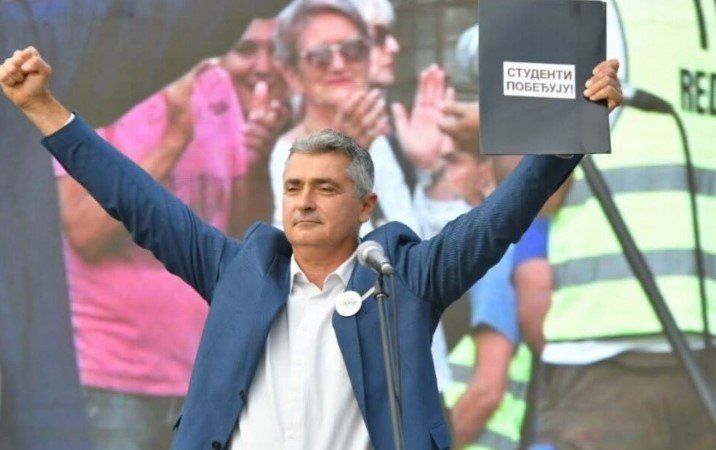
Ilija Srdanovic, a cardiologist and professor at the Faculty of Medicine in Novi Sad, is the figure who led the “Student List” to victory in Serbia, ending Aleksandar Vucic’s 14-year political dominance.
But who is Ilija Srdanovic?
His political engagement took a new direction after public support for student protests against corruption. In September 2026, he was introduced as the leader of the independent student list, representing a movement that demands changes in the way institutions operate and in the direction of the country.
His political platform emphasizes the decentralization of the health system and the priority of national interests, before an immediate integration into the European Union.
During a recent meeting with students in Novi Sad, where he presented himself as a candidate, Srdanovic touched on the tragedy of the city’s railway station, where the collapse of a concrete shelter caused the death of 16 people. He emphasized that, almost two years after the event, citizens continue to demand answers and responsibility for what happened.
According to him, part of the hope for change is related to the young generation and its commitment to a better future for Serbia. He sees youth as a force that can influence the transformation of the country and the improvement of institutions.
Srdanovic was born in 1970 in Novi Sad, where he also built his academic and professional career. After completing his medical studies and related specializations, he defended his doctorate in 2012.
Since 2018, he is part of the academic staff of the Faculty of Medicine in Novi Sad, where he teaches in the department of emergency medicine.
His involvement in the student movement came in the context of protests against corruption, which he supported from the first stages. He appeared for the first time to speak at the rallies held in Belgrade in May this year, gradually strengthening his public profile.
With experience in the field of medicine and commitment to the student movement, Srdanovic has become one of the representative figures of efforts for political change in Serbia.