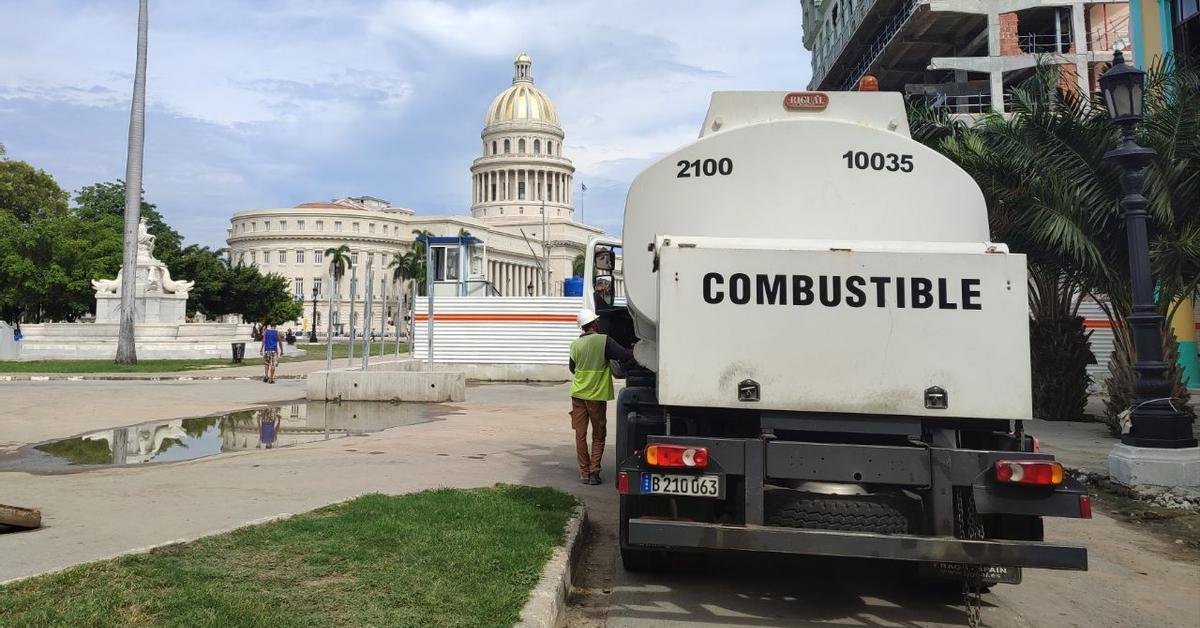
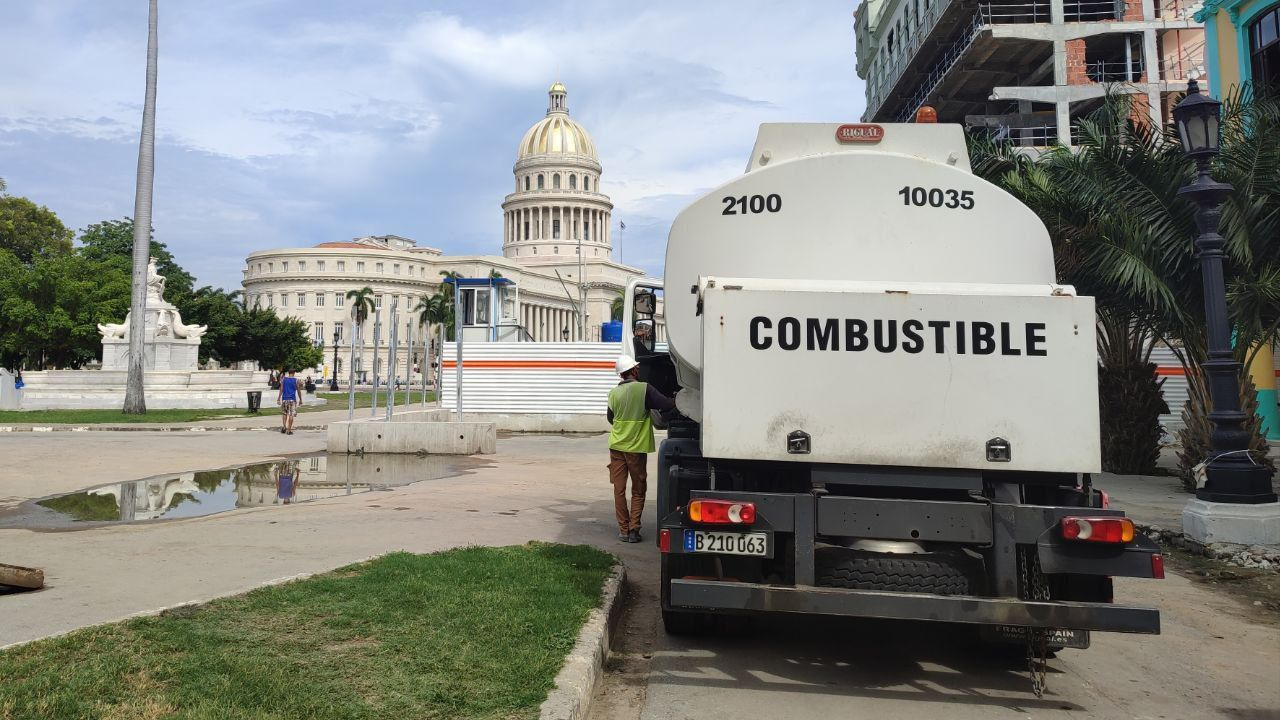
Madrid/The US Government admits that part of the fuel it exports to the Cuban private sector may end up in the hands of the regime. This is what a State Department spokesperson expressed in a statement sent to journalist David Adams, to which he had access. 14ymedio.
“We cannot rule out some diversion towards figures or entities linked to the regime, but we will continue to repress their efforts to evade sanctions, targeting any company that knowingly supplies the regime,” says the text signed by the State Department Press Office, adding that “the regime must now resort to subterfuge and illegality only to obtain a small part of the fuel that reaches the country, instead of controlling the entire market.”
The statement celebrates that Washington’s policy towards the Island “has already caused the largest privatization in the history of the Cuban economy,” and recalls that, after Venezuela cut off the supply of free oil to the regime – part of which was resold abroad for foreign currency, according to the text – the Donald Trump Administration maintained fuel exports to private Cuban entrepreneurs. These, he states, “now import and sell to other private individuals, humanitarian NGOs and diplomatic establishments,” so that “the regime’s monopoly on fuel has been broken.”
“The Trump Administration continues to target key sources of income from the illegitimate Cuban regime through the imposition of sanctions. We are also combating the regime’s circumvention of sanctions,” the State Department emphasizes.
The regime must now resort to subterfuge and illegality just to get a small part of the fuel that reaches the country, instead of controlling the entire market
This statement has been issued in the context of Washington’s offensive against fuel shipments destined for the state sector. On October 7, agencies of the Department of Homeland Security announced the seizure of 90 shipments of biodiesel, 71 in Port Everglades (Florida) and 19 in Houston (Texas). Its value was around 2.8 million dollars and its destination was the state-owned Enetec, included on the sanctioned list of the US Office of Asset Control (Ofac) on July 13.
Washington’s admission confirms what this newspaper is saying documenting since Aprilwhen the authorities began to rent state gas stations to MSMEs such as the one in Acapulco, in Nuevo Vedado, to dispense fuel purchased in the United States. Since then, it could be seen that the Ticket platform, managed by Cimex – a corporation of the military conglomerate Gaesa, sanctioned by Ofac – was already selling gasoline and diesel in dollars in Havana when only private companies could import them from the United States.
A month later, this newspaper verified that in the old Shell of Guanabacoa vehicles were supplied of Transmed and other state companies in pumps rented by private parties, which US regulations expressly prohibit.
In September 14ymedio revealed this link in a more disturbing way: the El Eficiente gas station, one block from Villa Marista, supplied vehicles from the state-owned Sepsa, trucks from the so-called black berets –special brigades of the Ministry of the Interior– and the Suzuki motorcycles of State Security. It had been more than five months since the last tanker with hydrocarbons had arrived in Cuba – the Anatoly Kolodkin, coming from Russia – and that the Minister of Energy and Mines, Vicente de la O Levy, will declare publicly: “We have absolutely no fuel, we have absolutely no diesel.”
Among the documents that evidence this link, there is an invoice dated September 21 from Cimex-Mariel to an Oro Negro service center for more than 23,000 liters of gasoline.
Just a few weeks ago, an incident once again left evidence this link: The fire in a fuel tank at the Azutecnia company, a subsidiary of the state-owned Azcuba, in Granma. Official information does not specify what type of fuel burned or its origin, but Cuba does not have the conditions to produce refined fuel from its national crude oil.
To this day, the Ticket platform, which continues to sell fuel in state service centers, continues to be the most visible sign. Not only is the sale of gasoline and diesel still active in the provinces, but prices have also decreased over the months.
An investigation of Cuba DNA and Martí Newspublished this fridayhas confirmed that Cimex buys fuel from 21 suppliers, at least 16 of them MSMEs, and resells it in its network of service centers. Among the documents that evidence this link, there is an invoice dated September 21 from Cimex-Mariel to an Oro Negro service center for more than 23,000 liters of gasoline. Cimex does not appear as a direct importer, but rather as a buyer of fuel supplied by Cuban MSMEs.
From January to August of this year, the accumulated products petroleum derivatives exported from the United States to the Island amounted to 231.74 million dollars, unprecedented figures in the entire history of trade relations between both countries.
These specific data did not prevent De la O Levy from stating in a recent interview with Reuters about those imports: “I would dare say that the amount that enters the country does not even cover 3% of its fuel needs.”
“No Cuban state company has managed to obtain a fuel contract, whether for small or large quantities,” the minister said then.