Rising production costs, inadequate policy and a shortage of sales opportunities make small rice farmers in Nickerie fear for their livelihoods. Some have been forced to drastically reduce their production. Others have quit altogether and have taken refuge in government jobs or poultry farming. Yet they refuse to give up their rice fields permanently.
Text and image Audry Wajwakana
It is mid-September and the vast rice fields in Nickerie turn golden yellow. In some fields, combines are busy harvesting the ripe paddy under the scorching sun until late in the evening. It’s a beautiful sight. But behind this idyllic landscape lies a worrying reality. Less and less is being sown, which means that the total rice harvest is also in danger of declining further.
“Rice is in us. We are bound to that clay and have a certain feeling about this soil here. So we are going to stay”
‘Ko’ Dwarka
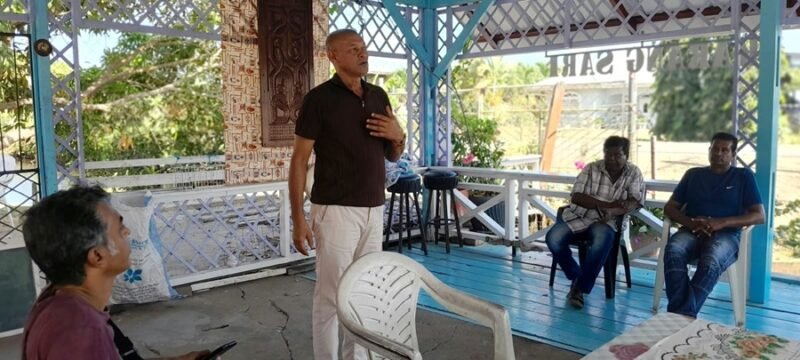
A handful of small rice farmers have gathered on the blue and white veranda of rice farmer ‘Ko’ Dwarka in the Clarapolder, surrounded by beautifully flowering potted plants. Opposite the True Time they vent about the ongoing problems that are increasingly pushing the sector into a corner.
One of the farmers points out the sharp decline in the sector. “In the past, more than 34,000 hectares were sown. This season we are barely reaching 19,000 hectares. That is a huge decline,” he describes the decrease with concern. The consequences will eventually also be noticeable on the shelves, the farmer warns.
By the way, not only the rice supply for the population is under pressure, the poultry sector is also in danger of being affected. After all, grinding meal, a by-product of rice processing, is an important component of poultry feed.
Fifty years of the same problem
According to Dwarka, the problems facing rice farmers are “anything but new”. “The same bottlenecks have been raised for more than fifty years, without successive governments succeeding in providing structural solutions. If this continues, the sector will slowly die,” he emphasizes.
The farmers feel abandoned. “When you talk about rice farmers, we immediately get the stigma that we always complain,” says Dwarka. But according to him, farmers mainly want to be able to work under conditions in which production is profitable.
‘Wrong and corrupt’
Rajen Bishar does not deny that a lot of money has been invested in the rice sector by successive governments. When asked what all those investments have yielded, he responds critically. “A lot was invested by the previous government, but incorrectly or corruptly,” he firmly believes.
As an example, he mentions the planned construction of the modern Jai Kisaan rice mill, for which money was made available and even the go-ahead was given in October 2024 by then President Chandrikapersad Santokhi. However, this has not gotten off the ground to date.
Bishar also mentions the problems surrounding the Wakay pumps. At the time, farmers who depended on these pumps to irrigate their rice fields would ask for fresh water for days. This was not made available in time, causing them to suffer major losses. Rumors then spread that fuel intended for the pumps in Wageningen was used for private purposes.
Funds are also said to have been tampered with during excavation work for the maintenance of canals due to inadequate control. The farmers also wonder what has become of the investments in the Maratakka Canal. “Millions have actually been invested for the farmers, but most of them were show projects to support their own friends,” it is claimed. Ultimately, farmers are the ones who suffer the consequences.

Production costs
Despite government investments, it remains difficult for small rice farmers to keep their production running. The image of rice farmers holding out their hands for subsidies is upsetting to those present. “We don’t actually want any subsidy at all. What we want is an affordable paddy price,” one of them emphasizes.
In order to produce profitably, costs must be reduced. A major stumbling block is the price of fertilizer. A bag of urea that cost SRD 1,350 the previous season rose to SRD 2,350. The farmers speak of price gouging and insufficient controls on the import and sale of agricultural supplies. Fuel, chemicals, seeds and machine parts are also becoming increasingly expensive.
A farmer illustrates how the relationship between costs and returns has changed. Twenty years ago, he could buy a bag of fertilizer with the proceeds from a bag of paddy. Nowadays he has to sell five bags of paddy for this.
Costs are also driven up by problems with water management and the availability of good seed. Poorly maintained supply and discharge channels make production difficult. Dwarka therefore advocates better functioning water boards, where farmers are given more responsibility for the maintenance of the infrastructure. Now they always have to turn to government agencies for machines, fuel and other facilities.
Prices, interest, payments
The support from Adron, the Anne van Dijk Rice Research Center Nickerie, also leaves much to be desired in the eyes of the farmers. The center used to play an important role in the development and propagation of rice varieties and the provision of quality seed. That support has declined sharply. As a result, farmers have become increasingly dependent on rice varieties from Guyana, which do not always have the desired quality.
That uncertainty does not end once the paddy is harvested. The farmers have little influence on the price that millers and buyers pay for their paddy. Moreover, they sometimes have to wait months before receiving their money.
One of those present says that some millers even make payments for up to two years, without paying interest. On the other hand, farmers themselves have to pay interest when they buy fertilizer on credit or take out a bank loan.
Dwarka mentions interest rates of 17 to 18 percent for agricultural loans, which are even higher due to additional charges. Banks have also become more reluctant to finance rice production. “Because the rice sector no longer offers security,” explains a farmer.
(read more below the photo)

Forced to reduce production
The debt burden is forcing more and more farmers to reduce their production. The proceeds from the harvest are first used to pay off debts, after which there is insufficient money left to replant the same area. Bishar describes how farmers who once sowed a hundred hectares fell back to eighty, then fifty and finally barely ten hectares. Some have now not sown anything at all.
One of the farmers during the conversation is a living example of this. He initially planted eighty hectares. When financial problems increased, he reduced his production to fifty hectares. The counter is now at zero. He invested his last savings in coops for chickens and docks for poultry farming. He now tries to make a living with this. “But I want to continue planting. My heart can’t let go,” says the farmer. For Dwarka, that attachment is recognizable. “Rice is in us. We are bound to that clay and have a certain feeling about this soil here. So we are going to stay,” he says firmly.
The representation of farmers in farmers’ organizations is another concern of farmers. They believe that their interests are not being adequately represented. There are hardly any meetings and concrete results are not forthcoming. Bishar advocates a strong, independent farmers’ organization that is separate from party politics and defends the long-term interests of farmers.
(read more below the photo)

Sales market and hope
In addition to the problems with production and financing, marketing of rice is an obstacle. The European market has partly disappeared due to restrictions, while new markets are not being sufficiently tapped. Dwarka wonders what role the Surinamese embassies play in the search for new markets.
More peeling mills can increase competition between buyers, but that does not solve the main problem. “You have production and you have processing, but you have no sales.” The consequences extend beyond farms. Bishar points out that when farmers earn less, shops, transporters and other entrepreneurs also notice this.
“Millions have really been invested for the farmers, but most of them were show projects to support their own friends”
Rajen Bishar
Farmers fear that the rice sector will suffer the same fate as other agricultural sectors that have declined sharply over the years. Yet they refuse to accept this development. Dwarka emphasizes that farmers have the required knowledge and experience, but policymakers must actually listen to them. “You sow seeds every time with the hope that things will get better this season,” he says.
After the conversation with the farmers, Dwarka takes over the True Time to the rice field behind his house. He shows how he expanded his activities with keeping chickens, ducks and goats to compensate for the declining income from rice farming. When asked what the farmers will do if the rice sector in Nickerie collapses, he answers with a shrug: “Then we will all stand on the doorstep of Social Affairs or apply for a job with the government, as is already happening.”