The Danish economy is in top form, but it must be prioritised, says the finance minister about the proposed finance bill.
It is a finance bill with “hard priorities” because the current security policy situation “makes it necessary” that more money must be spent on security.
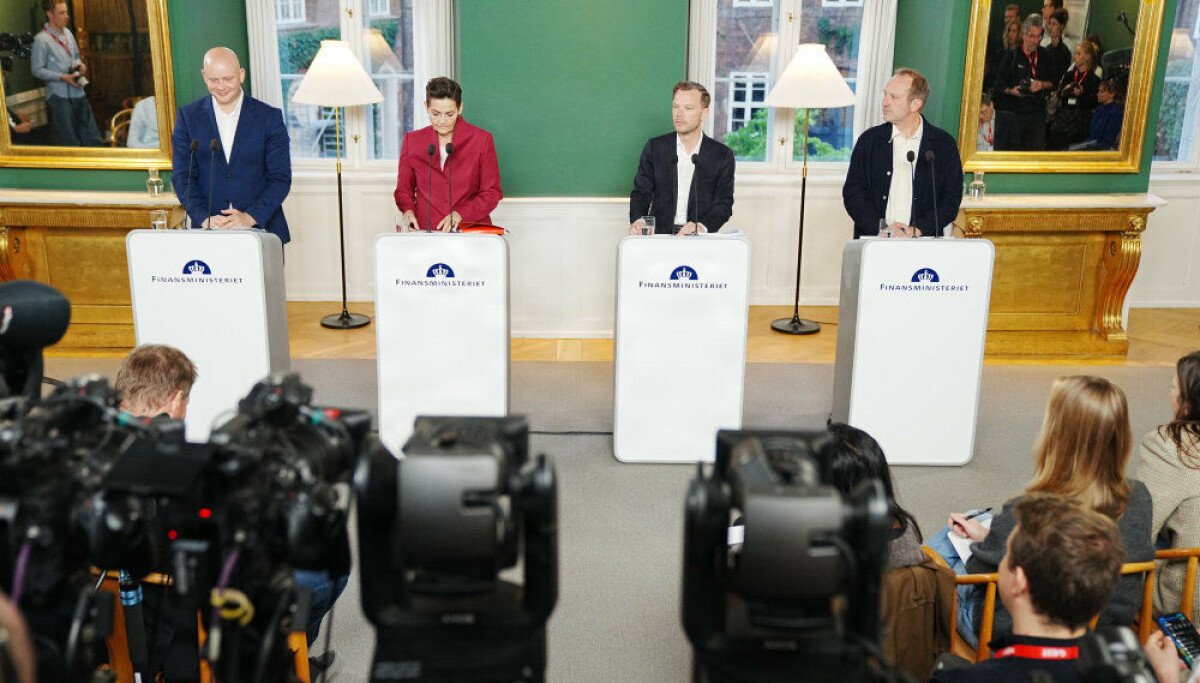
This is what Finance Minister Peter Hummelgaard (S) says, who on Friday morning will present the government’s finance bill in the Ministry of Finance.
The proposal has been named “A stronger defense of Denmark – a strengthened Denmark to defend”.
Among other things, the government wants to allocate enough money to the Armed Forces so that in 2030 3.5 percent of the gross domestic product (GNP) is spent on defense expenditure.
Peter Hummelgaard states that “the Danish economy is in top form”.
– The government’s proposal for a finance law shows that we take responsibility and that we are at the forefront of the work for a greener, freer and more equal Denmark, says Peter Hummelgaard.
The Minister of Economy and the Interior, Pia Olsen Dyhr (SF), also stresses that the financial bill is characterized by a “security-politically challenged situation”.
– We will not solve all the challenges we have in Denmark with this Finance Act. But we are well on our way.
– I also think that everyone should remember that we are in a heightened security policy situation, says Pia Olsen Dyhr at the press conference.
The majority of the government’s financial bill is already known in advance, as the initiatives are either part of the government’s foundation or have been presented continuously by various ministers recently.
For example, 1.2 billion kroner is set aside for the children’s area, which includes primary school, among other things, in 2027, while the draft financial law also sets aside a total of 10.1 billion kroner in 2030 to lower taxes.
Among other things, this concerns the abolition of the intermediate tax and the top tax as well as a lowering of the corporation tax.
– We are simplifying the tax system, says Tax and Growth Minister Jakob Engel-Schmidt (M).
The various tax proposals must be negotiated in an independent tax reform. In the finance bill, only tax reductions appear, but the government, for example, also plans to freeze a number of amount limits in the tax system, which is a tax increase.
According to the bourgeois-liberal think tank Cepos, there will be a net tax reduction of DKK 2.2 billion in 2030 as a result of the government’s various plans.
The last minister at the press conference, Business and Competitiveness Minister Martin Lidegaard (R), focuses on the fact that the finance bill “invests in young people and education”.
– We significantly strengthen knowledge, education and training in Denmark, from abc to PhD. It is good for the individual young person, but it is also good for Denmark’s future, says Martin Lidegaard.
Where the fiscal leeway has been able to finance large parts of the Finance Act in recent years, this time there are a number of financing initiatives in the draft Finance Act.
This means, among other things, that the SU must be cut, savings must be made on the senior pension, a tax on cruise ships must be imposed, and more administrative savings must be found in the state.
The government must now enter into negotiations with the rest of the parties in the Folketing to find a majority for a new finance law for 2027.
For those negotiations, there is a negotiating reserve of DKK 500 million annually in 2027-2030, where other parties can get their priorities through.
RITZAU