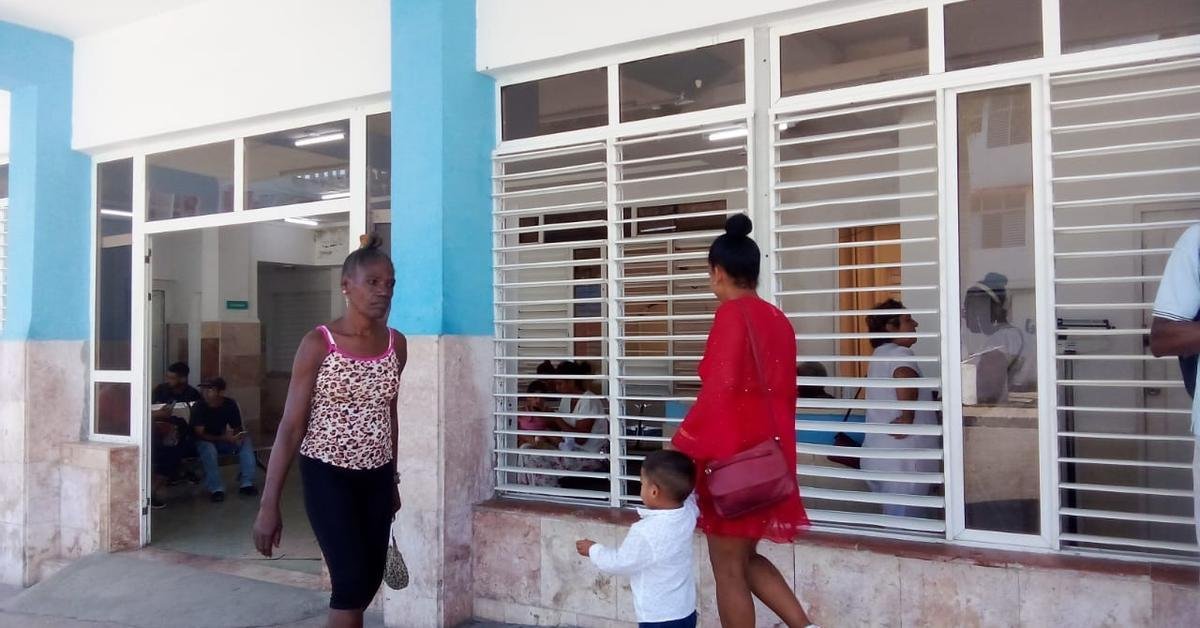
Matanzas/In the guard room of the Eliseo Noel Caamaño Pediatric Hospital, you can barely see the health personnel moving from one side to the other. Along the corridor that leads to the admission rooms, from time to time someone in a white coat comes out of a consultation, closes the door and walks away quickly to avoid questions. Children and family members remain on the metal benches, looking towards the infirmary and waiting for an employee who, as they are told, went to have a snack.
Standing in front of that door, Yanelis has less patience. Your four-year-old son needs an injection to reduce his persistent fever. “First I had to buy acetaminophen on the street, because there isn’t any in here. It’s been more than an hour since the doctor saw us and we still haven’t been able to solve it because the nurse is missing,” he tells 14ymedio. The young woman threatens to go to the hospital management.

/ 14ymedio
The lack of health personnel has become one of the most visible holes in the Cuban health system. In December 2024, even a commission of deputies which visited 39 municipalities in the 15 provinces recognized that the departure of professionals to other sectors and the migratory stampede had turned the deficit of workers into one of the most alarming problems of Public Health. Years before, the authorities themselves had admitted the departure of professionals and technicians towards other economic activities, inside and outside the country. The deficit has only worsened.
In the Matanzas Pediatric Center, this statistic takes on concrete faces. A young mother wipes the sweat that covers her daughter’s face with a handkerchief. From 8:30 in the morning he asked for the last one for the injections. After ten o’clock, he has seen elderly people selling roasted peanuts and medical students talking openly about the lack of professors at the University of Medical Sciences passing through the guardhouse, but not a single nursing professional has entered the premises.
“It seems unbelievable that in this hospital a nurse does not appear to give an injection,” he protests. The syringe and amoxicillin are still inside her bag when the antibiotic should already be taking effect in the girl’s body. What was missing in other times was taken for granted: the specialized hand that administers it.
A child bursts into tears and impatience grows. The receptionist finally looks away from the phone and assures that they already went to look for the nurse. Then he offers an explanation that causes more concern than relief: “She has been working alone for 72 hours and you have to understand that she gets tired because she is a human being.” The employee thanks God that there was no emergency.
/ 14ymedio
The phrase sums up the problem. It’s not just about missing medications, broken equipment or run-down buildings. In a system that for decades turned the abundance of white coats into a propaganda banner, now there is also a lack of those who know how to give an injection, measure blood pressure or prepare an aerosol. Last July, several health workers consulted by 14ymedio they described a panorama of low wageslack of means and official statistics that, according to what they denounced, led many to ask for the sector to be deregistered.
Another mother walks through the second floor of the pediatric hospital looking for help. “I didn’t find anyone who could help us,” he says. Since the boy cannot climb stairs because he is in a wheelchair, he has had to leave him alone while he searches the hospital. He is already thinking of another solution: locating a familiar nurse to come to his house. “I’m sure I have to pay him something, but that’s preferable to spending the week of treatment falling behind these people.”
A man walks in carrying a little girl and asks who is last for the injections. He has arrived from his corresponding polyclinic, where he found a similar situation. He sits and keeps his gaze fixed on a door, waiting for someone in a white coat to appear.