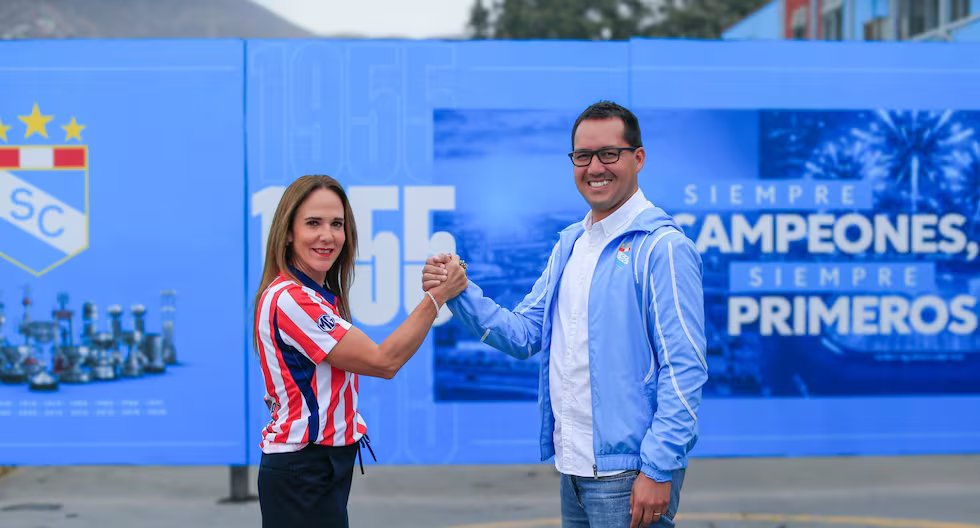
The Seedbed of Champions Foundationlinked to Sporting Cristaland the Jorge Vergara Foundationlinked to the Chivas de Guadalajarathey have been running since last September “Pásala”, a program that uses football as a development tool for girls, boys and adolescents in the town of Cantagallo, in Rímac. The alliance was born from foundation to foundation, but the agreement also involves the two clubs, something never before seen in Peruvian soccer.

Participants, families and team of Pásala en Cantagallo. The program also seeks to involve between 50 and 80 families in the community. (Photo: Semillero de Campeones Foundation)
“Pásala is one of the programs that we are executing in different provinces of the country, “But it is the only project that has two clubs integrated, associated and involved in the execution of this methodology,” explained to El Comercio Juan Carlos Velardeexecutive director of the Semillero de Campeones Foundation.
“It is a project that is very representative of what we believe in relation to football, sports in general and education as an equation for the comprehensive development of boys and girls,” Velarde added. The program began with 86 participants and, in its 12 months of execution, it plans to directly serve between 100 and 180 minors between 6 and 17 years old, in addition to involving between 50 and 80 families.
How was the alliance born?
Ana Karina Vazquezoperational director of the Jorge Vergara Foundationsaid that the alliance arose from looking for models in other parts of the world. “I always ask my team to look at how work is being done in other parts of the world to increase the scope of social programs,” he explained. His team reviewed the training and social work of European clubs such as Barcelona and Real Madrid, and then looked at Latin America. “Why don’t we go beyond what is done in Europe? And in that search we arrived at Sporting Cristal”, story.

Each Pásala session is led by a sports technician and a professional from the social or psychological area. Thus, football is combined with the development of life skills. (Photo: Semillero de Campeones Foundation)
Upon learning about the work of the celestial club, through its Semillero de Campeones Foundation, they found programs very similar to theirs. “It made perfect sense to us. We foundations work on structured, formal programs, with proven results and transparent reports. But we cannot hide that, for our girls, boys and adolescents, the fact that they are supported by the football teams, which are their inspiration, gives them a plus”held.
On the local side, Velarde valued the approach of the Mexican institution. “It is a pride for us that a club like Chivas sees the work we are doing, recognizes it and comes closer, and that from the connection between the foundations we can make this alliance between the clubs”said.
Three axes of work
Juan Carlos Velarde He detailed that Pass it works on three fronts. The first is the socio-sports activity with children. Then, there is a parents and caregivers school. Finally, it is the call “DT School”which trains local leaders and educators.
“We generally intervene in communities that have complex challenges, exposed to crime, addictions, and school dropouts. “Through sport we teach them a different route, one in which they can rebel in the face of an adverse situation, in which they can be the first in their families to finish school or go to university,” he pointed out.

Back to back, with the Chivas and Sporting Cristal t-shirts: Ana Karina Vázquez (Jorge Vergara Foundation) and Juan Carlos Velarde (Semillero de Campeones Foundation) lead the alliance behind Pásala. (PHOTO: César Bueno / GEC).
Working with families completes that task. “We believe that it is not enough if we only impact boys and girls. We need their caregivers, their environment, to understand why we do this, where it is going and what we are looking for.”, he explained.
The training of leaders, meanwhile, aims to ensure that the project does not depend on the foundations. “We do not want to be a welfare accompanimentof ‘I cover you, I take care of you, I give you food in your mouth’, but to teach you how you can make it sustainable. We believe that this is the correct route for really contribute to a change in our society: teaching how to do things, rather than doing things for them”, he stated.
One to three years per community
Ana Karina Vazquez agrees that Pásala is not “welfare accompaniment.” As he explained, this type of intervention works best when it lasts between one and three years in the same community. Therefore, permanence in Cantagallo will be evaluated depending on how the community responds.
“A foundation should not be welfare-oriented. I give you the tools, I trust you, I implement “And I leave when I know that I left the community prepared, that the leaders are ready to continue and replicate the program, even in other communities.”, said.

Ana Karina Vázquez, operational director of the Jorge Vergara Foundation, announced that they seek to replicate Pásala in other communities in Peru. (PHOTO: César Bueno / GEC).
The operational director of the Jorge Vergara Foundation He is confident in the effect the program will have on Cantagallo. “We must teach them that what they are experiencing is complicated, but that they can face it with tools. If they take the tools of these programs, I assure you that the vast majority of these 180 children, who are our goal for one year, will have another reality or will be able to glimpse another reality.”, held.
The Mexican foundation already worked in Comas in 2025, and the intention is to stay in the country. “The idea is to be permanently here in Peru and, together with the Semillero de Campeones Foundation, we will surely be replicating the program in other communities. “As a foundation and as an Omnilife-Chivas corporate group, the idea is to continue transforming,” Vázquez said.
Besides…
From the foundation to the field
Can this link go to the sporting level? Ana Karina Vázquez was cautious, but did not rule it out. “I cannot speak to you as the technical director or as the sports director of Chivas. Of course I would love to tell you that it would be incredible if within the framework of this alliance we could generate a match or a meeting, for Chivas players to come and learn about what we are doing, including the coaching staff, including Amaury,” he told El Comercio, in reference to Amaury Vergara, owner of the Mexican institution.
“I don’t see it as crazy, because Chivas will surely have promotional games in Latin America and, if at some point it happens in Peru, we can surely figure it out,” he added. As he explained, Vergara follows the foundation’s initiatives very closely: “I assure you that, if he is here on a tour, he would love to see the work.” A possible time for a visit would be the mid-program balance, at six months, “to encourage these children and let them see how the progress is going.”
The operational director of the Jorge Vergara Foundation also wants to add women’s football to both clubs. “It is very important to see how women’s soccer has grown in Mexico and throughout Latin America, and to bring these great players for our girls to see”he pointed out.
Velarde acknowledged that the path was unusual. “We have used a route that is not the conventional, the traditional one, of rapprochement between the clubs. But what I find to be a very beautiful, very inspiring opportunity, is that the foundations represent the heart, the maximum essence of what is sought, which is transformation through education and sports,” he said.
“There is so much closeness in how we think, in the values we proclaim and in the intentions we have with our communities, that this naturally paves the way to continue exploring things together. Super good things are sure to come”he concluded.
ABOUT THE AUTHOR