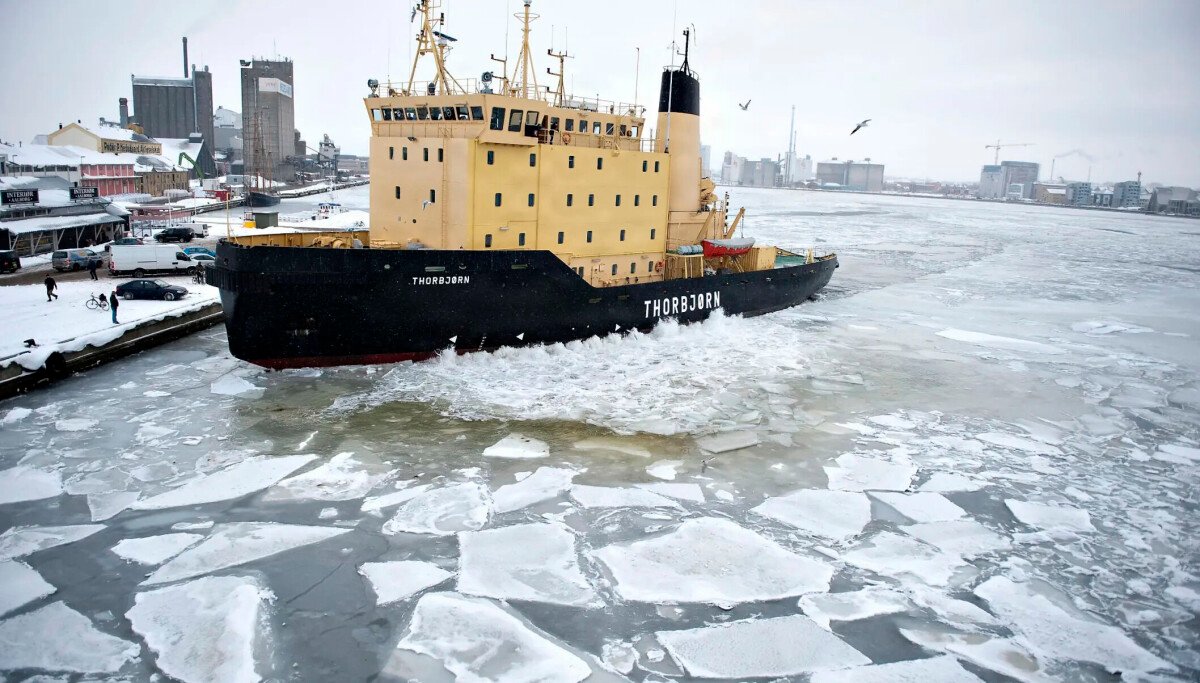
It will be at least a year and probably also a year and a half before gold mining company Amaroq’s new icebreaker, Thorbjørn, hits Greenlandic waters.
– On the other hand, it will be an investment that will be important for all mining companies in Greenland, explains a spokesperson for the company to Sermitsiaq.
It will be at least a year and probably also a year and a half before gold mining company Amaroq’s new icebreaker, Thorbjørn, hits Greenlandic waters.
– On the other hand, it will be an investment that will be important for all mining companies in Greenland, explains a spokesperson for the company to Sermitsiaq.
– Now the vessel must be rebuilt for use in Greenland, so that we can utilize its icebreaking capacity. We expect that Thorbjørn will help us create better access to new areas and support our exploration programs as well as provide logistical support in connection with the transport of personnel, materials and supplies.
– As part of Suliaq – our service business – Thorbjørn will be able to provide services to other mining companies in Greenland in addition to Amaroq, explains the spokesperson.
The former Danish state icebreaker was sold in 2015 to Danish shipping company Nordane Shipping in Svendborg, which operates a fleet of tugs and tugboats that, among other things, operate icebreaking in Danish ports. The company hoped that the icebreaker could be used for operations in, for example, the Baltic Sea.
At the yard
The plans never materialized – and now Thorbjørn is going to Greenland. But first it has to go to the shipyard and have a major overhaul, upgrade and, not least, more lifeboats, reports the medium Søfart.
– This concerns, among other things, the replacement of instruments and navigation equipment. The vessel is still equipped with a lot of the original instruments, which still work, but of course need an upgrade – also for activities in the Arctic, says Ed Westropp, Chief Corporate Development and Strategy Officer at Amaroq to Søfart.
– Furthermore, it is about more lifeboats, because we expect that there will be more personnel on board now than before due to the vessel’s new function, says Westropp.
Amaroq expects that the purchase of the icebreaker and the upcoming stay will add up to a total investment of six million dollars – just over DKK 40 million. The gold mining company has not yet found a yard for the upgrade.
Thorbjørn will be Greenland’s only actual icebreaker so far, so Amaroq expects that it will also be put to good use in other companies’ raw materials projects.
– In Greenland, you have to own the equipment you need to support the mining business. It differs from other mining markets in the world, where you can hire yourself out, says Ed Westopp to Søfart.
End of Danish icebreakers
In recent times, Denmark has had four state icebreakers, which were in operation during the worst ice winters, when the ice closed the internal Danish waters – among others in the Great Belt, Little Belt and the Limfjord. In 2020, the Norwegian Armed Forces’ icebreaking service was closed down and the icebreakers were put up for sale.
The state icebreakers were decommissioned – partly because the climate had become warmer, and partly because modern ships have greater engine power and can often manage without icebreakers in Danish waters.
The oldest and smallest of the icebreakers, Elbjørn, had been sold after an engine failure already in 2003 and functioned for a number of years as a restaurant ship in Aalborg, but has now been scrapped.
The two largest state icebreakers built in 1965-66 proved difficult to sell. For many years they were laid up in the harbor of Hals at the mouth of the Limfjord, but were sold for scrapping two years ago – and are now gone.
The newest of the icebreakers, Thorbjørn, was sold in 2015 to Nordane Shipping, who have now sold it on to Amaroq – and in a year and a half, the trip will then go to Greenland.
At the moment, the defense occasionally helps with ice-breaking in Greenland, if the authorities want it. The large inspection ships of the Thetis class can handle up to 1.6 meters of ice, while the inspection vessels of the Knud Rasmussen class can handle approximately half that, 0.8 meters.