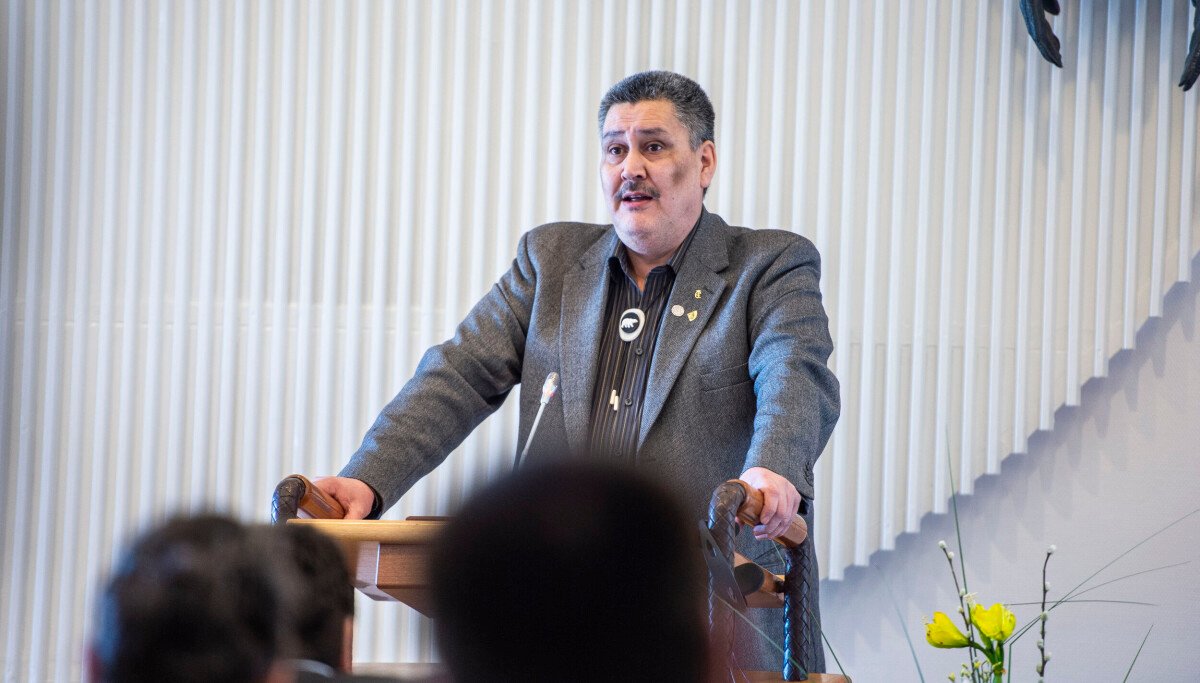
Then the chairman of NaalakkersuisutJens-Frederik Nielsen (D), on 18 September gave his opening speech in Inatsisartut, cooperation was one of the central messages.
– Political disagreement is a natural part of democracy, but the disagreement must not lead to a standstill, the message read.
Then the chairman of NaalakkersuisutJens-Frederik Nielsen (D), on 18 September gave his opening speech in Inatsisartut, cooperation was one of the central messages.
– Political disagreement is a natural part of democracy, but the disagreement must not lead to a standstill, the message read.
Naalakkersuisut reached out to Inatsisartut with a desire to listen, negotiate and find solutions that can last longer than one electoral term.
Disagreement must never become more important than the country
However, the subsequent opening debate showed that the path to broader political cooperation will not necessarily be easy.
After Jens NapãtôK’s (N) speaker’s presentation, it was noted how limited the willingness to ask questions from the other parties was. There were only a few questions from the floor, and this led Naleraq’s rapporteur to question whether the other parties really wanted to enter into an in-depth debate with him.
– It seems as if they almost deliberately avoid asking questions, said Jens NapãtôK’.
At the same time, he pointed out that politicians who have previously criticized Naleraq for the party’s live broadcasts on social media could have used the opportunity to ask questions and get the party to elaborate on its views.
– After criticizing us heavily for our live broadcasts on social media, perhaps they could have asked us and made us elaborate on what it is we are talking about, he said.
For NapãtôK’, however, the lack of dialogue is about more than just the number of questions in the room. He believes that the political debate must also be based on the problems that citizens experience in their everyday lives.
– We want to talk about the conditions under which people live, he said.
According to Naleraq’s speaker, the politicians are continuously contacted through social media by people who talk about difficult circumstances in their lives. Therefore, Inatsisartut should also be a place where these problems are raised and discussed.
NapãtôK’ ended his criticism with a direct appeal to the coalition.
– The silence during the political work is high. It takes up too much. It is dangerous for democracy. It is not appropriate to refrain from saying anything to the opposition.
Atassat: Put the party colors aside
The political tone and the relationship between the parties also became a central theme for Atassut’s Aqqalu C. Jerimiassen.
He warned that political disagreements develop into personal attacks and ultimately create greater division in society. Social media in particular play a role in this development, according to him.
– We must be able to talk together without again dividing us and without attacking each other, so that we can find the solution that suits us, he says and adds:
– In order to fight this more effectively, we have to put party colors aside and cooperate.
Jens-Frederik Nielsen: We won’t get far by throwing mud
In his closing remarks, Jens-Frederik Nielsen dealt directly with the criticism that had come from the opposition.
He denied, among other things, that Naalakkersuisut tries to silence the opposition when the government reacts to its criticism.
– You call everything we work with a lack of action. When we say something and you disagree with us, you call it trying to shut you up. It’s not right.
For the Naalakkersuisut chairman, real cooperation requires, above all, that both sides are willing to listen.
– If the two sides are to cooperate, we have to be able to listen. If we stand very far apart and throw mud at each other, we are not going to achieve improvements for society.
Siumut: Collaboration must be central
From Siumut there was also a clear call to make cooperation a central part of political work.
– Collaboration must be central, said Erik Jensen (S).
He also pointed out that the population’s frustration can grow when political election promises are not translated into concrete results.
According to Erik Jensen, citizens become disappointed and angry when promises are not implemented. He pointed not only to the current election period, but also to promises from the previous election period, which were not realized.
According to the Siumut politician, this may help to explain the harsh tone on social media.
– Therefore, it is also part of the reason why the debate on social media becomes disorderly.
An outstretched hand
Across the opening debate, there were thus several calls for better cooperation, but also different perceptions of why cooperation is difficult.
The criticism from Naleraq was that the coalition does not engage sufficiently in the dialogue with the opposition. From Atassut came the call to put the party colors aside. Siumut emphasized cooperation as central, while Jens-Frederik Nielsen maintained Naalakkersuisut’s desire for a more constructive political dialogue.
At the same time, the debate showed that there is a difference between agreeing on the need for cooperation and agreeing on how the cooperation should take place.
Jens-Frederik Nielsen therefore ended with another call to change the tone:
– If the debate does not improve, we will not achieve results. We have extended our hands. Let’s talk properly and with mutual respect.
For Naalakkersuisut, the question now becomes whether the extended hand can be translated into concrete political agreements.
For the opposition, the challenge will be to simultaneously maintain its criticism and at the same time find the dialogue that several of the parties themselves are calling for.
The opening debate was thus not just a debate about Naalakkersuisut’s plans for the future. It was also a first test of whether the desire for broader political settlements can be translated into cooperation in practice.