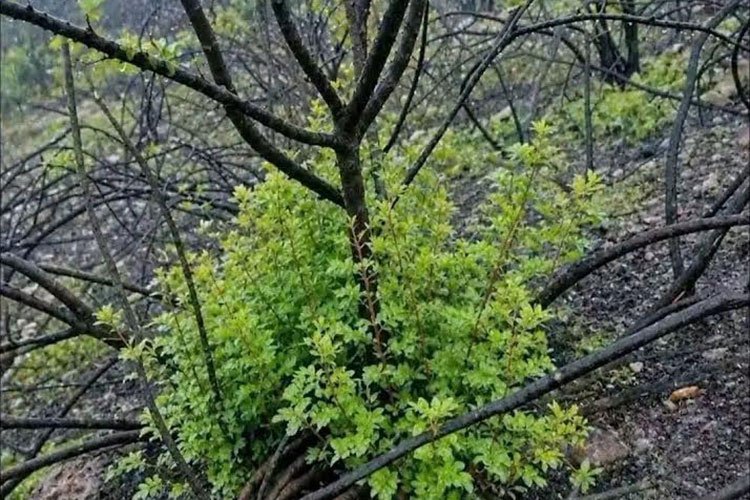
Two weeks after the fires, green shoots are making their way from under the ashes
father-in-law
The forests of Jijel, like the forests of eastern Algeria, did not succumb to the black color left by the fires, and the ash was not the end of the story. Rather, it seemed to have become a new beginning for a forest that knows how to resist and recover. Only 20 days after the outbreak of fire, life began to gradually return to the areas that yesterday seemed as if they had lost all elements of life. The state of the forests now, in many areas of Jijel, shows remarkable scenes, as the blackness that covered the soil and trunks has transformed. The trees opened into spaces where buds and small green plants crept in, some emerging from the ashes, and others appearing at the bases of trees that had survived the flames.
The most exciting scene is the appearance of new green colors along the charred trunks of trees, in an image that sums up nature’s ability to renew. Even trees that appeared burned from the outside, new buds appeared at their bases trying to make their way toward the light, and in other places, small plants began to regain their presence on soil that still bears traces of the fire, as if the forest was sending a clear message: black is not its final color. This rapid return of vegetation highlights one of the most prominent manifestations of the ability of Mediterranean forest systems to renew, especially among some. Plant species that have buds or living parts below the soil surface can regrow after the top part is exposed to fire.
While the fires left behind painful scenes of charred trees and black earth, nature on the other side began a silent battle without a sound. The battle to restore green. Small buds, young leaves, and new branches are forming day after day, waiting for them to grow and for the forest to regain some of its image that the region’s residents and visitors knew. But this natural renewal does not mean that the forest has returned to its previous state, as the environmental effects of fires may extend for months, depending on the severity of the fire, the type of vegetation and soil cover, and the extent of the damage to the trees.
Only 20 days… and the message is stronger than ashes
The scenes of the forests, which the Jigliese woke up to, with the cohesion of the people, and the role of the state itself with its people, through compensation, and material and moral support, all scenes that documented the difference between the black scene left by the fire, and the green shoots that appeared after only 20 days, carrying an influential human and environmental aspect, as the forest that burned takes years to regain its complete structure, but at the same time it does not wait for humans to begin the journey of recovery, it begins on its own, from roots that remained alive, And from the seeds that survived, and from the buds that were hidden under the ground, and here lies the beautiful irony, as fire may burn trees in hours, but it cannot always kill the spirit of the forest, and today among the black trunks and burnt soil, the color green emerges again, in a scene that raises hope that Jijel will regain its forests, and that what appears to the eye as a tragic end may be, in part, a long beginning for a new birth, with the slogan of Jijel forests that do not surrender to the ashes… they are racing against time to breathe again.