In 1999, when he was still in school, Rodolfo Espinoza Ríos wrote on a typewriter in the dining room of his grandparents’ house. Between a natural sciences assignment and a biology assignment, I would reserve a few pages for a story that would end up taking up nearly 200 pages. I didn’t know then that that first script would be the inspiration for “Santidad”, his first feature film, more than two decades later.
The seed of the story had come from her grandmother, a rural teacher and fan of telling stories from Cusco. Among their stories was the legend of a high representative of the Church who visited a town and refused to stay in the house of a rich family, about which a rumor circulated that its members were excommunicated.
“When I moved to Paris for my graduate studies in film, the story of my adolescence came back to me, and I filmed it in a first short film,” says Espinoza Ríos in an interview with El Comercio.
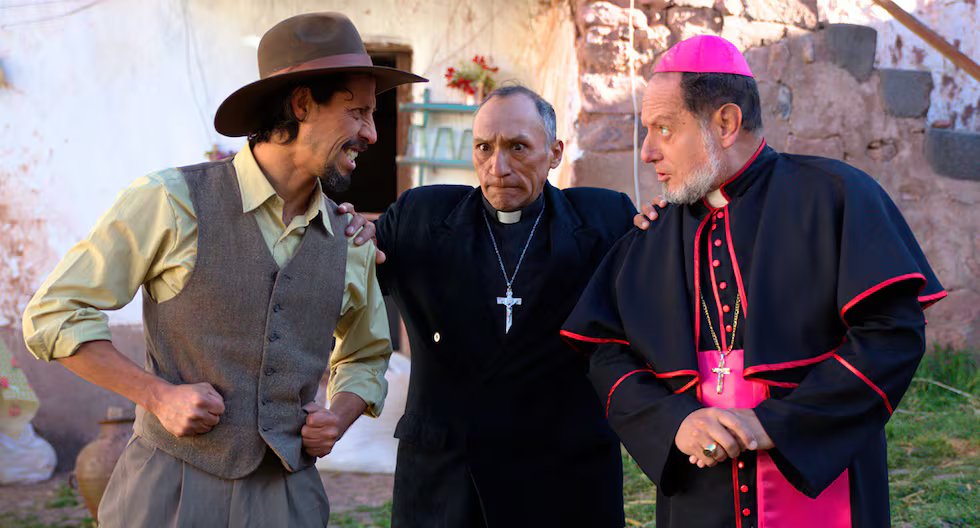
“Santidad” takes place in Sarapampa, a fictional town in any part of Peru, which is preparing for the festival of the Virgin of Maíz. There, Archbishop Pedro Boluarte (played by Pedro Olórtegui) arrives to crown the image. His refusal to stay with a powerful local family and his treatment of the villagers trigger a conflict that calls into question his authority. Highlights in the cast include Beto Benitez as the priest Fermín Pinares, and Lilian Nieto as the matriarch of the excommunicated family.
The cast also brings together actors from Cusco, starting with the 21-year-old performer, Victor Acurio, remembered for “Willaq Pirqa”, who takes on the performance in the company of Hugo Bonet, Pedro Ramos, Marina Pumachapi, among others. Additionally, the film incorporates the Ñawpa Ñan Cultural Community as the town band.
The preview of “Santidad” took place in Cusco on September 16, but its official premiere is scheduled for Thursday, September 24 in theaters.

“Santidad”, a Peruvian film, is directed by Rodolfo Espinoza Ríos. (Photo: Diffusion)
“Holiness” arrives in theaters during the wait, exciting for many Peruvians, for the visit of Pope Leo XIV to Lima, Chiclayo, Cusco and Pucallpa from November 11 to 17. But one thing is not related to the other. “I could not find a meeting point (with the archbishop), because Pope Prevost does not approach this character anywhere”says the filmmaker.
In a comedic tone, to the rhythm of the storyteller and with expressions in Quechua, the film builds its charm. In the center, the archbishop reveals his contradictions, such as a marked attention to feminine beauty and uncompassionate language, traits that call into question the solemnity of his investiture for the people. “The objective was to criticize power using characters that are very characteristic of Andean narratives. (…) This character would have calmly fallen on a mayor, a soldier or a landowner”says the director.
The story, without a doubt, contrasts with a country where Catholicism still represents 67% of adults, according to a survey by Pew Research Center carried out in 2024. “In Peru, I think we are Catholics, but not necessarily believers. We are cultural Catholics”says the director. He confesses to be more a Cusco native than a believer. “But, if I am in Cusco during Holy Week, I don’t miss the procession of the Lord of the Tremors”he maintains in part of the interview.

“Santidad”, a Peruvian film, is directed by Rodolfo Espinoza Ríos. (Photo: Diffusion)
For this reason, the visit of Leo XIV and the premiere of the film months after his arrival serve as a topic of conversation. “(The Pope’s visit) is a religious and important phenomenon for the country, with political, social, economic and religious connotations. I think there is too much to analyze and I have not yet delved into that analysis. Yes, it is quite important, because our country is religious, it has always been linked to the history of the Vatican and has already received the visit of two Popes before,” he adds.
Leo XIV, born in the United States and with a pastoral career of almost four decades in Peru, where he carried out much of his religious work in Chiclayo, will be the third Pontiff to visit the country and the first to return as Pope. In “Holiness”, the figure of a Supreme Pontiff does not appear as such. There is only one reference in a dream or a nightmare. The story focuses on the archbishop’s visit and a community that has its own ways of understanding the sacred. Who knows, that synopsis could awaken the attention of the Peruvian public at this time.