The Coprínceps have been, historically and modernly, the foundations on which the Andorran State, today known as the Principality of Andorra, has been built, which has a political regime known as the parliamentary Coprincipate.
They have performed this function since the Pariatges of 1278-1288, supporting the entire Andorran institutional structure, traditional and contemporary.
And these foundations have been consolidated century after century, and for nearly 750 years, with the asymmetrical but undivided action of the two Princes.
A fact that is confirmed even with the Constitution of 1993, the last consolidation of 33 years ago, in which the Crown Princes “are, jointly and undivided, the Head of State, and assume its highest representation. (…) they are a symbol and guarantee of the permanence and continuity of Andorra, as well as of its independence and the maintenance of the spirit of parity in the traditional relations of balance with the neighboring States. (…) they arbitrate and moderate the functioning of the public authorities and institutions”.
For a taste, see the outstanding role of the six bishops of Urgell
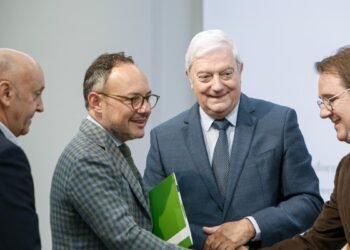
The book The Principality of Andorra and the bishops of Urgell in the 19th century by Nemesi Marquès i Oste presented at the Palau Episcopal by Copríncep Serrano, Minister Bonell, President Mach and the author last September 29 has been published by the Andorran Society of Sciences and Anem Editors, with the decisive and strategic sponsorship of the Ministry of Culture, Youth and Sports.
Starting the collection Knowledge of the Academic Section of the SAC, the book gives us an illustration, starting from the episcopate of the 6 bishops of Urgell who held office between 1797 and 1901.
The Andorran history of the 19th century, despite its proximity, is still very unknown, probably due to the complexity and the changes that occurred with the transition from a society of old regimes to one with new regimes. And for the upheavals he had to live with, in the south, the three Carline wars and all the ideology that was linked to them and in the north, Napoleonic and post-Napoleonic Europe, among others.
Nothing is given for free and you have to earn it
Even Andorra, with the New Reform of 1866, takes a leap forward, leaves Old Andorra behind and begins a transition towards the current New Andorra that will last until 1993 with the Constitution.
The change will also be radical in the economic sphere, as it goes from being a closed, structured, regulated, civilly religious, rigid both rural and urban, artisanal and pre-industrial society to an open, industrial society, where capitalism will gradually be implemented.
As a taste, see the outstanding role of the six bishops of Urgell, amid the ups and downs suffered by the two neighboring giants, France and Spain.
Thus FA de la Dueña i Cisneros (1797-1817) had to combine years of institutional rupture with France but also the years of restitution with Napoleon I with his planned administrative inclusion of Andorra in Catalonia, the elimination of the feudal lordships by the Courts of Cadiz in 1812 and the recognition of Andorra and its privileges by King Ferdinand VII in 1817.
B. Francés i Caballero (1817-1825) defended the sovereignty of Andorra against the motions in the liberal Courts of Spain and lived the Regency of Urgell with the confrontations between royalists helped by France and liberals, ensuring the country’s neutrality and independence in the face of military incursions from the two neighboring states.
B. López y Pulido (1825-1827), despite the short episcopate, made a decree on the entry and stay of liberal Spanish refugees and criminals invoking the inviolability and security of Andorra to guarantee public order.
S. de Guardiola i Hortoneda (1827-1851) lived through the first Carline war of 1833 and, despite his 12 years of exile (1835-1847), he did not stop exercising his dual authority. The pugs were more empathetic towards Andorra. He let in Spanish troops to pursue and imprison malefactors considered liberal squires with the help of French force if necessary. The Spanish Government introduced commissioners and took direct actions considered critical for Andorra’s neutrality and independence that were protested by France during the bishop’s exile. He lived through the beginning of the problem of the abolition of tithes by the General Council and the attempt to establish a gambling house in Solana with the agreement of the Communes of Encamp and Canillo, but not of the General Council or of the Coprínceps or Spain.
J. Caixal i Estradé (1853-1879) was involved in the Carlin movement in a full way which meant exile in the last years of his life. Andorra approved the New Reform proposal on April 22, 1866 with immediate effect and a great and positive impact. And that the French Co-Prince would confirm two years later. He inhibited the topic of tithes. And he lived through the problems of the 1866 concession of the use of all his own waters with the establishment of casinos understood as theaters and cafes and not gambling houses, which generated an institutional conflict and various internal disorders that led to the dismissal of the General Council and the prosecution of the issue with a sentence of the Court of Courts. He promoted the foundation of the Sisters of the Sagrada Família in 1859 by Mother Janer, who would settle in Andorra offering education and health care. And in 1860 he began the work of building the Seminary, which had an important impact on the offer of higher education in its surroundings, including Andorra, and which was completed by his successor.
S. of H. Casañas i Pagès (1880-1901) did a task of approximation and joint action with the services of the French Coprincipe; he had to resist Spanish-French pressure for the extinction of the Andorran lordship, as well as from France to achieve exclusive sovereignty in front of the Vatican; he had doubts about his continuity as Coprincipe considering his resignation in favor of the Spanish Government, but both Pope Leo XIII and the Queen Regent of Spain advised him that the secular regime of Andorra was the best to safeguard the rights of the Church and the common good of the Principality.
Nemesi Marquès offers us a synthetic but deep enough analysis of the action of the Episcopal Coprincipes of the 19th century that makes it committed, responsible and comparable. And that it is similar to the history of the Co-Principate that happened before and later until today at least in the will to survive of the institution, partially interrupted only a few years with the French Revolution.
Despite all the vicissitudes experienced, the continuity of the Coprincipate adapted to each historical moment has been the basis on which the Andorran institutional building is founded.
A base that needs to be preserved, maintained and strengthened and for which each generation of Andorrans is responsible.
Anton Fiter i Rossell already remembered it in 1748 directly in maxima 18, 48 and 52 and indirectly in 36, 37, 38, 39, 41, 45 and 47.
Nothing is given for free and in addition to not losing it, it is necessary to earn it and secure it.