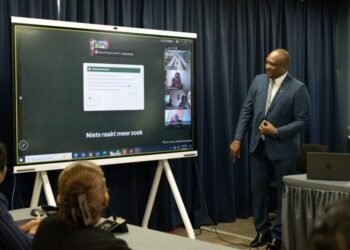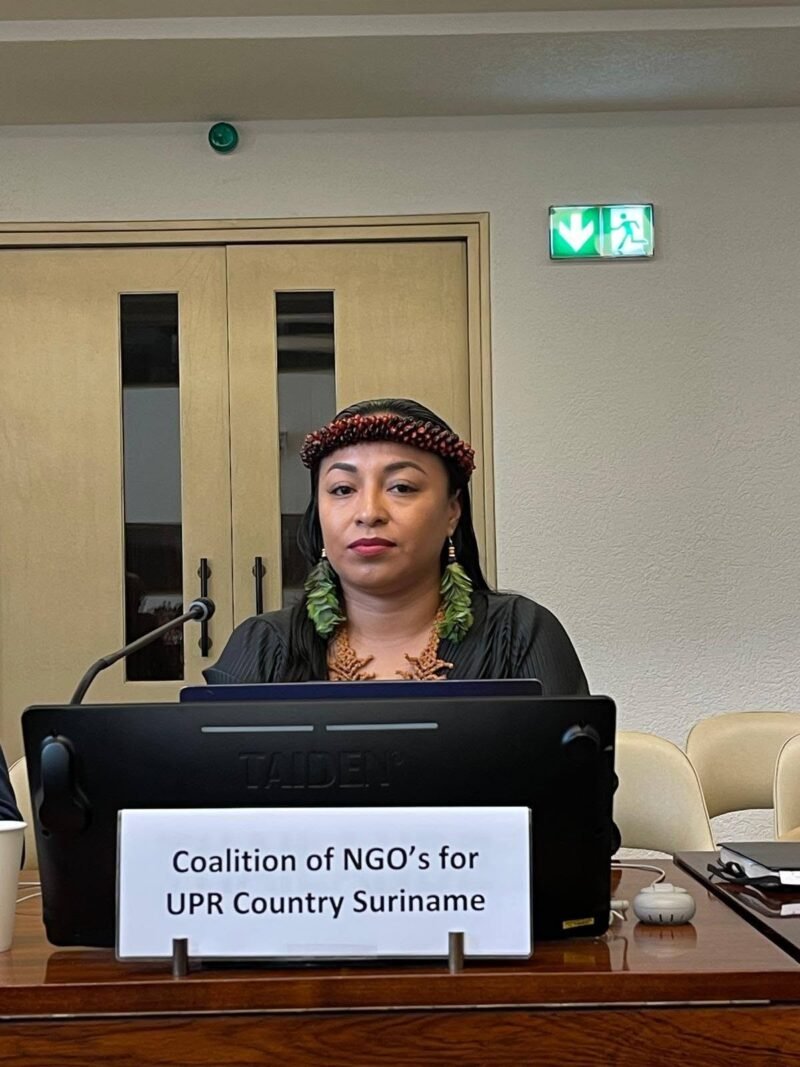
“The realization that you are not only talking for yourself, but also for the next generation. Something that will always stay with me is the moment when I stood in front of the audience to talk like a Ikihiea child of the Kaliña– and Lokonopeoples. I ‘felt’ not only my own voice, but also that of my ancestors, my community and the generations to come.” This is how Sharmaine Artist, chairman of the Khose organization, looks in conversation with the True Time recalls her participation in the pre-session of the 53rd United Nations Universal Periodic Review at the end of August in Geneva. She was selected by a coalition of six collaborating social organizations in Suriname.
Text Kevin Headley
Image private collection
The pre-session was a preparatory meeting for assessing the human rights policies of various countries. The Khose chairman calls the meeting in Geneva both impressive and intensive. “The welcome was warm. We were at the United Nations, a place where history is being written. I was therefore happy that I could make my voice heard. The audience listened attentively and, above all, I felt encouraged that the world was listening to me.”
“We still have a long way to go, but at least another step has been taken towards the goal we want to achieve: ‘recognition of the rights of indigenous peoples’”
Her intention was to make the voices of indigenous peoples heard on one of the highest international stages. She sat among diplomats from various countries worldwide to talk about the reality of the indigenous people in Suriname.
It was also important for her to tell the world about the contradictions that indigenous people experience every day. On the one hand they protect the forest, but on the other hand their rights are still not recognized.
Artist finds it poignant that Suriname is still the only country in the Western Hemisphere that does not recognize its indigenous peoples. “It is not an administrative error or mistake. It is a choice. That choice has consequences for the people, the forest and the future of the country.”
Important themes for Suriname
Artist says that he has asked special attention from the participants for two important themes. First, recognition of the Kaliña and Lokono judgment, om Free, Prior and Informed Consent binding, but also to ratify the Escazu agreement. This agreement is the first international environmental treaty for Latin America and the Caribbean that establishes citizens’ rights to environmental information, participation and legal protection.
Her second theme was to approach human rights in conjunction with the rights of nature. This also concerns the rights of future generations and the recognition of indigenous peoples as protectors of nature.
By the way, Artist was not the only speaker from Suriname. Milton Castelen, representative of Suriname Men United, spoke about the LGBTIQ+ situation in the country and the developments surrounding discrimination and violence against this group. Andrea Meraz was also present as a representative of the Surinamese Citizens’ Initiative for Participation and Good Governance.
The three representative delegations of Suriname had to jointly present a stakeholder report: ‘The Future of Our Forefathers, a Legal Roadmap to the Recognition of Indigenous Rights and the Rights of Nature in Suriname’. “The presentation was well received. Support was expressed for the points I made,” says Artist.
(Read more below the photo)

Step towards the goal
The Khose chairman says she also spoke with Aashna Kanhai, the Surinamese ambassador in Geneva, about the concerns and recommendations of the indigenous communities. Views were exchanged with other participants about the struggle they are waging for human rights, the environment and equality.
“The Surinamese ambassador has indicated that the government has committed itself to guaranteeing indigenous rights. That is an important statement, but for us words are not actions. The goal will only be fully achieved when the recommendations are actually implemented. We still have a long way to go, but at least another step has been taken towards the goal we want to achieve: recognition of the rights of indigenous peoples.”
Artist explains that it should become clear in the coming weeks how the three representations of Suriname during the pre-session can play a role in the follow-up process. “We continue to put pressure on the government and on the international community to hold Suriname to its promise. What strikes me most is that we are not alone. Many countries face the same challenges: governments that make promises but do not keep them, communities that protect their habitats, including the forest, but are not supported by the government and activists who take risks for their cause. I have seen how others organize their struggle, how they lobby diplomats and use international mechanisms.”
Blueprint for sustainability
The indigenous worldview, in which people, forests, rivers and animals are connected, is a blueprint for sustainability, according to Artist. “Protecting our nature and human rights is a shared responsibility. We, as indigenous people, are not against development, but we ask: ‘development for whom, decided by whom and at whose expense?’”
During the 53rd session of the UPR Working Group (2-13 November), the human rights performance of several UN member states will be officially assessed and discussed. Suriname will have its turn on the first day and will have to respond to the points raised during the preparation process in Geneva.