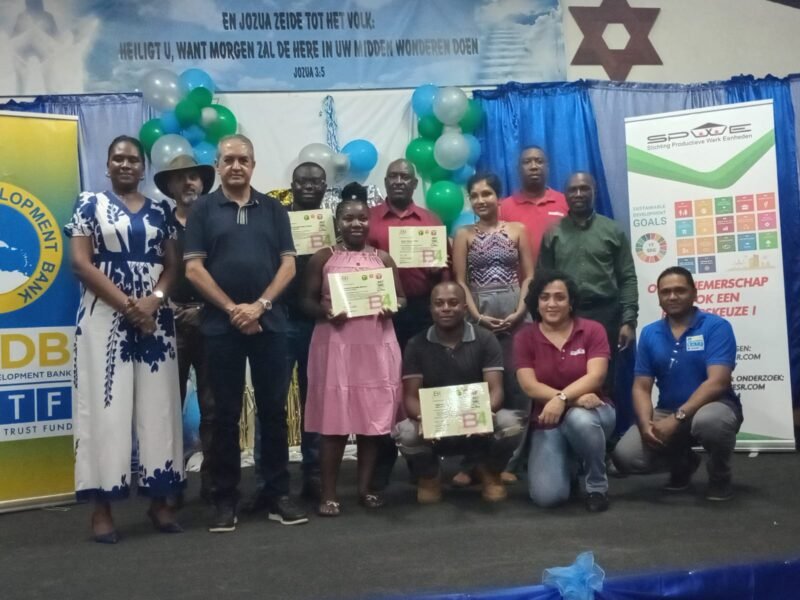
PARAMARIBO – The Engedi Foundation took an important step in the development of its agricultural business on Friday. During a festive meeting, four participants received their certificates for successfully completing the Hybrid Hydroponics training, a crucial part of the project “Development and Initial Implementation Support of a Business Plan for Engedi’s Agricultural Business Foundation”.
The project officially started on December 8 last year with a kick-off meeting and is implemented by the Productive Work Units Foundation (SPWE), led by project coordinator Simone Haridat. The implementation takes place with the support of B4 Concepts Management & Advies NV on behalf of the Engedi Foundation and is financed through the Basic Needs Trust Fund (BNTF)-10 program of the Caribbean Development Bank.
The aim of the project is to set up a financially and operationally sustainable agricultural enterprise based on hybrid hydroponics systems, intended for the cultivation of fast-growing crops. In this way, the Engedi Foundation not only wants to create new, sustainable sources of income, but also strengthen the self-reliance and internal capacity of the organization.
The process rests on three pillars: the development of a business plan, the implementation of a technical training in Hybrid Hydroponics and the set-up of a Monitoring, Evaluation and Learning (MEL) system. For the technical training, SPWE collaborated with B4 Concepts Consultancy, which specializes in hydroponic agricultural systems.
The training lasted eight days and consisted of a combination of online and physical sessions. In addition to the director of the Engedi Foundation, four residents of the foundation participated. The program covered both theory and practice, with topics such as system construction, propagation, cultivation techniques, cutlery and assembly, fertilization, water management, crop protection and maintenance of hydroponics installations.
The choice for a small group of four participants was deliberate: according to the trainer, this scale ensures more effective knowledge transfer and more room for intensive practical guidance. The trained participants will also pass on their knowledge to other employees and residents of the foundation in the future, which benefits both the continuity of the system and broader capacity building within the Engedi Foundation.
The training program is officially concluded with the certificate presentation, but the milestone also heralds a new phase. The coming period will focus on the further implementation of the business plan and the practical expansion of the agricultural company.
With this initiative, the Engedi Foundation, the Productive Work Units Foundation and their partners are taking an important step towards sustainable agricultural development, economic self-reliance and strengthening the community.