Text and image Edwien Bodjie
PARAMARIBO — To strengthen the declining care capacity, the Basic Acute Care Training (BAZ) has been officially launched. The shortened further training program for 175 nurses lasts one year and should contribute to better care and the sustainable strengthening of the expertise of nursing staff in the field of acute and specialized care.
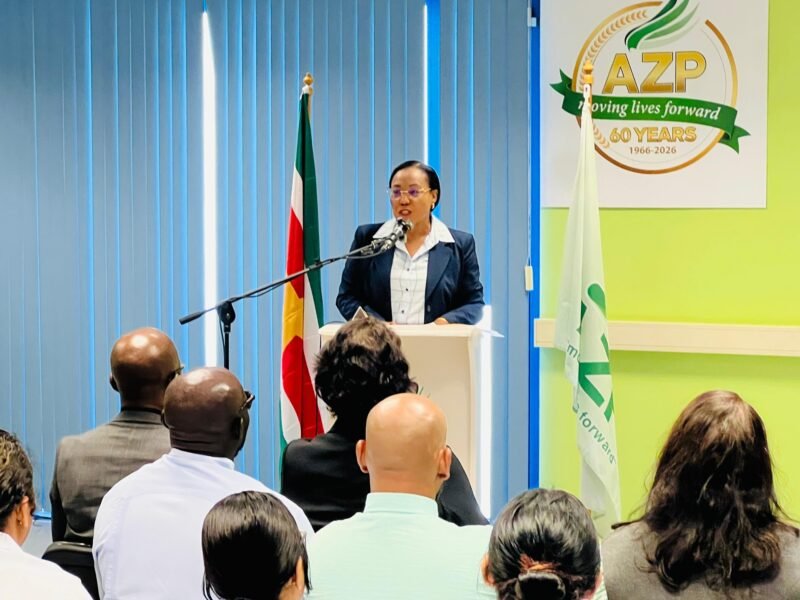
“The recovery of the Paramaribo University Hospital is not just about buildings and systems. A patient must be able to trust that the lighting works, a good bed is available, equipment functions and that there is no shortage of medicines. But without well-trained nurses, we cannot provide care with modern equipment,” director Claudia Marica-Redan said during the launch on Monday.
“Without well-trained nurses, we cannot provide care with modern equipment“
AZP director Claudia Marica-Redan
Her hospital has a shortage of 130 specialized nurses and more than eighty basic nurses. Since 2021, 567 nurses, including many experienced workers, have left. The AZP has fallen from 1,061 employees in 2021 to 921. By the way, the decrease also concerns retirees.
The director therefore called the investment an important step in the recovery of the hospital. She repeated what has been said so often: the departure of nurses has major consequences for services.
Between 2023 and now, 81 specialist nurses and 22 healthcare managers have left. These two groups include employees with more than ten years of work experience. “When an experienced ICU nurse leaves, we not only lose someone who can work a shift. We also lose knowledge, experience and someone who colleagues can rely on,” explains Marica-Redan.
The staff shortage puts pressure on operating capacity and the availability of care. Departments have had to close their doors and patients sometimes have to wait months for an operation.
Train and retain
The BAZ training is part of the Health Facilities Readiness Initiative, with which the government wants to improve the quality of care and hospital capacity. It is the first time that the government has financed a training course of this magnitude within the AZP, the director said.
She expressed her appreciation for President Jennifer Geerlings-Simons, who released the money for the training and emphasized that training must go hand in hand with investments in safe working conditions, appropriate remuneration, equipment and infrastructure. The government is investing six hundred thousand euros in the project.
The BAZ is provided by the Expert College-Nightingale Institute, a Dutch training institute that specializes in education and training for healthcare professionals in acute care. The nurses learn, among other things, how to resuscitate, recognize in time when a patient is deteriorating and how to act appropriately. The online learning platform ‘Kweki’ has been developed for the process.
The hospital has also attracted nurses from the Philippines in recent years to make up for the shortages. However, according to the director, Suriname must ensure that it trains and retains sufficient specialized nurses. She called on the participants to take advantage of this opportunity, despite the high workload and obligations at home. Marica-Redan also addressed the discussion about binding agreements. The hospital wants what the participants learn to benefit healthcare provision.
Appreciation and employment conditions
Silvana Afonsoewa, chair of the parliamentary standing committee on Health, Welfare and Labour, also pointed out the need to invest in healthcare personnel. According to her, a well-maintained hospital building is not sufficient to guarantee quality care. “Investing in nurses is investing in our country’s healthcare.”
Afonsoewa praised the participants for choosing further education in addition to their busy work. At the same time, she acknowledged that workload, staffing and working conditions remain major challenges.
The parliamentarian encouraged the participants in the training to support each other and share knowledge. According to her, combining work, study and private obligations requires a lot of perseverance.
Afonsoewa, who has been a nurse herself, said her committee will continue to closely monitor the government as it introduces new salary ranges for nurses. She also argued for better opportunities to have Surinamese nursing diplomas internationally recognized.
The politician recalled that Suriname does not have a professional register for nurses, as exists in other countries. The international recognition of diplomas also requires further attention, so that nurses who want to develop abroad have clarity about their level of education and professional qualifications.
Afonsoewa emphasized that much still needs to be done to better appreciate and support nurses. According to her, this is not only about salary, but also about the conditions under which they perform their work. “You are the backbone of our healthcare,” the parliamentarian said.