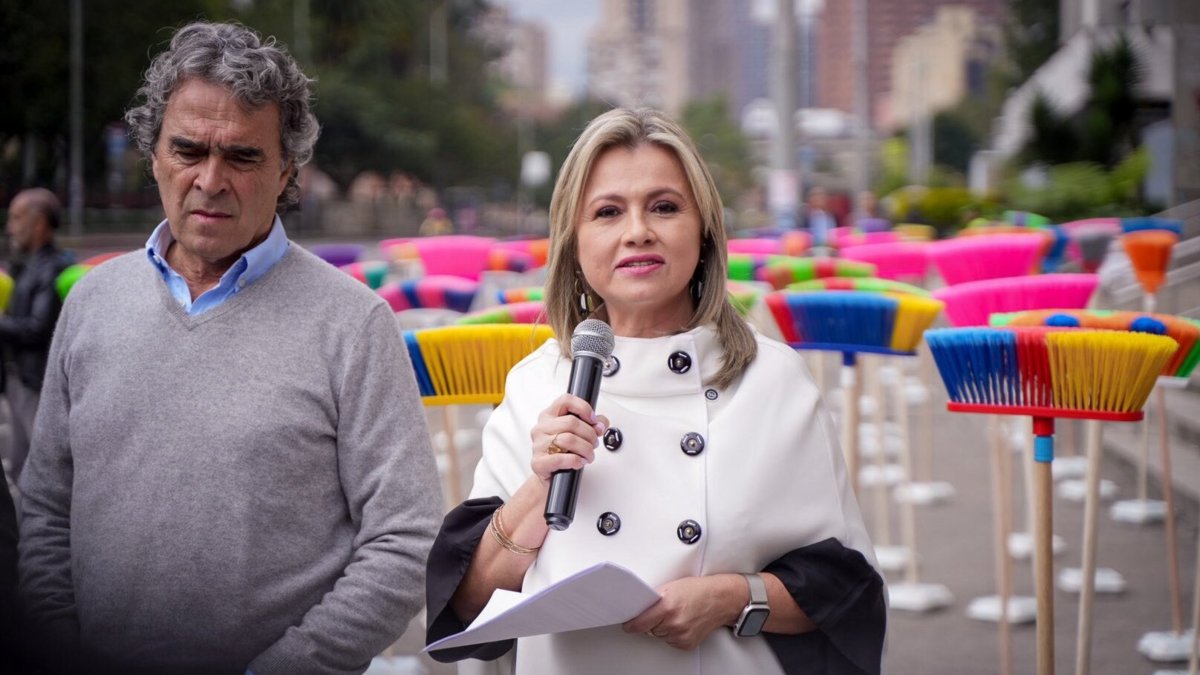
Since President Gustavo Petro launched the idea of convening a national constituent assembly in Cali in April 2024, different sectors have come out to reject it, warning of possible risks to democracy. However, Until now, no specific legal mechanism had been activated to stop it.. That step was taken by Sergio Fajardo’s campaign last week, when the “Referendum for institutional stability 2026-2030” committee was filed with the Registry Office.
The promoting committee is led by Edna Bonilla, former Secretary of Education of Bogotá and current vice-presidential candidate of the former governor of Antioquia. Your goal, once you get the green light from the Registryis to collect 3 million signatures to call a referendum to the polls – which must have the approval of Congress and the Constitutional Court – in which citizens decide on the approval of a legislative act that would add a transitional article to the 1991 Constitution. The initiative seeks to establish a period of constitutional stability that prevents the convocation of a constituent assembly until August 2034.
To understand how they hope to carry out this referendum, EL TIEMPO consulted Bonilla about what is behind this initiative, which raises a fundamental pulse with sectors of the left.
Why do you consider it necessary to protect the current Political Charter?
Edna Bonilla is Sergio Fajardo’s vice-presidential formula. Photo:Social networks.
The 1991 Constitution is the largest agreement that Colombia has made with itself. It was born from students, from communities, from different people who sat down to build together. It recognized human dignity, fundamental rights, separation of powers and diversity. The 1991 Constitution is the most important agreement we have built as a nation: it recognized rights that did not exist before, created independent institutions with serious controls on power. It is not perfect, but it is legitimate as a great national agreement. Changing it without a broad consensus, in the midst of polarization and institutional distrust, is not reforming Colombia for all Colombians.
How will the initiative be financed?
The signature collection campaign will be financed through support collection campaigns with full transparency and in strict compliance with current regulations: the spending and individual contribution limits set by the National Electoral Council, and the accountability duties established in Law 1757 of 2015. There is nothing more to say about it.
Do you see it viable to stop the Petrism constituent assembly before it advances in its process? What specific scenarios do you contemplate?
Yes. If we manage to incorporate the transitional article into the Constitution through this referendum, before the project that is in progress is discussed in Congress, no government would be able to convene a constituent assembly until 2034 and any attempt would be unconstitutional and susceptible to immediate judicial control. That is the scenario we are looking for. But even along the way, the collection of millions of signatures in itself sends the country and the Government a clear signal: there is a citizen majority that defends the current Constitution. It is democracy working as it should. Not a decree.
Registration Committee of the Constituent Assembly. Photo:@PetroGustavo
How do you plan to collect the nearly 3 million signatures? Will there be a territorial strategy, alliances or only street collection?
The strategy is territorial, digital and interparty. It cannot depend on a single movement or campaign.
We are going to convene mayors, governors, social organizations, unions, universities and citizens from all regions who share the conviction that the Constitution deserves to be defended. Whoever wants to protect the Constitution has a place in this cause, regardless of their party or candidate. In addition to collecting signatures, the strategy includes activating leaders in key cities, alliances with universities, think tanks and chambers of commerce.
Several sectors have criticized the constituent assembly, but you are the first to activate a specific mechanism. Does this also seek to measure the electoral strength of Fajardo’s campaign?
No. If we wanted to measure electoral strength, we would do a survey. A referendum requires months of work, more than two million valid signatures, processing in Congress and review by the Constitutional Court. This referendum, more than a campaign event, is a citizen cause that transcends any election. We activate it because we believe that the Constitution deserves a concrete defense, not just statements. That others have criticized the constituent assembly with words and we have acted with a legal mechanism says everything about the difference between speech and commitment.
The committee proposes shielding the Constitution until 2034. Why that deadline and what would happen after?
We do not change it, we do not replace it. We defend it.
We ask the people to sign to say: the Constitution of ’91 is not touched. Not forever. For eight years. Long enough for no government, of any color, to replace it with an assembly tailored to its needs. The term corresponds exactly to two full presidential terms, enough for No government derived from the current polarization can use the constituent assembly as a political tool.. After 2034, all reform mechanisms remain fully in force, including the possibility of a constituent assembly. The difference is that by then, we would expect that any proposal for profound constitutional change would have to be built with genuine consensus, not from the pressure of power.
What would be the main risks of a constituent assembly without broad consensus?
President Gustavo Petro Photo:Presidency
The main risk is that the caller defines the rules before the game begins. A constituent without consensus in a polarized country does not produce a bill of rights: it produces the constitution of the government in power. The recent Latin American experience confirms this. And when constitutional rules fall, the first to lose are not the powerful, but the most vulnerable, those who depend on the State for education, health care, and access to justice.
Beyond opposing the Constitution, what specific changes do you consider necessary in the current Constitution?
Colombia needs profound reforms, but through the ordinary channels and democratic forms that the Constitution itself establishes: Congress, legislative acts, the referendum. In matters of justice, access to land, real decentralization and health financing, there is a pending legislative agenda that does not require overturning the Charter, but requires political will and the ability to reach consensus, without radicalization. The Constitution is not the problem: the problem is that we have not complied for decades
Iván Cepeda speaks little about the Constituent Assembly, and does not completely distance himself, while signatures continue to be collected in progressive sectors. Do you think that, if Cepeda comes to power, he will end up promoting it?
Iván Cepeda declares that he defends the 1991 Constitution but does not rule out reforming it. He has not unequivocally rejected the constituent assembly promoted by Petro, which places him as the candidate with the greatest constitutional ambiguity. What matters is not what candidates say in the campaign but what they do when they govern. The Petro Government also did not announce in 2022 that it was going to govern by decree, to pressure the Bank of the Republic or to challenge the rulings of the Court. He even signed in marble that he would not call a constituent assembly. Campaign ambiguities are resolved in the exercise of power. That is why this referendum is not designed against any specific candidate: it is designed so that the Constitution resists any government that wants to bypass it.
JUAN PABLO PENAGOS RAMÍREZ
Political Writing