State backing, talent scale and integrated supply chains drive China’s lead
China has emerged as the world’s leading force in humanoid robotics, while Korea, the US and other rivals race to catch up in what is quickly becoming the next frontier of advanced manufacturing.
Behind the country’s dominance lies years of coordinated policy support, academia-driven research and tightly integrated industrial ecosystems — a playbook that mirrors its rise in electric vehicles.
“China’s progress is not driven by a single factor,” said Li-Wei Zhang, a professor of mechanical engineering and automation at Fuzhou University, who has worked closely with local robotics firms.

In a written interview with The Korea Herald, Zhang highlights three pillars behind China’s lead: sustained government backing, a deep talent pipeline and a fully integrated value chain.
China’s policy advantage began well before Korea stepped up efforts under its 4th Intelligent Robot Basic Plan (2024-2028).
Korea’s earlier policies, since 2009, focused largely on groundwork, but China moved earlier to secure technological leadership through its Made in China 2025 initiative in 2015. This was followed by its Robot Industry Development Plan (2016-2020) and, more recently, the Guiding Opinions on the Innovation and Development of Humanoid Robots plan in 2023.
“Policy matters, but timing matters just as much,” Zhang said, noting that China’s early entry into the EV sector followed a similar trajectory.
He also underscored the importance of regional industrial clusters spanning Beijing, Shanghai, Shenzhen and Hangzhou, where each hub specializes in different segments: from AI and core components to system integration.
“These clusters create a demonstration effect,” Zhang said, describing them as testbeds for both policy experimentation and rapid prototyping.
China’s scale advantage is equally pronounced in talent.
Of roughly 12 million graduates annually, more than 5 million — or 41.7 percent — are in science, technology, engineering and mathematics fields.
By comparison, Korea produces about 600,000 graduates a year, with STEM majors estimated at around 34 percent, highlighting a significant gap in both proportion and absolute numbers.
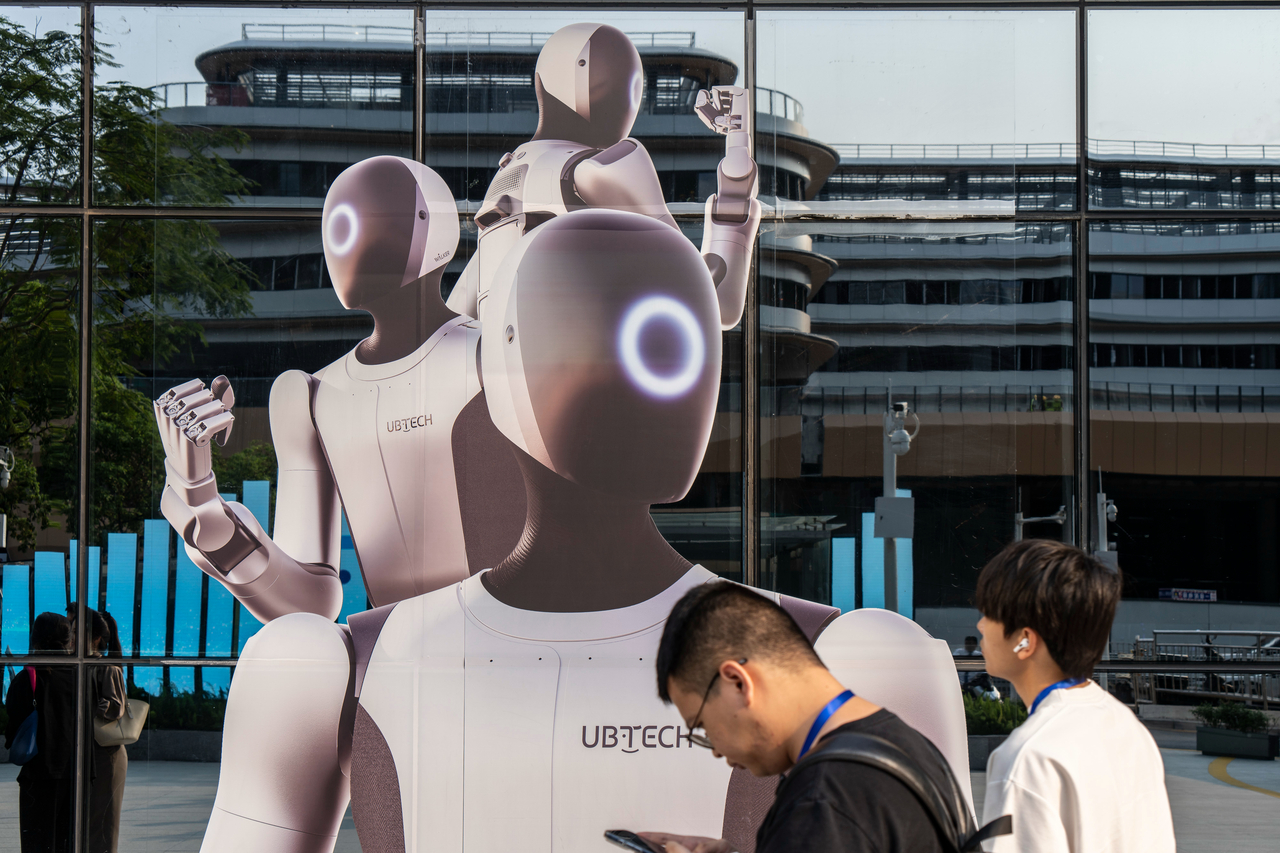
Zhang emphasized that Chinese universities work closely with robotics firms such as UBTECH and Leju Robotics, creating a feedback loop that accelerates commercialization.
“Researchers and engineers collaborate directly with companies, allowing rapid iteration from prototype to mass production,” he said.
China’s biggest structural advantage lies in its industrial ecosystem.
The country has built a complete value chain spanning raw materials, key components and finished humanoid robots. Core parts — including sensors, actuators and dexterous hands — are largely produced domestically, enabling faster development cycles.
In hubs such as Shenzhen, dense supplier networks allow companies to test and refine products quickly, significantly shortening time to market.
China’s lead is increasingly evident in market data.
As of 2025, the country is home to more than 140 humanoid robot manufacturers, accounting for 84.7 percent of global shipments, according to industry estimates cited by Zhang.
By contrast, US players remain at an early commercialization stage. Tesla’s Optimus has produced fewer than 1,000 units in pilot runs, while Figure AI shipped around 150 units last year.
Chinese firms are also expanding rapidly. More than 300 humanoid robot models had been released by the end of 2025, Zhang noted, citing government data.
Leading players are carving out distinct niches: Unitree in quadruped and humanoid robots, Agibot in dexterous systems, UBTECH in industrial applications and Leju in wheeled humanoid platforms.
Boston Dynamics in spotlight
Despite the gap, Zhang highlighted the technological strength of Boston Dynamics, Hyundai Motor Group’s US-based robotics unit.
“Boston Dynamics has led the field for two decades and remains highly competitive,” he said, pointing to its engineering capabilities and partnerships with Nvidia and Google DeepMind.
The company aims to scale production of its Atlas humanoid robot to 30,000 units annually by 2028.
However, Zhang suggested that partnership-based manufacturing models may ultimately prevail over vertically integrated approaches pursued by companies such as Hyundai, Tesla and XPeng.
He cited a recent collaboration between Leju Robotics and Dongfang Precision, which separates design and manufacturing to lower costs and improve flexibility. The two firms began operating China’s first automated humanoid robot factory in Guangdong in March, with an annual capacity of 10,000 units.
While concerns over job displacement persist, Zhang said the industry’s long-term trajectory remains positive.
“Humanoid robotics will ultimately create new types of employment, including maintenance and service roles,” he said, adding that both China and Korea stand to benefit from the sector’s expansion.
hyejin2@heraldcorp.com