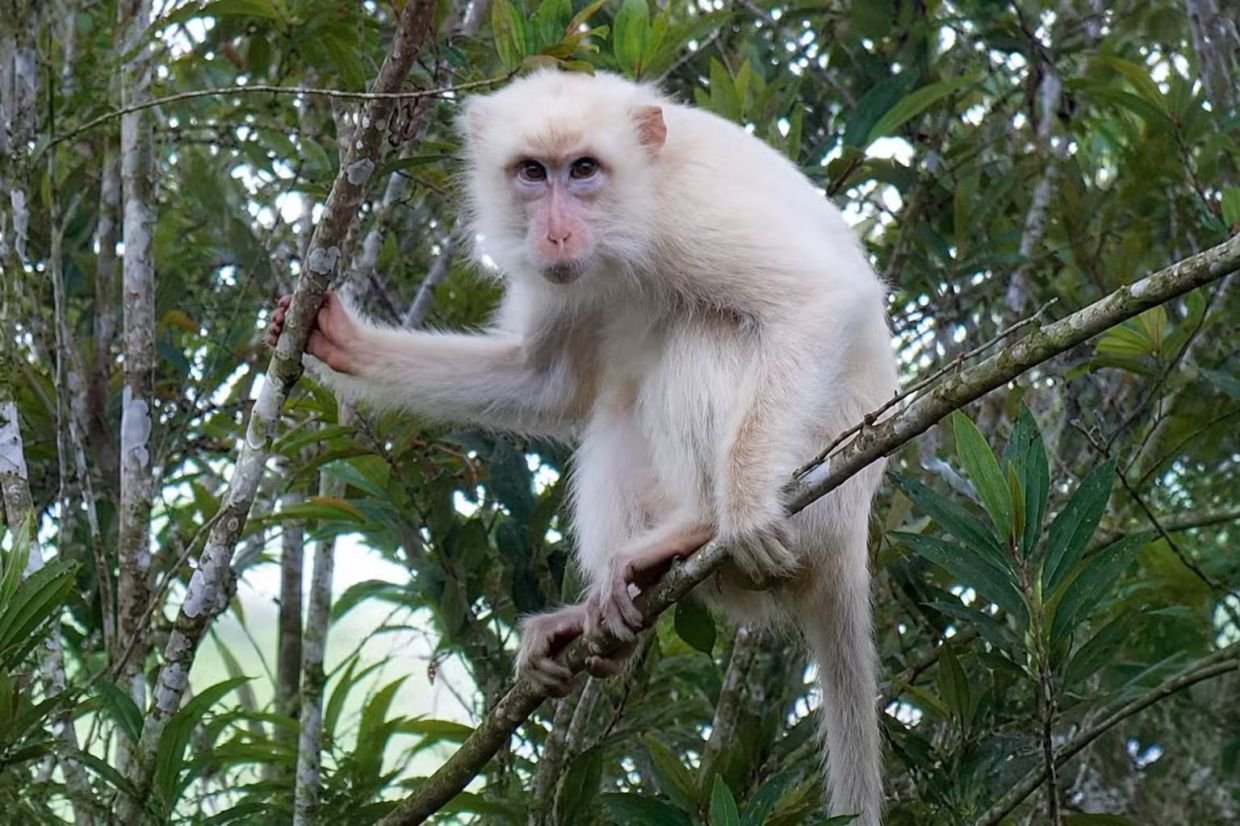
MANILA: For nearly a decade, a white monkey has been moving through a forested area in Sultan Kudarat, quietly becoming a familiar sight to residents.
Its unusual appearance set it apart from the other macaques in the area. But when videos and photographs of the animal began circulating widely on social media, curiosity quickly became a conservation concern.
The Department of Environment and Natural Resources (DENR) Region XII, together with the local government of Senator Ninoy Aquino town, has since taken steps to protect the monkey and restrict access to the area where it is often seen.
The animal is believed to be a Philippine long-tailed macaque (Macaca fascicularis philippensis) with a pigmentation anomaly.
It was initially presumed to have albinism. A field validation by a DENR XII composite monitoring team, however, found that the macaque had brown to dark brown eyes, suggesting that it may instead have leucism or another pigmentation condition.
DENR said wildlife experts must still conduct scientific verification before the condition can be definitively identified.
A local resident identified as Armando said the macaque had been regularly seen in the area since 2016 and often roamed nearby.
Its growing visibility online, however, has raised fears that the animal could be disturbed, hunted, captured or collected. DENR also warned that the attention could expose it to poaching and wildlife trafficking.
During the field validation, the monitoring team found that the macaque’s habitat remained suitable. Secondary forest vegetation and natural food sources continue to support the resident monkey population.
To minimize disturbance, the municipal government temporarily closed the area where the animal is frequently observed. The move is also intended to prevent illegal wildlife collection and other threats.
Barangay Bugso is meanwhile preparing an ordinance that would institutionalize protection for the white macaque, its habitat and the surrounding forest ecosystem.
Pending the ordinance’s enactment, unauthorised entry into the immediate vicinity of the reported sighting remains prohibited.
The barangay government also plans to conduct tree-planting and habitat-restoration activities as part of efforts to strengthen biodiversity conservation and promote responsible ecotourism.
DENR reminded the public that all wildlife is protected under Republic Act No. 9147, or the Wildlife Resources Conservation and Protection Act.
The law prohibits hunting, capturing, collecting, possessing, transporting, trading or disturbing wildlife without the required permits.
The agency also appealed to vloggers, photographers, journalists, social media users and residents not to reveal the exact location of wildlife sightings or post geotagged content that could put protected species at risk.
As part of its continuing conservation efforts, DENR XII will submit documentation on the macaque to the Biodiversity Management Bureau for technical evaluation.
It will also continue monitoring the habitat, strengthen coordination with local stakeholders and intensify information campaigns on wildlife protection.
For now, the white macaque remains in the forest where residents have seen it for years — no longer just an unusual sight, but a species under watch and protection. – Philippine Daily Inquirer/ANN