Madrid/Iran began the funeral of Ali Khamenei this Friday in Tehran with a staging designed to show internal unity, diplomatic muscle and defiance against the United States and Israel, for the elimination of the supreme leader on February 28, on the first day of the war.
The ceremony, held at the Mosala mosque in Tehran, brought together senior Iranian officials and foreign delegations around the coffin of the religious man, who directed the country’s destinies for more than 36 years. The coffin, wrapped in the Iranian flag, was presented with a black turban, a symbol of the descendants of Muhammad, and a Palestinian scarf, in a setting full of political and religious symbols.
Next to Khamenei’s coffin were those of four relatives killed in the same attack, including a three-year-old granddaughter and the wife of Mojtaba Khamenei, the deceased’s son who was named the new supreme leader on March 8, but who has not been seen in public since then.
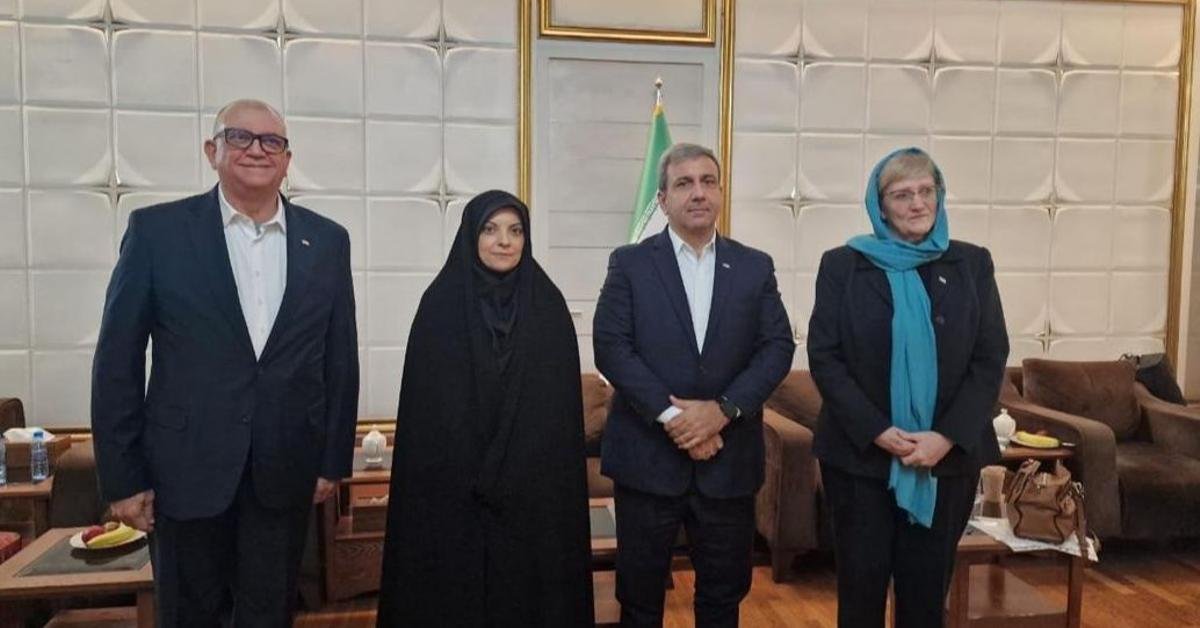
Cuba was represented by Walter Baluja García, Minister of Higher Education, and by Armando Vergara Bueno, director for North Africa and the Middle East of the Ministry of Foreign Affairs. The delegation arrived in Tehran on the night of July 2 and was received at the Imam Khomeini International Airport by Zahra Ershadi, director general for the Americas of the Iranian Ministry of Foreign Affairs. In addition to attending the funeral ceremonies, the Cuban representation had planned bilateral meetings with local officials, according to the Iranian Embassy.

/ EFE
The Cuban presence is part of the close political relationship between Havana and Tehran, two regular allies in international forums and united by their confrontation with Washington. For the Cuban regime, attending the funeral also represents a gesture of alignment with one of its main political partners outside of Latin America, at a time of growing diplomatic isolation and economic crisis on the island.
The list of foreign attendees was much broader than that initially disclosed by Iranian media. In addition to Cuba, delegations from Russia, China, Iraq, Syria, Lebanon, Afghanistan, Morocco, Qatar, Oman, Saudi Arabia, Nicaragua, Pakistan, Armenia, Tajikistan, Georgia, Turkey, India, Bangladesh, Belarus, Kyrgyzstan, Uzbekistan, Namibia, Malaysia, Myanmar, Tanzania and Thailand, among other countries, participated or were announced. The Iranian authorities spoke of the attendance of delegations from around a hundred States, although this Friday’s high-level events were led by a smaller group of leaders, prime ministers, presidents of parliaments and special envoys.
Among the attendees were the Prime Minister of Pakistan, Shehbaz Sharif; the Prime Minister of Armenia, Nikol Pashinyan; the presidents of Iraq and Tajikistan; the Turkish vice president, Cevdet Yilmaz; and former Russian president Dmitri Medvedev, current vice president of the Russian Security Council and special envoy of Vladimir Putin.
The capital remains under maximum alert, with a strong police presence, limited flights over the city and a kilometer and a half security perimeter around Mosala.
The Iranian authorities turned the farewell into a reaffirmation of loyalty to the system. President Masud Pezeshkian wept before the coffin, accompanied by the Speaker of Parliament, Mohamad Baqer Qalibaf, and the head of the Judiciary, Golamhosein Mohseni Eyei. The senior military commanders took advantage of the ceremony to renew their support for the Islamic Revolution and promise revenge.
The commander-in-chief of the Army, Amir Hatami, stated that Iran “will avenge the blood of the martyred leader,” while Ahmad Vahidi, commander-in-chief of the Revolutionary Guard, who had not been seen since February, reappeared in public. His presence was interpreted as a message of continuity of the military apparatus after the blows suffered during the war.
Tehran woke up armored. The capital remains under maximum alert, with a strong police presence, limited flights over the city and a kilometer and a half security perimeter around Mosala. The device seeks to avoid attacks or protests at funerals that the regime considers decisive to project control after months of war and internal turmoil.
When Khamenei’s death was announced in February, celebrations were heard from windows in several areas of Tehran shouting “Khamenei is dead.”
The events will last six days and will visit five cities in Iran and Iraq. After the initial tribute this Friday, a wake will be held in Mosala on Saturday and Sunday. On Monday, the funeral procession will pass through Tehran; on Tuesday he will be transferred to Qom; On Wednesday it will pass through the Iraqi cities of Najaf and Kerbala, sacred to the Shiites; and on Thursday Khamenei will be buried in Mashad, in the mausoleum of Imam Reza.
The authorities expect massive attendance and have even predicted up to 20 million people in Tehran alone. If that figure is met, the funeral would surpass that of Ruholá Khomeini, founder of the Islamic Republic, which was attended by some 10 million people in 1989 and which until now was considered the largest funeral event in the history of the country.
The official motto of the ceremonies, “we must rise,” appears on posters installed throughout the capital. The slogan summarizes the message that the regime wants to convey: resistance, continuity and defiance in the face of its foreign enemies.
However, the mobilization also attempts to cover the internal cracks in the Islamic Republic. Many Iranians reject the clerical system, demand freedoms and do not forget the repression of the January protests, which left more than 7,000 dead according to opposition organizations abroad. When Khamenei’s death was announced in February, celebrations were heard from windows in several areas of Tehran, shouting “Khamenei is dead.”