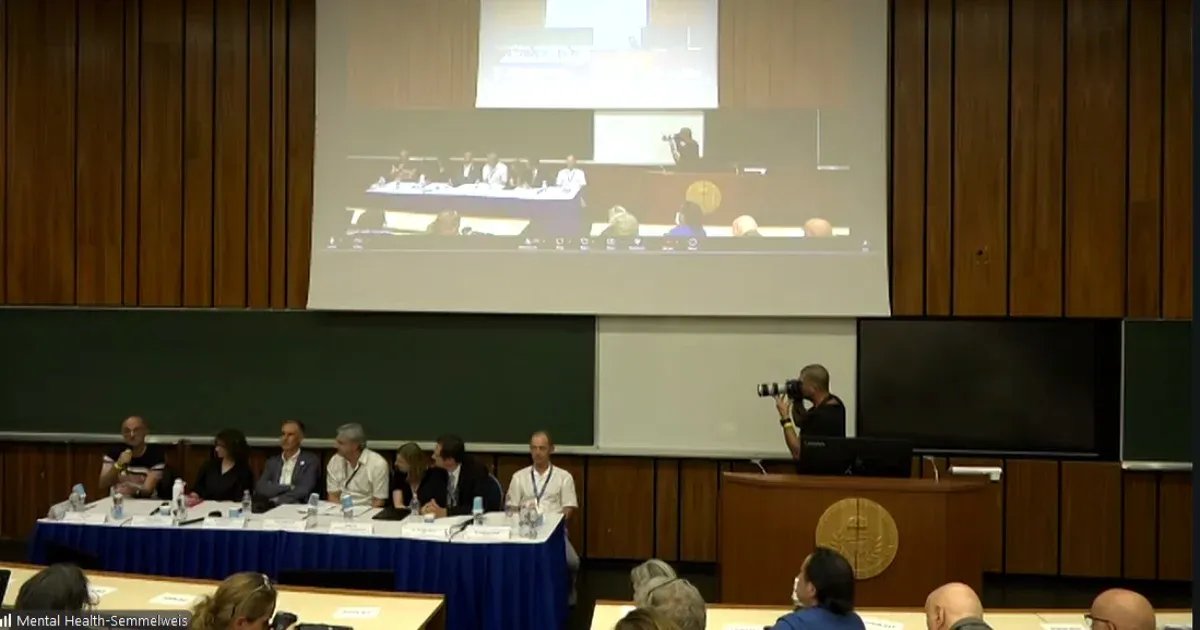
Mental Health in Hungary 2026 – a conference with this title was held on Tuesday at Semmelweis University in Budapest, where it was also revealed that psychiatrist György Szekeres is the candidate for the ministerial commissioner’s seat for the development of mental health care.
The goal of the conference was to create a common professional space where different professions, institutions, decision-makers, civil organizations, researchers, stakeholders and relatives can think together about what Hungary’s mental health system should look like in the next decade.
“It has become increasingly clear that the challenges of the current system – the lack of professionals, the inadequacy of prevention, inequalities in care, the lack of child and youth psychiatric capacities, the growing burden of care for the elderly, limited access to psychotherapy, and the difficulties of coordination between the health, social, educational and child protection systems – are complex problems that require comprehensive, long-term and broad professional cooperation,” wrote the organizers of the event.
For example, the participants of the event were looking for the answer to how mental healthcare can be moved more and more towards prevention and support of well-being instead of treating diseases. How can nationally accessible psychotherapy care be ensured? What should the future of child, adolescent and youth psychiatry be like in Hungary?
After the introductory briefing, these topics, among others, were discussed in 19 smaller working groups. Nearly a thousand professionals participated in Tuesday’s conference in person and online. After the forum, the organizers will summarize the experiences and draw up a problem map based on them, which can be the basis of the government’s action plan.
The treatment of mental illness is a central issue in the health of society
“Together, let’s start planning the future of Hungary’s mental health,” said Zsolt Unoka, head of the SE Psychiatric and Psychotherapy Clinic at the beginning of the conference. He then talked about how mental health affects education, workplaces, and local communities. Nevertheless, psychiatry often meets people at the end of the story. According to him, if you want to improve the mental health situation, it is not enough to develop the care system, you need to build cooperation between the professions. That is why not only professionals were invited to the forum, but also people living with mental disorders, their relatives and their representatives.
In his speech, Clinical Deputy Rector Attila Szabó spoke about the fact that Hungarian psychiatry is at a turning point. The number of patients is constantly increasing, the infrastructure is outdated, there are new challenges, while the methods and research are advanced. The stakes are high: every sixth person in the EU and in Hungary lives with some form of mental illness. The treatment of mental illnesses is a central issue of the health of society – said Attila Szabó, who also emphasized that mental health is not a matter of a profession and a ministry.
In her speech, State Secretary for Children’s Rights and Child Protection Szilvia Gyurkó spoke about: if you look around, you see a healing society, where the question is not whether there is a problem, but how to name the problem. He emphasized the importance of language. According to him, it doesn’t matter that we talk about children struggling with being stuck as “they are the only ones with problems”, “they run away”, “drug users”, while they need care, support and love. It doesn’t matter whether we are looking for the absence of illness or how the children in need of help can be well. He then reminded us: we should never forget that the well-being of the children is tied to our well-being, that the children cannot be better than ourselves.
According to Róbert Wernigg, the president of the Hungarian Psychiatric Association, the question is finally not whether there is a need for reform, but how they will act. He also said that policy has already been contacted, health policy has changed and he is finally recognizing the importance of mental health. An example of this is that the area receives a special ministerial commissioner. According to him, this is a “very rare political moment”.
According to Péter Kéri, the representative of the Ébredésés Alapítvány’s peer committee, all lived experiences are important for systems to be renewed, and the involvement of those involved is necessary.
György Szekeres announced that he is the candidate for the ministerial commissioner’s chair appointed for the development of mental health care. He described this period as a historical moment. He does not remember a government that would have appointed a special person responsible for psychiatry and would have highlighted the plight of the mentally ill to such an extent. According to his experience, so far nothing other than complaints has reached the decision-makers, now we are facing a paradigm shift.
According to Zsolt Zalka, so far the decision-makers have not heard the voice of the profession, but he sometimes had the impression that the profession does not hear its own voice either. So, in the first round, it is necessary that “we ourselves hear each other’s voices”.
Psychiatrists consulted with Hegedűs as well
A few weeks ago, Health Minister Zsolt Hegedűs consulted with psychiatrists. Róbert Wernigg, president of the Hungarian Psychiatric Association he then said to Telex: they were promised that Hegedűs will now prioritize the issue of emergency care and psychiatry in the health sector. The president of the company does not remember that since the nineties, psychiatry has received special attention at such a level.
MPT representatives prepared for the negotiation with a package of proposals, and finally agreed on some of the “urgent and urgent intervention points” included in the package. Thus, for example, by announcing the tender for the director general of the Gyula Nyírő National Institute of Psychiatry and Addiction (OPAI), several hospitals in Budapest are involved in acute psychiatric care and targeted incentives are being incorporated to strengthen the operation of the care system.
Robin Ézsi, the former director general of Nyírő OPAI in the capital, in March submitted his resignation. The psychiatrist does not have a qualification, previously mage training academy Ézsi led the largest institution of psychiatric care in Hungary for a little over two years. Under his leadership, specialists and other workers also left the Nyírő OPAI en masse. This January 40 scissors doctor signed a petition in which, among other things, department closures were demanded due to the shortage of specialists due to the leadership of the director general.
As the speakers said: urgent changes are needed, the acute crisis of psychiatric care in Budapest is at the limit of a decades-long process. In care, the problems resulting from the shortage of doctors and specialists, lagging developments, persistently low mental health spending, fragmented patient journeys and the drifting of social care burdens to acute wards appear at the same time.
Based on OECD data, in 2025 Hungary spent 6.5 percent of GDP on health care, according to the World Health Organization (WHO) report, only 2.5-3 percent of the resources spent on health care go to mental health care in the country.
Meanwhile, the Hintalovon’s tenth anniversary report on Children’s Rights according to him, the mental state of the children is depressing. School psychologists are overworked, the vast majority of them only work part-time or commute between several institutions. The Blue Line Children’s Crisis Foundation reported in their 2025 report that they had 12,397 meaningful calls that year. Most of the children who come to them are between the ages of 13 and 18, but in recent years they have noticed that more and more children under the age of 12 are also looking for them. Moreover, in 2025, they had 35 calls where children under the age of 10 asked for help.
We also covered the topic of mental health several times on Telex. In 2023, it was already visible in domestic psychotherapy: the mental health system looks like those who can afford it go to a private psychologist for 15-20 thousand per hour, those who can’t, he drinks it.