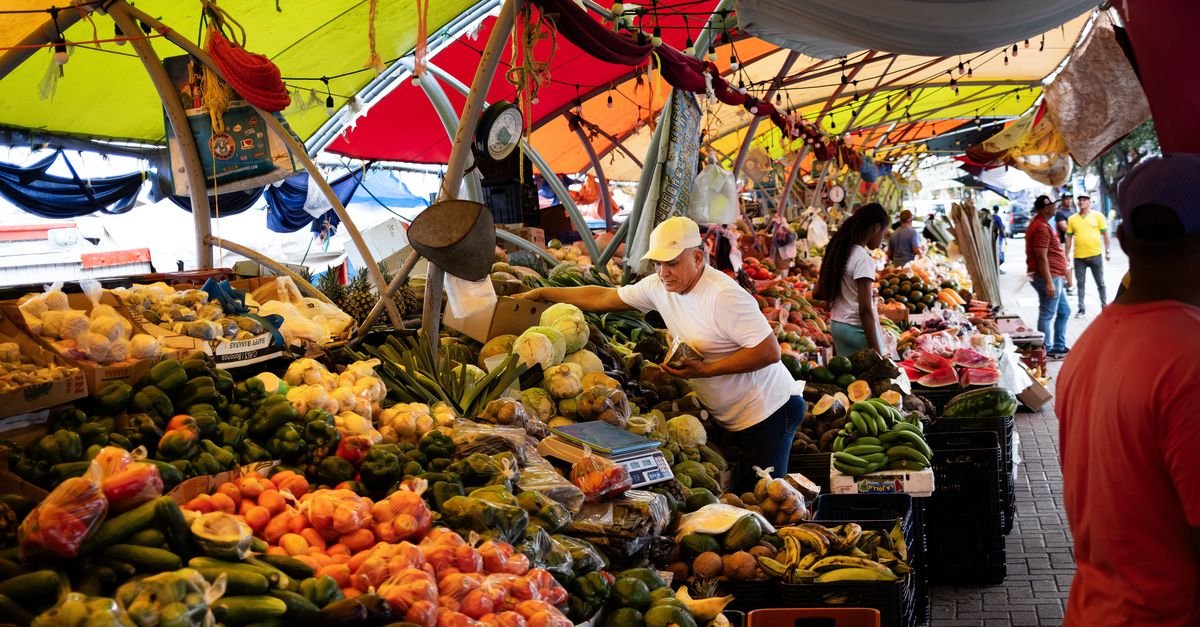
At his stall at the fruit market in the Punda district of Willemstad, 37-year-old entrepreneur Juan Rodríguez carefully displays the fresh mangoes and bananas. He arrived by boat in the early morning from La Vela de Coro, a port town on the coast of Venezuela. On a clear day you can see its South American neighbor about sixty kilometers away from the beach of Curaçao. The two major earthquakes with a magnitude of 7.2 and 7.5 struck Venezuela on Wednesday evening local time hit hardwas also felt by some residents in Curaçao, but there was no damage on the island. Nevertheless, this heaviest earthquake since the last century also concerns many people in Curaçao; The island (over 156,000 inhabitants) is home to a large Venezuelan community of an estimated 16,000 people.
“I have not received any news so far about close relatives of mine among those affected,” said fruit seller Rodríguez, whose relatives live in a region where as far as he knows there is little damage. “But it hurts me that my fellow countrymen have been hit so hard. Buildings and houses can be rebuilt, because materials recover. But life does not recover,” he says.
On his phone, Rodríguez scrolls through the videos that he constantly receives via WhatsApp, sent by acquaintances and family members from Venezuela. These are terrible images of screaming people under the rubble, while emergency workers try to remove debris in the dark. A baby who is stuck is being rescued, he sees on the screen. Happy. The buzz of his phone sounds again; Rodríguez opens a new video. This time of pets trapped between collapsed walls. “Maybe I shouldn’t keep looking. I feel involved, but also so powerless,” he sighs.
:format(webp)/s3/static.nrc.nl/wp-content/uploads/2026/06/26133025/260626BUI_2034761010_venezuelacurJuan.jpg)
Juan Rodríguez at his stall at the fruit market in Punda.
Photo Nina Jurna
The Venezuelan sellers of these so-called fruit bars are a well-known phenomenon in Curaçao; Little fruit is grown and produced on the island itself. Residents of Curaçao drive along the quay in the morning and make a stop to buy fruit here. Or they walk along the different stalls and look for the most beautiful and best fruits.
“I sympathize, because Venezuela is our neighboring country, there is a strong bond,” says teacher Erlien Cijntje as she pays for watermelon and papayas. “People have already experienced so much misery. There has been an economic crisis for years. Many Venezuelan refugees have come to Curaçao in recent years. And earlier this year there was Trump’s invasion and the kidnapping of President Maduro. It seems like they are going from one drama to another,” she says.
Also read
The latest news about the double earthquake in Venezuela in our live blog
The stall of Juan Rodríguez, who has been sailing back and forth between Venezuela and Curaçao for ten years, is the regular place where she buys her fruit. Rodríguez cuts a piece of mango and lets her taste it. “Yes, I would like some of those too,” she says cheerfully.
Looking for information
For Venezuelan Jennifer Sifontes, who has lived in Curaçao for more than twenty years, these are days of extremes. Her cousin is missing and there is a good chance that he is buried under the rubble. “He lives in a building that is now certain to have collapsed,” she says with a broken voice. “Every hour it takes longer for them to find him makes me sicker inside.”
Sifontes is chairman of Venex, an interest group that works for Venezuelan migrants and refugees on the island. Newcomers are helped by Venex with their integration process and legal help and assistance is provided. Since the earthquake, her phone has been ringing off the hook and Venezuelans have been visiting in panic as they seek information about their relatives and loved ones in the affected areas. They hope that Sifontes can help them, but she also has no information.
:format(webp)/s3/static.nrc.nl/wp-content/uploads/2026/06/26100146/260626BUI_2034761010_venezuela1.jpg)
A man sits among the rubble in the hard-hit region of La Guaira, about 40 kilometers northeast of the Venezuelan capital Caracas.
Photo Gaby Oraa/Reuters
There are also people who want to offer help and collect items and money for the people in Venezuela. “We have a list of items that are really needed urgently. There may be an emergency line so that these items can be quickly transported by boat or perhaps by plane. There are currently no flights and many airports are closed. Caracas airport, for example, has partly collapsed, and other airports have also suffered damage,” she says.
Volunteers report to Venex. Someone is in nursing, another wants to collect items for Venezuela and set up an emergency center so that everything can take place in one place in a structured manner. Sifontes sends the list of things that are desperately needed via an app group. Drinking water, for example, but also baby food and canned food. A wide variety of items must be collected: from power banks and batteries to medicines and safety helmets and boots for emergency workers. “Venezuela cannot handle this alone. The country has been in a humanitarian crisis for years, there is no capacity at all in the country. Hospitals are functioning poorly and there is a shortage of just about everything. Aid really needs to come from abroad as quickly as possible,” says Sifontes.
Also read
‘Impossible balancing act’ for Venezuelan President Rodríguez after earthquakes
:format(webp)/s3/static.nrc.nl/wp-content/uploads/2026/06/25161312/250626BUI_2034746577_venezu.jpg)
World Cup joy overshadowed
Sifontes is torn inside these days, she says. She has lived in Curaçao for twenty-four years and she feels committed to her country Venezuela as well as to this island. The day she woke up to the bad news about the major earthquake was also the day that the national football team of Curaçao, which played for the first time took part in a World Cupplayed the last game – the team was eliminated. “It feels very double, because both things are at odds with each other. But both are historic, just in a completely different way. This earthquake is a tragedy, and it is the first time that I have experienced such a violent natural disaster in Venezuela. At the same time, I now live on an island that is in a party mood, and I am also proud of Curaçao,” she says.
Something like politics is the last thing that should count right now. There are people under the rubble
:format(webp)/s3/static.nrc.nl/wp-content/uploads/2026/06/26100722/260626BUI_2034761010_venezuela2.jpg)
Residents walk among the rubble in Caraballeda, in the La Guaira region.
photo Federico PARRA/AFP
The fact that the United States is now coming to the rescue and that Donald Trump is being thanked with great words by interim President Delcy Rodriguez shows how even during a disaster like this political interests. “But something like politics is the last thing that should count now. There are people under the rubble, action has to be taken,” she says.
At the fruit market, some fellow sellers stand around fruit seller Juan Rodríguez, together they look at the small screen of his phone on which the interim president addresses the population and gives an update on the number of victims. “There were probably a lot of people relaxing at home watching football,” Juan Rodríguez mutters. Moreover, it was a national holiday, an important victory of the great liberator of South America Simon Bolivar was celebrated. People then go on trips, he says, and the La Guaira region, which was hit hard, is a popular area, including for tourists. The fruit sellers are silent and they agree. The only thing that can help is prayer.
Also read
Caracas rarely experienced major earthquakes. How could this have happened?
:format(webp)/s3/static.nrc.nl/wp-content/uploads/2026/06/25121800/250626WET_2034747508_1.jpg)