The phone rings, it’s an Italian print journalist who is covering his eighth World Cup. A couple of hours earlier there had been a long talk about the topic in question. He returns with a concern: “An Argentine journalist told me that Bielsa He’s a blackmailer. What does that mean?”
// // //
The elimination of Uruguay, one of the bombshells of the World Cup, transformed football into another sport that arouses passion and has countless followers: polarization around Bielsa. For some it is an enlightenment that to interpret it requires a cognitive effort that many are not willing to make due to laziness or preconception. For others, he is a lunatic who lives his own dystopian reality, oblivious to everything around him. And that’s why it goes that way. For whatever reason, no one perceives him as just another technical directorsomeone who begins and ends with the result.
In the cycle that goes from one World Cup to the next, Bielsa had a regressive management in Uruguay, he deteriorated in everything, relationally and in football, until the defeat against Spain that bordered on losing control. Final point and farewell, with the finality that the facts gave off. His word or that of any leader of the Uruguayan Association was not needed to know that the paths were separating.
Bielsa had an auspicious start to his management, with victories in the qualifying rounds against Argentina in the Bombonera and over Brazil in the Centenario. That night, in November 2023, Bielsa congratulated Scaloni because “he had built a signature team in his first experience.” Later, in the 90 minutes, the 2-0 for La Celeste was read as a “tactical lesson” for Rosario.
When did everything start to go wrong? The turning point may be located after the Copa America 2024, in which Uruguay was third. Bielsa was carrying out the transition of replacing the team’s two all-time top scorers, Luis Suárez and Edinson Cavani. The Inter Miami forward was in that Copa América, in a secondary role, playing the remaining minutes of most of the games.
Suárez was already aware that he had little left in the national team, but for Bielsa he had even less left. There was a tension that the forward detonated with statements that greatly pierced Bielsa’s human profile: discourtesy with the concentration employees, distant treatment with the squad, little empathy and a self-absorption that led him to deny something as basic as the greeting. He supported Suárez at that time Agustín Canobbio with statements that still did not leave him out of the World Cup, from which he was expelled against Spain: “There was a constant lack of respect.”
Troy burned. Bielsa sensed a destabilizing movement, but he clung to his position, trusting that he was going to right the ship, while the leadership looked on from the outside, somewhere between embarrassed and oblivious. Publicly, the coach released the first of the self-incriminating phrases, which continued to this day: “I am not ignorant of everything that happened and I know that my authority is affected in some way.”.
The football renewal that Bielsa had undertaken had watertight points. He directed the Pre-Olympic that was based on the Under 20 world champion in Argentina. He was far from qualifying for the Paris Games and none of those players earned a place on the World Cup roster. The project was left without the supply of those that came from below.
A friendly that should have gone almost unnoticed produced another outbreak. The 5-1 defeat against the United States reserves led to another hara-kiri: “I am toxic, The person who interacts with me gets worse. Yes, toxic. Guys who only see the error, who are correcting it, who sue, who are never satisfied with anything, who like to talk only about work, who go out to eat and keep a diary because they don’t want to integrate with the rest so as not to have to talk about things that take them away from all that. I live it like karma.”
The arrival to the World Cup took place in the midst of a climate that was addictive to the squad. Bielsa contradicted some of his principles: due to the physical demands of his training, Ronald Araújo suffered an injury. In turn, a coach who prioritizes physical fitness so much made room on the list for several players who were not 100 percent: Giménez, De Arrascaeta, De la Cruz. He did it out of gratitude for what they gave in his cycle and because there were no guarantee options either. Bielsa had not managed to expand the support base.
Before the 2002 World Cup, when it was not clear whether Cavallero or Bonano would be the starter, Bielsa admitted: “I don’t know about archers”. The phrase becomes valid in light of how wrong the election of Legguard, with greater or lesser responsibility in the four goals that Uruguay conceded in the World Cup. Rochet, already a starter ahead of Muslera in the last World Cup, had been the established goalkeeper throughout the cycle. Muslera only reappeared in a friendly before the World Cup.
The chances of winning decrease considerably if a coach and the team’s leaders disagree, without agreeing, on the approach to be applied in a match. This was what happened in the previous match against Spain. While Bielsa continued with his usual ideology (high pressure, individual duels, taking the ball away from Spain for as long as possible), Valverde, Ugarte, Bentancur and Rochet preferred to wait in a low block and counterattack.
Bielsa arrived at the final battle without being able to change the historic football culture of the Celeste. Its players believed that the future in the World Cup involved returning to the sources of the Master Tabárez. As countries, Argentina and Uruguay have several points in common, but in football there is distrust and pride in one’s own. The mix of identities already failed when he directed Celeste Daniel Passarella.
For this reason, the last immolation before Bielsa’s microphones was the admission that His passage leaves nothing for Uruguay. This lack of legacy is its main failure, which goes beyond the results. It didn’t happen to him in Argentina or Chile, where the lack of titles did not prevent his players from recognizing him for everything that had improved them. There is no Uruguayan footballer with a text of gratitude. That kind of contrast didn’t usually happen.
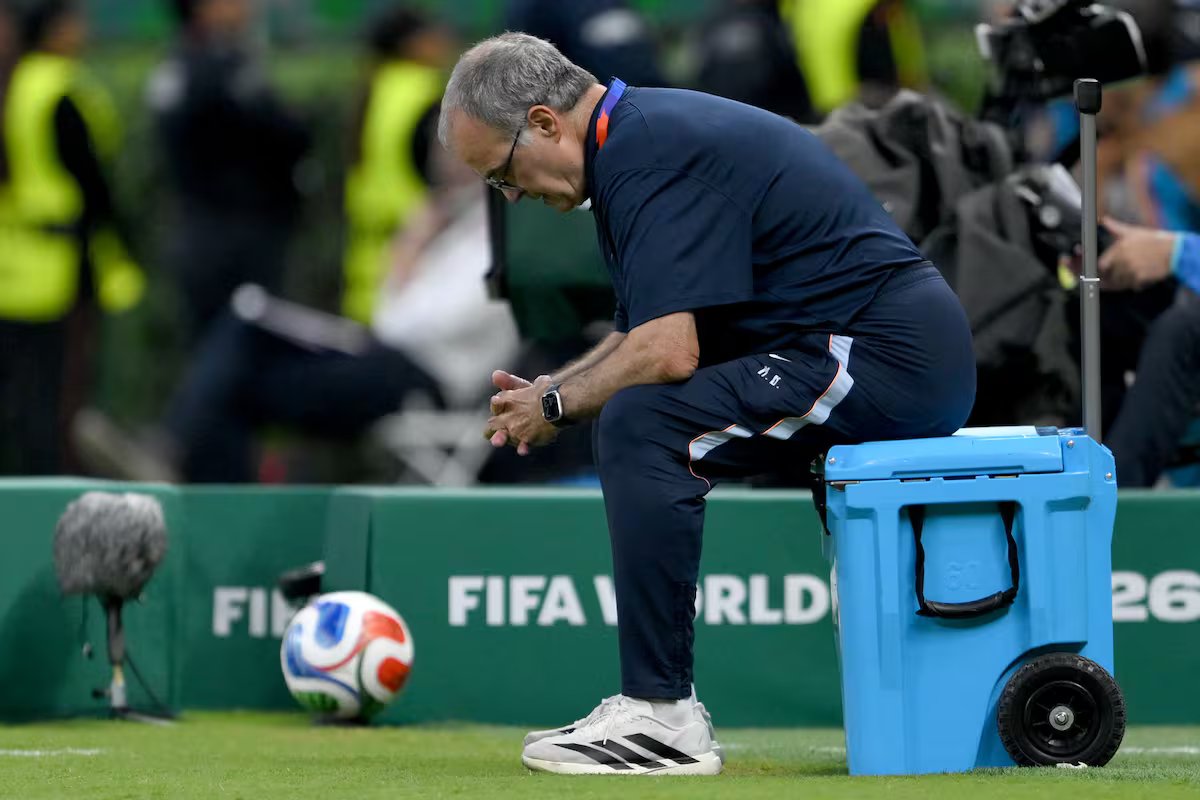
With 70 years, perhaps Bielsa’s way of leading does not fit with the times. His intemperance He had already given a start in Leeds, where even his closest collaborators suffered. Lowering your gaze in front of the camera in FIFA’s presentation of the formations, or the disrespect towards the television staff in the interview after the match with Spain, distances you from the basic rules of coexistence. There are other ways to fight the system or expose the abuses of the business, without becoming sullen or angry.
Will you direct again? Bielsa is unfathomable. Although it is very unlikely, perhaps the time will come for his career to come full circle and at some point he will return to where it all began, in Newell’s. Not necessarily to be the coach, but to set a course for a club that has been adrift for a long time. He would be received as a prophet, with the most faithful congregation he could find. Nobody names their stadium after a blackmailer.