The special protection status for millions of people displaced from Ukraine in the EU is to be extended.

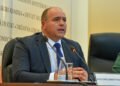
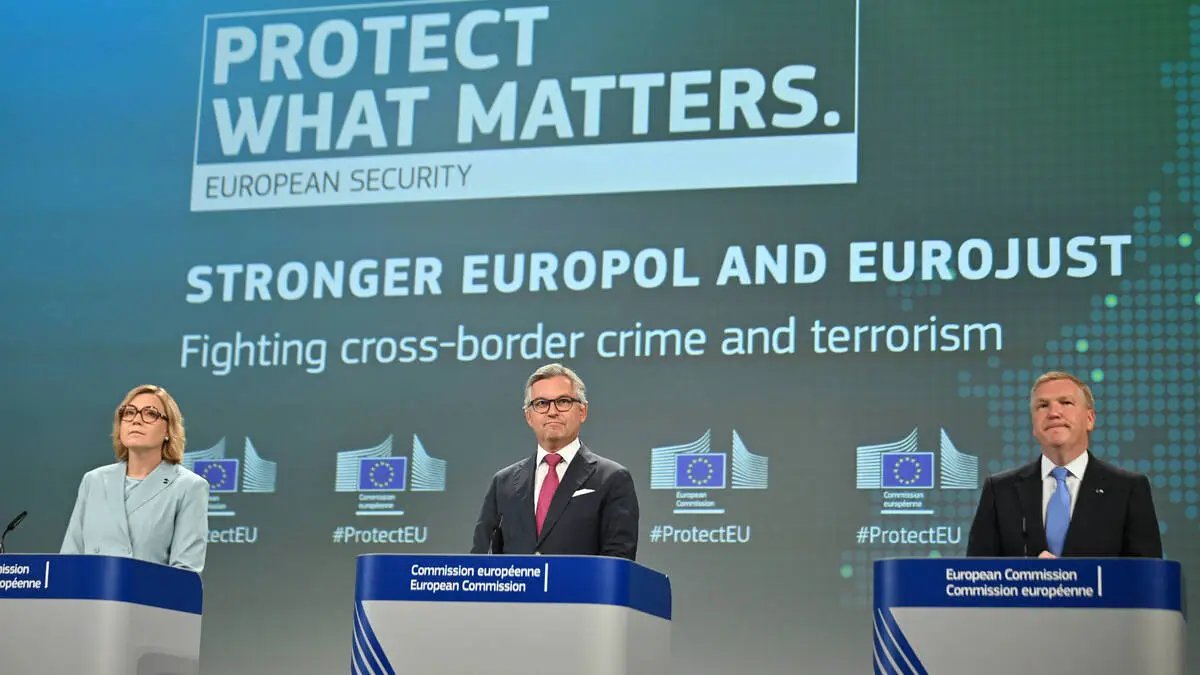
EU Migration Commissioner Magnus Brunner (center) presents the plans to extend the protection status for displaced people from Ukraine in Brussels. IMAGO/Dursun Aydemir
Add the Press on Google as your preferred news source.
EU-Commissioner Magnus Brunner announced in Brussels on Friday that men subject to military service should be excluded from the planned extension of protection status for Ukrainians: “People who are newly entering the country and who are not allowed to leave Ukraine due to their compulsory military service under Ukrainian law should not be granted temporary protection; that is exactly what Ukraine asked us to do, and that is exactly what we are doing,” said Brunner.
According to the Commission, the special protection status for people fleeing Ukraine from the Russian war of aggression should be extended for another year until March 4, 2028, as the need for protection for people fleeing Ukraine remains clear. The current protection status expires in March 2027. The EU activated a directive on temporary protection in March 2022. Brussels can use this emergency mechanism in the event of an exceptional mass influx. Displaced people receive protection status quickly and unbureaucratically and do not need an asylum procedure. The mechanism was originally valid for one year, but has already been extended several times.
The proposal is based on the Ukrainian exit regulations: In Ukraine, men between the ages of 18 and 60 are subject to compulsory military service. There is a ban on leaving the country for men between the ages of 23 and 60. However, only conscripts aged 25 and over are currently drafted for military service. Exceptions apply, for example, to single parents or fathers of several underage children or for health reasons. These exceptions are likely to also apply in the EU.
The proposal is part of a “broader and gradual transition from an emergency response framework to more stable legal solutions for Ukrainian refugees in the European Union,” Brunner continued. The Council of EU countries has already adopted a recommendation on the gradual transition to other residence permits and sustainable return and reintegration in Ukraine as soon as circumstances allow.
The Commission intends to develop a pilot program for voluntary return and reintegration in cooperation with interested Member States and the Ukrainian authorities. “Of course, Ukraine’s future depends not only on financial support, but also on its population. For this reason, today we are also launching a pilot project for a voluntary return and reintegration program to support those who already want to return and to prepare ourselves to support returnees as soon as the situation allows,” said Brunner.
Almost 4.4 million people displaced from Ukraine are currently enjoying temporary protection in the EU. The numbers have been stable since 2024 and are increasing slightly. There are currently around 94,100 Ukrainian citizens registered in Austria. Most of the displaced people are in Germany, Poland and the Czech Republic. The majority of those displaced are women and children, around a quarter are men.
Interior Minister Gerhard Karner (ÖVP) welcomed the decision in an initial statement. “From Austria’s perspective, there should no longer be automatic protection status for men subject to military service coming from Ukraine. This not only helps Austria, but also Ukraine. I am therefore pleased that the EU Commission has followed the Austrian initiative in its current proposal,” Karner told the APA on Friday.
“The temporary, unbureaucratic protection for people from Ukraine was one of the historically unique decisions at the beginning of the war. Europe has thereby shown that it will not do things by halves when it comes to freedom and peace. Clearly the regulation should be extended. Because Putin’s War (Russian President Vladimir Putin, note) is still ongoing. But if someone in Ukraine wants to evade their civic duties in defense, then the EU must not support that,” welcomed Luke Mandlsecurity spokesman for the ÖVP European Parliamentexpressly the initiative. (APA)