
All views expressed in this article belong solely to the author.
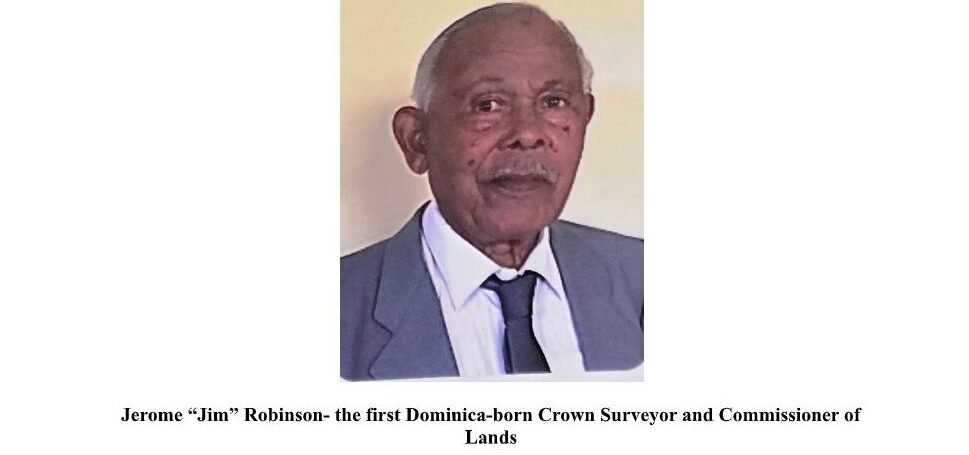
Early in 2026, I purchased a remarkable memoir chronicling the life and times of Jerome A. Robinson, the first Dominica-born Crown Surveyor and Commissioner of Lands. Aptly titled “A Time of Rapid Change in Dominica” (Micotrin Press, 2025), the book was published with the assistance of members of his family, principally his daughter, Dr. Jean-Marie Lawrence, Professor of Technology Systems at East Carolina University.
Before the generation that built modern Dominica passes from our midst, it is fitting that we record and publish their stories by every means available. Jerome A. Robinson was unquestionably one of those nation builders whose life deserves to be remembered. His memoir is therefore more than a personal narrative—it is a valuable contribution to Dominica’s historical record.
His daughters, Lena Bellevue and Dr. Jean-Marie Lawrence, deserve our heartfelt gratitude for ensuring that his experiences, accomplishments, and observations have been preserved for future generations.
The Robinson Family: A Tradition of Public Service
Growing up in Dominica, one quickly became familiar with the Robinson family. They enjoyed an enviable reputation for distinguished service in education, the professions, construction, business, and public administration.
Joffre Robinson was a respected educator. Cephas Robinson was an accomplished builder responsible for constructing churches, banana boxing plants, portions of Melville Hall Airport, and Vick’s Supermarket, now Lindo Mart. Belgrave Robinson served with distinction as Chief
Education Officer. Edgar Robinson was a highly regarded welder, while Ken Robinson became one of Dominica’s most innovative businessmen, operating a supermarket, pioneering a tire-retreading enterprise, establishing a music recording studio, and, together with his wife Eileen Robinson, operating a successful bakery and mini-mart.
During my years at the Dominica Grammar School, our woodworking instructor at the Technical Wing was Mr. Ernest Alfred “Robo” Robinson. He was disciplined, patient, and meticulous, having been sent to Los Angeles, California, to pursue advanced studies in vocational education
specializing in woodworking.
In the third form, I was privileged to study English Literature under Jerome Robinson’s niece, Ianthe Robinson. As a Dominica Grammar School Cadet, I also came to know the late Edmund Robinson, our Company Sergeant Major. Like many members of the family, he was affectionately known as “Robo”. He was exceptionally sharp, disciplined, and later became my colleague when we both taught at the Dominica Grammar School.
The Robinson family reflected Dominica’s rich and complex heritage. Their ancestry combined Scottish-Irish, African, and Kalinago roots. During the colonial period, many Scottish-Irish settlers arrived in the British West Indies as indentured servants, with many eventually rising to become estate managers, clerks, surveyors, and administrators within the colonial government.
A Young Man’s Journey Upward
Jerome Robinson was born on August 22, 1934, to Ellis Robinson and Florisca Robinson (née Joseph), the youngest of their children. He was the grandson of Alexander “Ellick” Robinson, who himself worked within the colonial administration.
Interestingly, Peter Hulme’s scholarly work on the Kalinago refers to “Mr. Robinson, who is the government man coming among the Caribs,” underscoring the longstanding connection between the Robinson family and public administration.
Robinson’s memoir vividly recalls the difficult years of the Second World War, when German U-boats torpedoed more than 400 ships throughout the Caribbean. Those turbulent years have been documented in greater detail by Dominican author Clement “Baba” Richards in his excellent work “Seawolves in Warm Waters”. Robinson recounts encounters with wartime refugees, Marigot policemen pursuing smugglers, and memorable childhood journeys alongside his father Ellis, as they traveled throughout the district.
Encouraged by his mother to pursue education, Jerome attended school in Laudat, where his brother Joffre served as the village schoolmaster. He excelled academically and ultimately entered the prestigious Dominica Grammar School.
One fascinating historical detail is that the Grammar School’s first building was formerly the residence of his paternal grandfather, Alexander Robinson. That historic structure still stands today at Piper’s Step on what was then Queen Mary Street—now Independence Street—in Roseau.
While at the Dominica Grammar School, Robinson distinguished himself academically. His abilities were recognized by the legendary Headmaster Victor A. A. Archer, B.Sc., M.S.A., who recommended that he pursue a career in surveying.
Breaking New Ground
Young Dominicans today should understand that it was only after the Second World War that local professionals gradually assumed senior positions within the colonial public service. Prior to that period, most departmental heads were British expatriates or Europeans. When I was growing up, the Crown Surveyor was Karol Winski, a Polish surveyor who preceded Jerome Robinson. Robinson speaks warmly of Winski’s mentorship, crediting him with teaching much of what enabled him eventually to rise to the highest office within the Survey Department.
In July 1954, at only twenty years of age, and after eighteen months as a pupil surveyor working in the field, Robinson received a scholarship to study surveying in Trinidad. He completed the three-year course in 1957 before successfully passing the examinations of the Royal Institution of Chartered Surveyors (RICS). For his outstanding performance, he received the prestigious Michael Dixon Prize.
Returning home, Robinson embarked upon the demanding work of surveying one of the Caribbean’s most mountainous islands. His memoir recounts climbing Morne Diablotin carrying delicate surveying instruments, fording swollen rivers while protecting his theodolite, and enduring weeks in remote forests. He explains that the Royal Engineers had installed metal survey markers atop Dominica’s mountains in 1945, which had to be re-established and verified in preparation for producing a new national map in 1961.
He also describes the extraordinary challenges of aerial photography in Dominica, where persistent cloud cover over its mountains and valleys frequently frustrated attempts to produce accurate maps. Long before satellite imagery transformed surveying, Robinson and his colleagues established camps deep within the forests, often living in tents for days while enduring poor food, constant rainfall, and primitive conditions. Yet they persevered.

These stories reveal not only the technical challenges of surveying but also the remarkable dedication, discipline, and resilience of those pioneers who literally mapped the nation under extraordinarily difficult circumstances.
Becoming Dominica’s First Native-Born Crown Surveyor
In 1962, Robinson pursued postgraduate studies at his own initiative by traveling to Glasgow to attend the Royal College of Science and Technology.
Upon successfully completing his studies, he returned to Dominica and was appointed Crown Surveyor and Commissioner of Lands—the first Dominican-born citizen to occupy that distinguished office.
His achievement represented more than individual success. It symbolized the gradual emergence of local leadership within the colonial civil service and demonstrated that Dominicans possessed the competence, discipline, and professionalism to administer their own country.

A Personal Connection
I had the privilege of attending several introductory surveying classes taught by Jim Robinson during the 1977–1978 academic year, prior to Dominica’s Independence.
At the time, I was a Sixth Form student in Form 6B at the Dominica Sixth Form College, preparing for the Cambridge University Advanced Level examinations scheduled for May and June 1979. Unfortunately, after our Geography teacher, Alfred Leevy, was assigned to other duties, our cohort lost its A-Level Geography instruction, and no examination was ultimately offered in that subject.
Nevertheless, Jim Robinson willingly stepped in to teach the surveying component of our Geography curriculum. He was exceptionally well prepared, patient, and committed to ensuring that his students understood both the science and the practical application of surveying. I remain
grateful for his contribution to my education.
Beyond that connection to Jim Robinson, I married his niece, Joan Robinson, daughter of the builder Cephas Robinson and his wife, Ernestina. Through her work alongside Dr. Peter Alfred, Deborah Blackman, Sandra Green, Alvin Abrahm, and other members of the Marigot History Working Group, they have been engaged in recording the history of families from Marigot

A Memoir Every Dominican Should Read
One of the greatest strengths of “A Time of Rapid Change in Dominica” is that it illuminates an important subject seldom explored in our schools: how our island was surveyed, measured, mapped, and ultimately administered.
The 177-page book is well illustrated, adding great authenticity to the work. Photos include survey team members erecting a rudimentary living quarter in the forests of Dominica, and photos of Robinson while studying in the United Kingdom. If there is any shortcoming, it is that not enough focus is given to his own immediate family, all of whom have done well.
This memoir deserves a place in every Dominican school library. It teaches our young people that the nation they inherited was built through the sacrifices of dedicated public servants who labored with limited resources but unlimited determination. Their work was grounded in
integrity, professionalism, and an unwavering sense of duty.
Dr. Jean-Marie Lawrence has rendered an invaluable service in helping preserve her father’s legacy. Her efforts should inspire other Dominican families to document the lives of parents and grandparents before those invaluable memories disappear forever.
Jerome Robinson also enjoyed a rich family life that undoubtedly strengthened his commitment to public service. He and his wife, Annette Robinson (née Butler), raised seven daughters—Jean-Marie, Esther, Denise, Carol, Lena, Anthea, and Elizabeth—whose accomplishments reflect the same values of education, discipline, and service that characterized their father’s remarkable career.
As a nation, we should celebrate this generation of Dominicans who accomplished so much with so little. Their stories remind us that nation-building is rarely glamorous. It is achieved through decades of quiet sacrifice, professional excellence, and faithful service.
For that reason, I strongly encourage the educational authorities to place this memoir in our schools and libraries, and I urge every Dominican family to support similar efforts to preserve our national memory.
History belongs not only to politicians and famous leaders. It also belongs to the surveyors, teachers, engineers, nurses, builders, civil servants, and countless ordinary citizens whose daily work quietly laid the foundations upon which modern Dominica now stands.
Jerome A. Robinson was one such nation builder. Thanks to this excellent memoir, future generations will know his story.