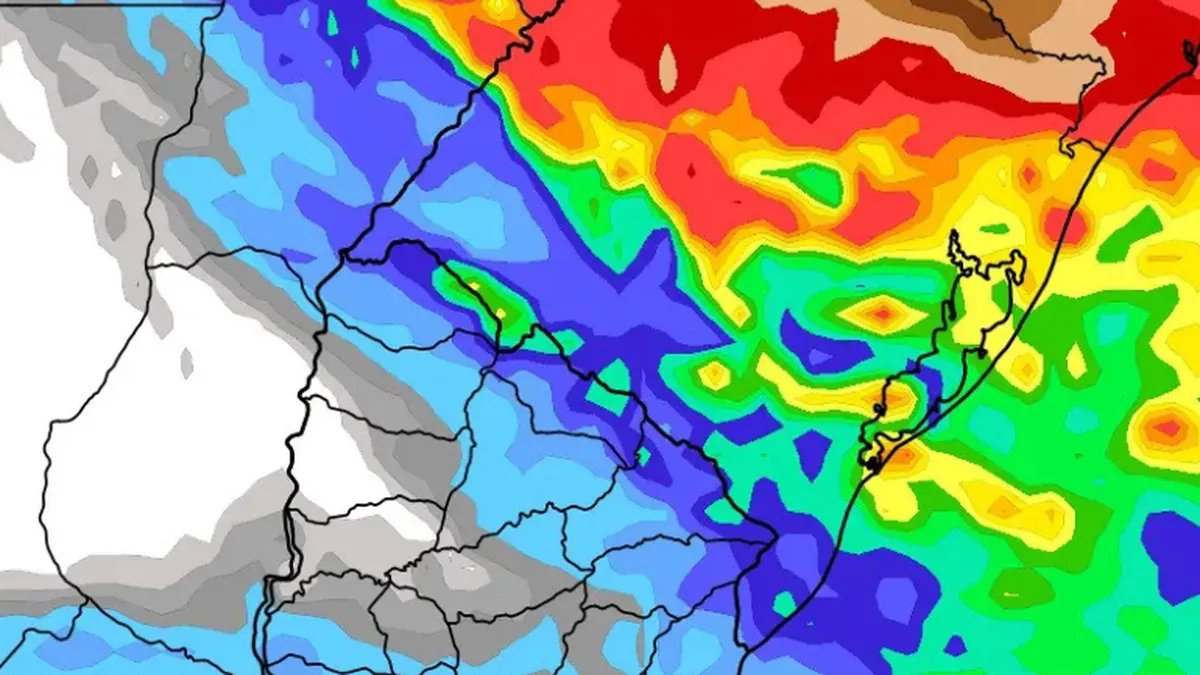
The phenomenon of The Child 2026 will begin to show its first signs of strong impact in the region. As he warned Metsul Meteorologythe south of Brazil will have in the coming days the first episode of intense rains associated with this phenomenon, with accumulated amounts that can be between 100 and 200 millimeters in areas of Rio Grande do Sul, Santa Catarina and Paraná.
The change in time will begin this Saturday June 27with increased cloudiness and a more unstable atmosphere. The rains will begin during the early morning and morning hours in different parts of Paraná and, towards the afternoon and evening, will extend to areas of Santa Catarina and sectors of the west and north of Rio Grande do Sul.
In addition to the rainfall, Metsul warned of the possibility of isolated stormswith hail and strong gusts of wind.

How the rainy episode will evolve
He sunday 28an area of low atmospheric pressure will favor rains throughout Rio Grande do Sul, much of Santa Catarina and some sectors of Paraná, especially in the southwest and south of that state.
For him Monday 29a cold front associated with a low pressure center—which will form a cyclone on the high seas—will concentrate the rains in Santa Catarina and Paraná, where they may be moderate to heavy. At the same time, the entry of drier and colder air will improve conditions in Rio Grande do Sul, with the presence of sun and clouds.
However, the advance of the front will be slowed by a atmospheric blockingwhich will make the system semi-stationary. As a consequence, on Tuesday the 30th instability will persist in several areas of Santa Catarina and Paraná, while the rains will return to sectors of northern Rio Grande do Sul.

He Wednesday July 1stwith the advance of an intense cold air mass over Argentina, the frontal system will strengthen and the rains may be stronger. The instability will mainly affect the northern half of Rio Grande do Sul, sectors of eastern Gaucho, Santa Catarina and the west and south of Paraná.
On Thursday the 2nd, the weather will remain unstable in several areas of southern Brazil, although with more irregular rainfall and lower volumes, as the cold air advances.
A typical El Niño configuration
Metsul explained that episodes of heavy rain in southern Brazil are common during the winter, even without El Niño. However, the atmospheric configuration predicted for this event presents typical signs of a warm phase of the Pacific.
The episode will be favored by the contrast between a very cold air mass of polar origin over Argentina and one warmer air mass over much of Brazil. This collision of air masses, added to the atmospheric blockage, will prevent the normal advance of the cold front and will maintain instability for several days over southern Brazil.
El Niño continues to intensify
The episode of El Niño 2026-2027which began in May and was declared by the NOAA on June 11, continues to strengthen in the equatorial Pacific Ocean, according to Metsul.
According to traditional monitoring by the United States climate agency, the sea surface temperature anomaly in the Niño 3.4 region already reaches +1.7°Ca value compatible with a The intense Child. Under the new RONI monitoring method, the anomaly is located in +1.1°Cwithin the range of a moderate El Niño.
MetSul reiterated that, as a result of the phenomenon, rainfall will increase significantly in southern Brazil during the second half of the year, with frequent storms, episodes of torrential rain, river flooding and sudden floods.
According to the organization, the most critical period will be between September and December.