Havana/“It is not a neoliberal package nor is it a return to capitalism.” With that warning, the vice prime minister – and great-nephew of Fidel and Raúl Castro –, Oscar Pérez-Oliva Fraga, presented this Friday the 176 economic and social transformations before the XXII Congress of the Central Workers of Cuba (CTC), the only legal union on the Island and one of the main transmission belts of the Communist Party.
The Government needs to expand the space for private businesses, attract foreign capital, decentralize decisions and allow new financial operations, but insists that none of this modifies the political foundations of the system. According to Pérez-Oliva Fraga, the reform does not require changing the Constitution either.
The official, who also heads the Ministry of Foreign Trade and Foreign Investment, assured that “If wealth is not generated, we cannot build the just society we want.” The phrase represents a recognition that the State no longer has sufficient resources to sustain its social policies, but avoids addressing the internal causes of the productive collapse.
Among the priorities remain the control of the fiscal deficit, inflation, price regulation and bankization. The state plan contemplates a deficit of 74,500 million pesos for 2026, of which 29,219 million had accumulated until the end of May. The Government has also authorized 91 self-financing schemes in foreign currency, a succession of exceptions that benefits companies capable of generating foreign currency without solving the general exchange chaos.

/ Cubadebate
Part of the reforms will begin to be applied in the next 30 days. The calendar includes measures on economic actors, the Central State Administration, the energy sector, agriculture, prices, salaries, commerce, gastronomy, services and the partial dollarization of the economy.
The program also contemplates expanding private participation in tourism, foreign trade and the real estate sector, as well as facilitating foreign investment by Cubans residing outside the Island. Cooperatives will be able to import and market fuel for their activity, seek external financing and open bank accounts abroad.
The fine print will depend, however, on numerous regulations still pending. The Government has created a legal group headed by Esteban Lazo, president of the National Assembly, and another for “political and communication assurance”, directed by the Party. While the first will have to speed up the drafting of the provisions, the second will be in charge of managing the public explanation of measures that may be unpopular.
Pérez-Oliva summarized the philosophy of the process as a “unity of direction with decentralization of responsibilities.” Havana will retain political command and strategic decisions, while companies, municipalities and workers will have to obtain income and be responsible for the results.
The union, which brings together 2,069,285 members, also intends to expand its presence in private companies
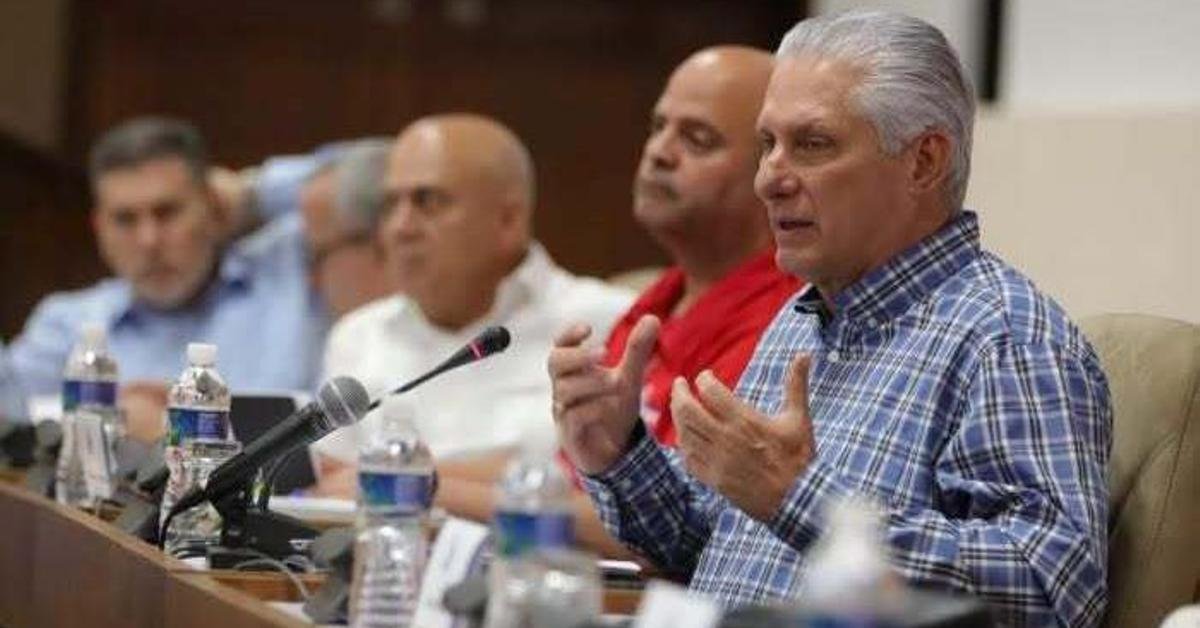
“The implementation of these transformations will not have the results we desire if there is not the active participation of our workers,” the president stated Miguel Díaz-Canel before the delegates. The CTC must convert the government program into a political movement, explain it in the workplace and accompany the “labor reorientation” processes, an expression that can encompass layoffs, transfers, workforce reductions and closures of unproductive entities.
The union, which brings together 2,069,285 members, also intends to expand its presence in private companies. The unionization of its employees was one of the issues debated, along with salaries, productivity, care for retirees and the protection of labor rights. It has not been explained what capacity the CTC would have to confront the state or private employer, but it seems evident that the workers will not be able to organize outside the central party subordinated to the Party.
The energy crisis even affected the organization of the congress. Of the 759 delegates, 561 participated via videoconference and only 198 met at the Havana Convention Palace. Nearly three out of every four union members were unable to attend in person the meeting called to debate the country’s economic recovery.
The delegates also analyzed the draft of the new Labor Code, which will be presented to the National Assembly in July. The Minister of Labor and Social Security, Jesús Otamendiz Campos, described the proposal as “revolutionary, innovative and updated to current times.”
Monreal highlighted that the verb “allow” appears 29 times in the document
Among its novelties are the exceptional incorporation into employment of adolescents between 15 and 18 years old, multiple employment, so-called combined work and the possibility of setting work days of less than eight hours with proportional remuneration. The authorities did not detail what tasks the minors will be able to perform or what guarantees will prevent poverty and family deterioration from ending up pushing them prematurely into the labor market.
The Cuban economist Pedro Monreal questioned that the list can be considered a coherent reform. The 176 measures are a “monster”, or “perhaps rather a deformed hybrid”, he wrote in X. In his opinion, the Government is trying to incorporate elements of a market economy without recognizing private property as a right protected against state power.
Monreal highlighted that the verb “allow” appears 29 times in the document. “’Allow’ is a permissive stance of power,” he observed, because it preserves the idea that private activity is a concession that authority can modify or withdraw.
“Nowhere in the 176 measures is it possible to identify a substantive recognition of the right to private property,” he added. There are also no clear guarantees regarding commercial arbitration, claims, compensation or dispute resolution.
The Government wants private parties to invest, produce wealth and take risks, but it does not seem willing to legally limit the power that decides who can operate and under what conditions. The CTC will now have the mission of incorporating these businessmen and workers into its ranks, while ensuring that economic opening is not confused with a return to capitalism.