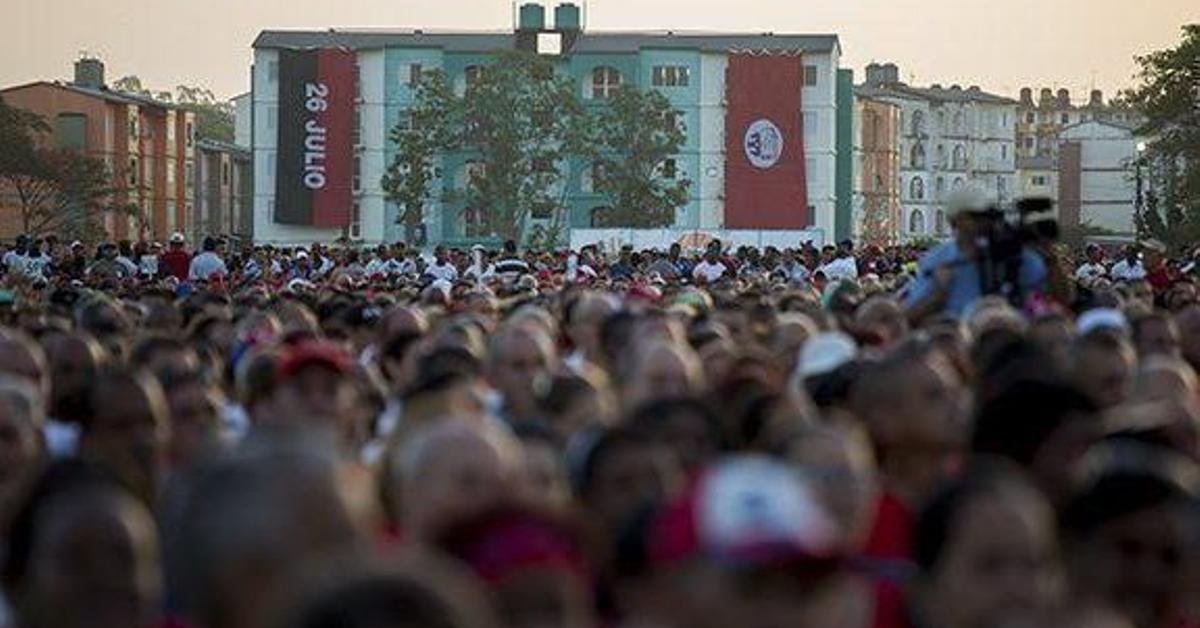

Madrid/The Political Bureau of the Central Committee of the Communist Party of Cuba agreed to grant Pinar del Río the headquarters of the national central event on July 26, “in the middle of a complex scenario,” according to a published statement. this saturday by Granma.
While Cuba is experiencing the worst economic crisis in recent decades and the population expresses social unrest that emerges more and more frequently in spontaneous protests, the Government once again allocates time and resources to the celebration of its main political anniversary. The time has come to honor the anniversary of the assault on the Moncada barracks, and no resources are spared to do so.
The reasons given by the Party for the election of the headquarters, faithful to its triumphalist rhetoric, draw a model province and ignore the problems that Pinar del Río has experienced this year. There is no mention of daily blackouts, which in some municipalities exceed 20 hours; nor the alarming ones hepatitis cases reported in recent months, nor the more than 40,000 families who have been waiting housing solutions for years, some for more than three decades.
“In recent years this territory has shown results in the fulfillment of the main tasks in the political, economic and social spheres,” states the official media, which also highlights the “impacts on foreign exchange earnings from exports”, something especially relevant in a country with a shortage of liquidity. The province continues to lead the national tobacco production –one of Cuba’s main exportable items– and maintains the export of lobsters, despite the production drop in recent years.
Faithful to their triumphalist rhetoric, they draw a model province and ignore the problems that Pinar del Río has experienced this year
In line with the open tone of the recent economic reformsthe statement also celebrates that the productions of the Ministry of the Food Industry “deploy new links with forms of non-state management”, a formula unthinkable in the official discourse of just a few years ago.
The Party praises the province in the social sphere, with a low infant mortality rate – 4.4 per thousand live births –, also the “adequate coverage” of family offices and doctors, and the “great effort” in education, “fundamentally in the completion of the teaching staff” – a serious problem facing the country: the difficulty in retaining workers in the educational sector due to the low salaries in the state system–.
The statement also recognizes Pinar del Río for nature tourism, another of the sectors hardest hit this year. As another achievement, he points out that the province “has established a work system that has allowed a greater link between the structures of the Party and the Government with the communities, especially those in a more vulnerable situation.”
The Political Bureau also granted “outstanding” status to the provinces of Matanzas and Villa Clara. “Both territories present progress in retail merchandise circulation, exportable items, foreign currency earnings from exports and transferred income.” Although the statement itself recognizes that the results of food production remain insufficient.
Once again, citizens are obliged to celebrate the glories of a State that they did not choose and that is leading the country to shipwreck.
Of these provinces, they praise the alternatives to the lack of transportation through electric mobility, and the attention to prioritized sectors such as health, education and tourism. In Matanzas, where Varadero is located, the tourism crisis has left hundreds of workers in a situation of interruption or forced relocation.
Guantánamo and Sancti Spíritus received, for their part, special recognition for continuing to promote prioritized programs “amid the complexities of the current context.”
The statement itself admits that the aforementioned provinces “face similar situations to the rest of the country,” but that the assessment took into account “the stability of the work in recent years” and the “progress in the search for solutions” in the face of the “multidimensional aggression” that Cuba faces.
The Political Bureau also recognized and congratulated the rest of the country’s provinces – all of Cuba – for their “firm demonstration of resistance and unity”, and gave as examples the tribute to the 32 Cubans who fell during the capture of Nicolás Maduro, the celebration of May 1 – whose participation was mandatory – and the “My Signature for the Homeland” campaign, during which they were reported several allegations of coercion for the collection of signatures.
The Party’s call raises the celebration in honor of the centenary of Fidel Castro, Raúl Castro and “the young people of that generation who, like Ramiro (Valdés), constitute an inspiration and example.”
Thus, the Government insists on honoring the leaders who have monopolized power for more than six decades, but citizens receive these ceremonies with indifference, fatigue or outright rejection. Few in the Cuban population continue to believe that these names are “inspiration and example.” Once again, citizens are forced to celebrate the glories of a State that they did not choose and that is leading the country to shipwreck.