Sunday, June 28, 2026
    The GeoStrategic Consensus
    No Result
    View All Result
    • Login
    • HOME
    • AMERICAS
      • Argentina
      • Brazil
      • Canada
      • Chile
      • Colombia
      • Costa Rica
      • Cuba
      • Dominican Republic
      • Ecuador
      • El Salvador
      • Greenland
      • Guatemala
      • Honduras
      • Mexico
      • Nicaragua
      • Panama
      • Paraguay
      • Peru
      • United States
      • Uruguay
      • Venezuela
    • ASIA-PACIFIC
      • Australia
      • Brunei Darussalam
      • Cambodia
      • China
      • Federated States of Micronesia
      • Fiji
      • Indonesia
      • Japan
      • Kiribati
      • Laos
      • Malaysia
      • Marshall Islands
      • Mongolia
      • Myanmar
      • Nauru
      • New Zealand
      • North Korea
      • Palau
      • Papua New Guinea
      • Philippines
      • Samoa
      • Singapore
      • Solomon Islands
      • South Korea
      • Taiwan
      • Thailand
      • Timor-Leste
      • Tonga
      • Tuvalu
      • Vanuatu
      • Vietnam
    • CARICOM
      • CARICOM – Non-English
        • Haiti
        • Suriname
      • CARICOM Associates
        • Anguilla
        • Bermuda
        • British-Virgin-Islands
        • Cayman-Islands
        • Curacao
        • Turks-and-Caicos
      • CARICOM English
        • Antigua and Barbuda
        • Barbados
        • Belize
        • Dominica
        • Grenada
        • Guyana
        • Jamaica
        • Montserrat
        • Saint Kitts and Nevis
        • Saint Lucia
        • Saint Vincent and the Grenadines
        • The Bahamas
        • Trinidad and Tobago
    • EURASIA
      • Armenia
      • Azerbaijan
      • Balarus
      • Georgia
      • Kazakhstan
      • Kyrgyzstan
      • Moldova
      • Russia
      • Tajikistan
      • Turkmenistan
      • Ukraine
      • Uzbekistan
    • EUROPE
      • Albania
      • Andorra
      • Austria
      • Bosnia and Herzegovina
      • Bulgaria
      • Croatia
      • Cyprus
      • Czech Republic
      • Denmark
      • Estonia
      • Finland
      • France
      • Germany
      • Greece
      • Holy See
      • Hungary
      • Iceland
      • Ireland
      • Italy
      • Kosovo
      • Latvia
      • Liechtenstein
      • Lithuania
      • Luxembourg
      • Malta
      • Monaco
      • Montenegro
      • Netherlands
      • North Macedonia
      • Norway
      • Poland
      • Portugal
      • Romania
      • San Marino
      • Serbia
      • Slovakia
      • Slovenia
      • Spain
      • Sweden
      • Switzerland
      • United Kingdom
    • MIDDLE EAST AND NORTH AFRICA
      • Algeria
      • Bahrain
      • Egypt
      • Iran
      • Iraq
      • Israel
      • Jordan
      • Kuwait
      • Lebanon
      • Lybia
      • Morocco
      • Oman
      • Palestinian Territories
      • Qatar
      • Saudi Arabia
      • Syria
      • Tunisia
      • Turkey
      • United Arab Emirates
      • Western Sahara
      • Yemen
    • SOUTH ASIA
      • Afghanistan
      • Bangladesh
      • Bhutan
      • India
      • Maldives
      • Nepal
      • Pakistan
      • Sri Lanka
    • SUB-SAHARAN AFRICA
      • Angola
      • Benin
      • Botswana
      • Burkina Faso
      • Burundi
      • Cabo Verde
      • Cameroon
      • Central African Republic
      • Chad
      • Comoros
      • Cote d’Ivoire
      • Democratic Republic of the Congo
      • Djibouti
      • Equatorial Guinea
      • Eritrea
      • Eswatini
      • Ethiopia
      • Gabon
      • Gambia
      • Ghana
      • Guinea
      • Guinea Bissau
      • Kenya
      • Lesotho
      • Liberia
      • Madagascar
      • Malawi
      • Mali
      • Mauritania
      • Mauritius
      • Mozambique
      • Namibia
      • Niger
      • Nigeria
      • Republic of the Congo
      • Rwanda
      • Sao Tome and Principe
      • Senegal
      • Seychelles
      • Sierra Leone
      • Somalia
      • South Africa
      • South Sudan
      • Sudan
      • Tanzania
      • Togo
      • Uganda
      • Zambia
      • Zimbabwe
    • HOME
    • AMERICAS
      • Argentina
      • Brazil
      • Canada
      • Chile
      • Colombia
      • Costa Rica
      • Cuba
      • Dominican Republic
      • Ecuador
      • El Salvador
      • Greenland
      • Guatemala
      • Honduras
      • Mexico
      • Nicaragua
      • Panama
      • Paraguay
      • Peru
      • United States
      • Uruguay
      • Venezuela
    • ASIA-PACIFIC
      • Australia
      • Brunei Darussalam
      • Cambodia
      • China
      • Federated States of Micronesia
      • Fiji
      • Indonesia
      • Japan
      • Kiribati
      • Laos
      • Malaysia
      • Marshall Islands
      • Mongolia
      • Myanmar
      • Nauru
      • New Zealand
      • North Korea
      • Palau
      • Papua New Guinea
      • Philippines
      • Samoa
      • Singapore
      • Solomon Islands
      • South Korea
      • Taiwan
      • Thailand
      • Timor-Leste
      • Tonga
      • Tuvalu
      • Vanuatu
      • Vietnam
    • CARICOM
      • CARICOM – Non-English
        • Haiti
        • Suriname
      • CARICOM Associates
        • Anguilla
        • Bermuda
        • British-Virgin-Islands
        • Cayman-Islands
        • Curacao
        • Turks-and-Caicos
      • CARICOM English
        • Antigua and Barbuda
        • Barbados
        • Belize
        • Dominica
        • Grenada
        • Guyana
        • Jamaica
        • Montserrat
        • Saint Kitts and Nevis
        • Saint Lucia
        • Saint Vincent and the Grenadines
        • The Bahamas
        • Trinidad and Tobago
    • EURASIA
      • Armenia
      • Azerbaijan
      • Balarus
      • Georgia
      • Kazakhstan
      • Kyrgyzstan
      • Moldova
      • Russia
      • Tajikistan
      • Turkmenistan
      • Ukraine
      • Uzbekistan
    • EUROPE
      • Albania
      • Andorra
      • Austria
      • Bosnia and Herzegovina
      • Bulgaria
      • Croatia
      • Cyprus
      • Czech Republic
      • Denmark
      • Estonia
      • Finland
      • France
      • Germany
      • Greece
      • Holy See
      • Hungary
      • Iceland
      • Ireland
      • Italy
      • Kosovo
      • Latvia
      • Liechtenstein
      • Lithuania
      • Luxembourg
      • Malta
      • Monaco
      • Montenegro
      • Netherlands
      • North Macedonia
      • Norway
      • Poland
      • Portugal
      • Romania
      • San Marino
      • Serbia
      • Slovakia
      • Slovenia
      • Spain
      • Sweden
      • Switzerland
      • United Kingdom
    • MIDDLE EAST AND NORTH AFRICA
      • Algeria
      • Bahrain
      • Egypt
      • Iran
      • Iraq
      • Israel
      • Jordan
      • Kuwait
      • Lebanon
      • Lybia
      • Morocco
      • Oman
      • Palestinian Territories
      • Qatar
      • Saudi Arabia
      • Syria
      • Tunisia
      • Turkey
      • United Arab Emirates
      • Western Sahara
      • Yemen
    • SOUTH ASIA
      • Afghanistan
      • Bangladesh
      • Bhutan
      • India
      • Maldives
      • Nepal
      • Pakistan
      • Sri Lanka
    • SUB-SAHARAN AFRICA
      • Angola
      • Benin
      • Botswana
      • Burkina Faso
      • Burundi
      • Cabo Verde
      • Cameroon
      • Central African Republic
      • Chad
      • Comoros
      • Cote d’Ivoire
      • Democratic Republic of the Congo
      • Djibouti
      • Equatorial Guinea
      • Eritrea
      • Eswatini
      • Ethiopia
      • Gabon
      • Gambia
      • Ghana
      • Guinea
      • Guinea Bissau
      • Kenya
      • Lesotho
      • Liberia
      • Madagascar
      • Malawi
      • Mali
      • Mauritania
      • Mauritius
      • Mozambique
      • Namibia
      • Niger
      • Nigeria
      • Republic of the Congo
      • Rwanda
      • Sao Tome and Principe
      • Senegal
      • Seychelles
      • Sierra Leone
      • Somalia
      • South Africa
      • South Sudan
      • Sudan
      • Tanzania
      • Togo
      • Uganda
      • Zambia
      • Zimbabwe
    No Result
    View All Result
    Agentially
    No Result
    View All Result
    Home EUROPE Austria

    Security expert: “The Old World will disappear” – DiePresse.com

    The Analyst by The Analyst
    June 28, 2026
    in Austria
    Security expert: “The Old World will disappear” – DiePresse.com


    Ms. Franke, we are talking about the geopolitics of the future. Where do you see the biggest breaks between the present and the world in 2050?

    READ ALSO

    Heat: Forgotten in the car: 18-month-old child in Marseille is dead – DiePresse.com

    Out of the democracy crisis! But how? – DiePresse.com

    Ulrike Franke: There are two long-term trends that we have recently lost sight of, but which will have a significant impact on the world by 2050: one is population development and the other is climate change. In some cases, these trends reinforce each other. Climate change will make places uninhabitable and lead to refugee flows, which in turn will affect population distribution. But I’m also concerned with population development beyond flight and in a geopolitical sense.

    What do you mean?

    We are moving towards a world where classic strength is once again important. And the population is a factor. If Africa gains a billion people by 2050 and Europe stagnates at best, then that will have an impact. Europe’s role in this world is not God-given. Its influence long had to do with the fact that Europe was populous and economically strong. If we can no longer sustain this, we will lose relevance in the coming decades.

    I actually wanted to ask you right at the beginning what makes you confident.

    Well. Unfortunately, we are heading into a few difficult decades. Because the climate crisis and demographics can be predicted fairly well by 2050.

    Then I ask you differently: What should Europe do by 2050?

    We can’t just talk about how to curb climate change. Looking ahead to 2050, we need to talk much more about how we adapt to the changes that will surely have occurred by then. How do we prepare our cities for this? In Europe in particular, we also need to deal with migration better. Migration pressure will increase. At the same time, it is often forgotten that Europe will need migration: for its economic systems, for its social systems and also for geopolitical power.

    Aren’t factors like population size becoming less important in the age of AI and robots?

    Technological superiority can compensate for many things, but not everything. By the way, I’m sure that the competition for AI supremacy will play a major geopolitical role until 2050. It’s not so much about who will be ahead in the end, but rather what such a situation does to the actors. States can act more irrationally in such competition. They could use systems or weapons that are not yet fully developed just to maintain the technological edge.

    What does the world order in 2050 mean for smaller states like Austria?

    They will tend to lose power. Because absolute power plays a bigger role, lose EU-Principles such as: “Everyone has a voice, everyone is somehow equal” in importance.

    Iran shows that even a comparatively smaller state can take on the USA if it has leverage – keyword: the Strait of Hormuz.

    Yes, there will always be states that have more power than they appear on paper – for example because they are strong in AI, in military technology or because they have what is called “spoiler power”: that is, not enough power to stabilize an order, but enough to disrupt it. Iran is a good example.

    Who are the future winners?

    Private companies and individuals will play a larger role in geopolitics by 2050. We can already see this today: Amazon Web Services, with its cloud systems, represents the backbone of the digital infrastructure. And Elon Musk can use its satellites to cut off the Internet to the Ukrainians or Russians at the front. This development will intensify: actors without democratic legitimacy will have more and more geopolitical power.

    Keyword democracy: Will the authoritarian trend continue?

    By 2035, many countries in Europe will face a phase in which autocratic and populist parties could also come to power in larger countries such as France or Great Britain. Where we will be in 2050 will depend heavily on how this development continues afterwards. One scenario is: These parties come to power, and at some point the pendulum swings back again – like in Poland or Hungary. The other scenario is: a more authoritarian Europe emerges.

    Which states do the future belong to?

    India and China will be more powerful. And possibly also some African countries, such as Nigeria. For other countries like Brazil, it depends on several developments. The relative losers could include the USA – although AI is likely to be a kind of wild card for the USA – and in any case Europe.

    Will the EU and NATO survive the next 25 years?

    Institutions like the EU don’t usually abolish themselves, so not without a big shock. The question is rather in what form they exist. I fear that the EU will remain as an economic area and an institutional framework, but it will not assert itself as a geopolitical actor capable of acting. Smaller mergers will play a larger role.

    So formats like E5 (Germany, France, Great Britain, Poland, Italy)?

    That would be very good. I’m thinking more of even smaller unilateral formats like the group of Nordic states.

    Who will replace the US leadership in Europe?

    The logical answer is Germany, France, Great Britain. But none of these countries alone. Because none of these countries are really able or willing to take on this leadership role. And I believe even less that the others are prepared to recognize this leadership. There are already concerns in France that Germany could become too strong as a result of the new era.

    Which capability will be more important than any other for geopolitical actors in 2050?

    Food security is a top priority. Of course, this also applies to energy. What is fundamentally crucial is a state’s ability to be secured in key areas – i.e. not to immediately become vulnerable if supply chains fail.

    Will the demographic shifts just translate into more influence or new conflicts?

    Even in new conflicts. Where is the population growing particularly rapidly? Especially in those regions that are hit hard by climate change – i.e. in already hot states and coastal areas.

    What will conflicts be about in 2050?

    About water, for example. We will see water wars. Some of that already exists today. And about resources in general.

    Keyword conflicts: China wants to have reintegrated Taiwan by 2045. Does that work?

    More like it. The crucial question is whether China will try to do so peacefully — or whether it will result in a small or larger war. I don’t think the US wants to wage a major war with China over Taiwan. At the same time, a Chinese operation would not be a walk in the park even without direct US help. Defeating a smaller country that has been carefully preparing for an attack for decades is very difficult. Ukraine also shows this.

    Speaking of which: Will Europe’s relationship with Russia improve by 2050?

    I fear that Russia will at least not be a partner in 2050 unless there is some kind of zero hour there.

    Will there still be soldiers fighting at the front in 2050 or just robots?

    Unfortunately still soldiers. Of course, unmanned systems will continue to increase. And especially on the ground. In the air we may have already reached some kind of climax. If you look at the technological developments of the past, new technologies usually do not completely replace the old ones, but complement them and in the end young men continue to die in the mud.

    Former Google CEO Eric Schmidt has said the difference between past and future wars could be that soldiers are no longer sent first to the battlefield, but rather last.

    It is very plausible that in the future satellites will be attacked or shot down first, cyber attacks will take place and unmanned systems will be used. But I don’t see a scenario that really reduces the number of soldiers significantly.

    Will there be compulsory military service again in more countries?

    That’s likely.

    Asked again: What can Europe do now so that the future is better than you expect?

    Become resilient. What is crucial is that Europe is truly capable of trying out new approaches. We are too attached to the status quo. But this Old World will disappear. An example would be to build a serious European defense industry, away from national isolated solutions. Just as it succeeded with the Eurozone.

    What should we say about this interview in 2050?

    That I was too pessimistic.

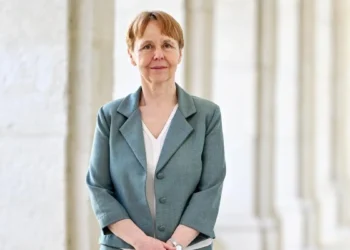
    Ulrike Franke sees demography and climate change as the main geopolitical drivers.

    Ulrike Franke sees demography and climate change as the main geopolitical drivers. Philip Provily/opale.photo

    To person

    Ulrike Franke (39) has been concerned with the major shifts in security policy for years. The German political scientist received her doctorate from Oxford and is currently a Senior Policy Fellow in the Paris office of the European Council Foreign Relations (ECFR) think tank.



    Source link

    Related Posts

    Heat: Forgotten in the car: 18-month-old child in Marseille is dead – DiePresse.com
    Austria

    Heat: Forgotten in the car: 18-month-old child in Marseille is dead – DiePresse.com

    June 28, 2026
    Out of the democracy crisis! But how? – DiePresse.com
    Austria

    Out of the democracy crisis! But how? – DiePresse.com

    June 27, 2026
    Pastor Hansl: “The church was never super cool, but it is currently celebrating an extreme comeback” – DiePresse.com
    Austria

    Pastor Hansl: “The church was never super cool, but it is currently celebrating an extreme comeback” – DiePresse.com

    June 27, 2026
    Tenants’ association wants to shift operating costs: “That would save a million households a lot of money” – DiePresse.com
    Austria

    Tenants’ association wants to shift operating costs: “That would save a million households a lot of money” – DiePresse.com

    June 27, 2026
    If you want to lead well, you have to communicate even better – DiePresse.com
    Austria

    If you want to lead well, you have to communicate even better – DiePresse.com

    June 27, 2026
    Justice Minister Anna Sporrer wants to spare young people from imprisonment – ​​DiePresse.com
    Austria

    Justice Minister Anna Sporrer wants to spare young people from imprisonment – ​​DiePresse.com

    June 27, 2026
    Next Post
    The goal is to convert money (is it?) – people are suffering from the Samarkand “work abroad” scheme

    The goal is to convert money (is it?) - people are suffering from the Samarkand "work abroad" scheme

    POPULAR NEWS

    Pema Deki Brings Bhutanese Heritage to the World of Luxury Watches

    Pema Deki Brings Bhutanese Heritage to the World of Luxury Watches

    June 27, 2026
    World Cup 2026: Ecuador resists, defeats Germany and advances to the 16th round

    World Cup 2026: Ecuador resists, defeats Germany and advances to the 16th round

    June 28, 2026
    Pastor Hansl: “The church was never super cool, but it is currently celebrating an extreme comeback” – DiePresse.com

    Pastor Hansl: “The church was never super cool, but it is currently celebrating an extreme comeback” – DiePresse.com

    June 27, 2026
    Greenland Sagalands: Tourism helps keep our culture alive

    Greenland Sagalands: Tourism helps keep our culture alive

    June 27, 2026
    Palace: Impeachment trial won’t cause division, affect gov’t work

    Palace: Impeachment trial won’t cause division, affect gov’t work

    June 27, 2026

    EDITOR'S PICK

    Extradited Sait Saitov from Serbia, suspect of the accident in Kapistec with fatal consequences

    Extradited Sait Saitov from Serbia, suspect of the accident in Kapistec with fatal consequences

    June 27, 2026
    Nancy Guthrie investigation: Why the trail went cold

    Nancy Guthrie investigation: Why the trail went cold

    June 27, 2026
    A mother died saving her daughter during the earthquake in Venezuela

    A mother died saving her daughter during the earthquake in Venezuela

    June 27, 2026
    The mistake made by those whose belly fat does not melt even though they constantly try has been revealed.

    The mistake made by those whose belly fat does not melt even though they constantly try has been revealed.

    June 28, 2026

    Recent Posts

    • "When borax is knocked into my hand, I have no desire or irritation" Zuri has struggled with weight most of his life. After countless diets, this is how he finally managed to free himself from carbohydrates and sugar in collaboration with the Abrahamson Institute
    • Jordan condemns the Iranian attacks on Bahrain and affirms its support for its sovereignty
    • Meeting with Sheikh Mohammed bin Zayed and the Syrian Foreign Minister
    • Al-Quds newspaper

      © 2026 Agentially - Navigating shifting sovereignties and global risk .

      Welcome Back!

      Login to your account below

      Forgotten Password?

      Retrieve your password

      Please enter your username or email address to reset your password.

      Log In
      No Result
      View All Result

        © 2026 Agentially - Navigating shifting sovereignties and global risk .

        This website uses cookies. By continuing to use this website you are giving consent to cookies being used. Visit our Privacy and Cookie Policy.