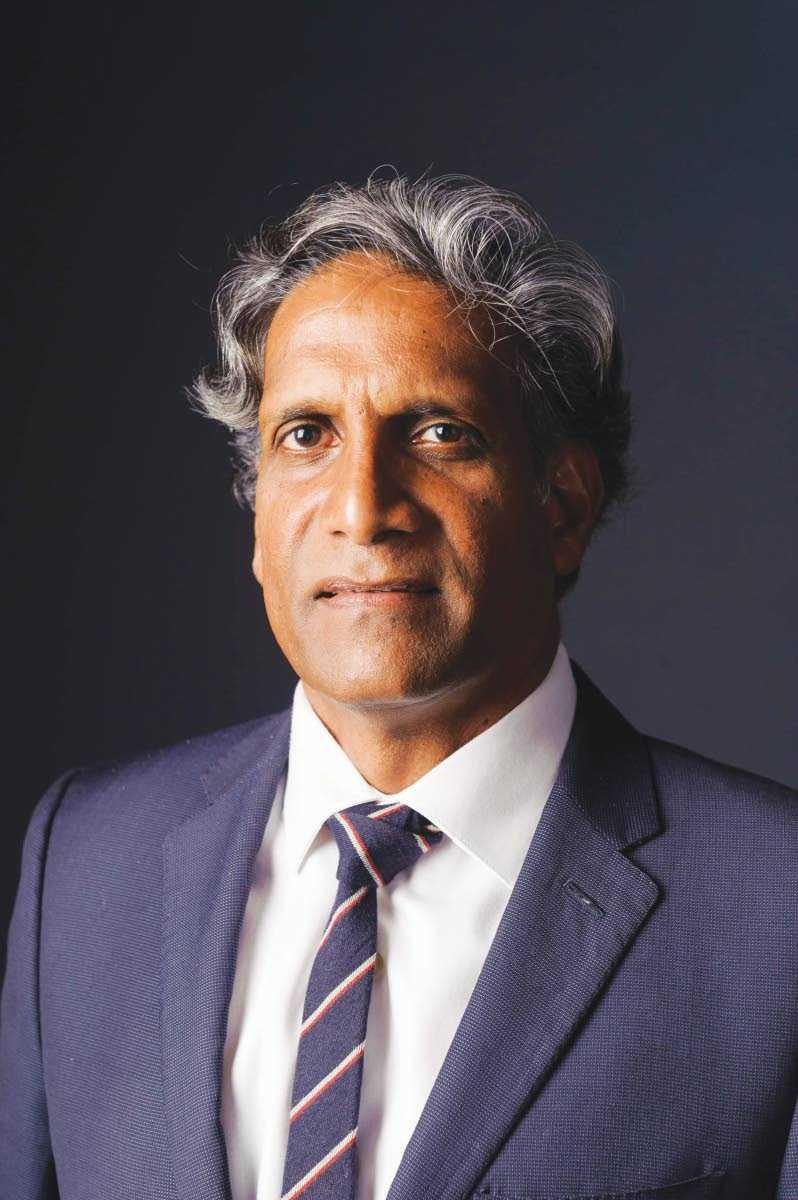
Dr Fazal Ali
Global hyperscale AI infrastructure is undergoing a massive US$3 trillion capital investment supercycle. This capital expenditure is driven by hyperscalers eager to build advanced AI data centres and procure hardware. Forecasts project global capacity will double from 103 GW to nearly 200 GW by 2030.
Driven by the explosive demand for Gen-AI foundation models, these mega-campuses are rapidly expanding from single facilities into gigawatt-level ecosystems spanning North America, Europe, and Middle East countries along the Persian Gulf and the Strait of Hormuz. But AI can’t build data centres, upgrade power grids, and fit pipes.
ChatGPT, Claude, and DeepSeek can’t build a solar farm at Brechin Castle, a combined-cycle power plant at Union Industrial Estate in La Brea, or the heating, ventilation, and air conditioning (HVAC) infrastructure needed for a Tier IV data centre in Trinidad, in which every piece of equipment, from generators to cooling units, has multiple independent, physically isolated backups.
The AI hyperscale buildout in the Middle East, the AI cloud hub in Canelones, Uruguay, the Chile Central AI project in Quilicura, the Rio AI City and São Paulo’s Tier 4 fault-tolerant architectures all require a welding torch, a hard hat, and steel-toed boots, not just PyTorch, laptops, and Retrieval-Augmented Generation (RAG) tools. AI is not just creating a new computing age; it’s driving the reindustrialisation of nation-states.
AI is building a new TechVoc layer of work. In the recent past, the Industrial Revolution, financed by the Transatlantic Slave Trade, was similarly challenged by shortfalls of skilled labour in fabric mills, foundries, and machine tool shops. To address the skills gap during the Industrial Revolution, Victorian leaders established the City and Guilds of London Institute.
On November 11, 1878, the institute set out to train craftsmen, engineers, and technicians. It enacted specialised curricula aligned with engines of economic growth. What followed were companies, trade unions, and labour laws, as social and contractual technologies were used to scaffold the economy.
Development in the Intelligent Age demands that countries implement specialised education and technical and vocational schools tailored to specific industries. These interventions are aligned with targeted economic growth poles, special economic zones (SEZs), and prosperity engines.
China’s “industry-education integration” is built around AI tech projects in economic centres, with a focus on talent, technology, and investment. India has a “Skill Upgradation Strategy”. The aim is to achieve a $5 trillion GDP target. India’s National Skill Development Corporation comprises 36 Sector Skill Councils, which develop Qualification Packs to ensure that TechVoc training is demand-driven and future-proof.
The intervention is guided by SMART goals, on-the-job training, mentoring, and incentivising employees to bridge gaps in AI, digital, and soft skills for future-proofing careers. Globally, salaries in the skilled trades have become competitive. The AI buildout requires plumbers, electrical, structural, and commissioning engineers, ironworkers, bricklayers, pipefitters, and masons.
The AI race has two tracks: a digital skills stream and a technical-vocational skills track. On the technology and digital skills track, countries need application-specific integrated circuit designers who can build custom silicon microchips tailored to perform a single, highly specific function rather than general-purpose computing.
They also need network and systems engineers to build ultra-high-speed, low-latency network fabrics that meet InfiniBand standards, which use NVLink technology to connect thousands of servers. In addition, they need Machine Learning Operations Engineers (MLOps) to design scalable storage pipelines and deployment platforms that enable data scientists to efficiently feed, manage, and process petabytes of training data.
But all of this rests on a layer of labour, including the Critical Infrastructure Engineers who design the physical buildings, focusing on high-density power distribution, liquid-cooling systems, and backup power to prevent outages. And finally, the Power and Energy Engineers who focus on sustainable, efficient power procurement and grid integration to manage the extreme electricity demands of AI hardware.
AI is giving the world a chance to build again, swinging hammers, pulling wire and fitting pipes. The scale of the built environment required to house AI Architecture that powers AI-Assemblages is staggering. Capital spending by the largest US tech companies could reach US$700B in 2026 alone, driven by data centre construction and the infrastructure needed to train and deploy AI models.
Talent companies have analysed job postings and found that demand for skilled trades is growing at three times the rate of professional desk-based roles. Postings for construction workers, welders and electricians are up between 18 per cent and 30 per cent. More specialised roles have seen even sharper spikes: demand for robotics technicians jumped 107 per cent, and HVAC engineers surged 67 per cent.
AI is creating a new industrial era, not just a new intelligent infosphere. But the pipeline of workers entering the trades is not keeping up. It is a once-in-a-generation opportunity to reindustrialise countries.
Dr Fazal Ali completed his Master’s in Philosophy at the University of the West Indies. He was a Commonwealth Scholar who attended the University of Cambridge, Hughes Hall; the Provost of the University of Trinidad and Tobago; the acting President of UTT; and the Chairman of the Teaching Service Commission. He is the President of NIHERST and an external services consultant with the IDB.