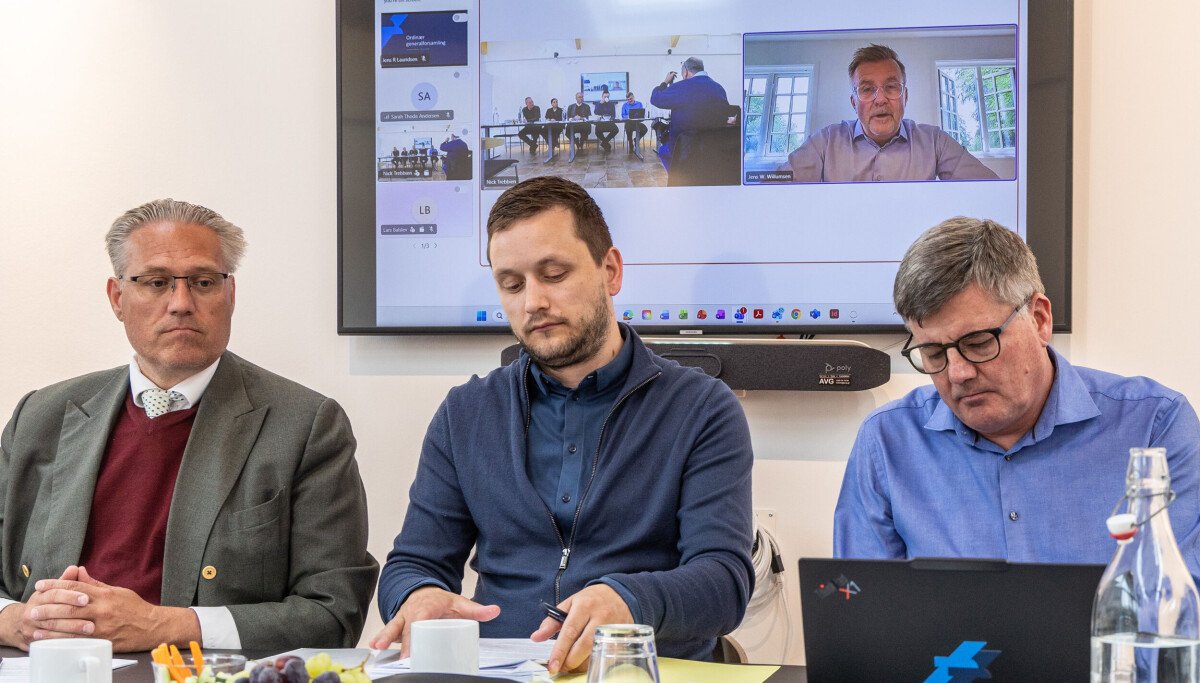
It was seriously reminiscent about an old-fashioned prayer meeting, where repentant sinners confessed their mistakes, and the skeletons almost fell out of the cupboards, when Greenland Airports held a general meeting at the company’s head office at Qeqertanut in Nuuk last week.
Outside it was quiet summer weather, but inside black clouds were gathering. On behalf of the owners, Naalakkersuisut, chairman of Naalakkersuisut Jens-Frederik Nielsen spoke in capital letters.
It was seriously reminiscent about an old-fashioned prayer meeting, where repentant sinners confessed their mistakes, and the skeletons almost fell out of the cupboards, when Greenland Airports held a general meeting at the company’s head office at Qeqertanut in Nuuk last week.
Outside it was quiet summer weather, but inside black clouds were gathering. On behalf of the owners, Naalakkersuisut, chairman of Naalakkersuisut Jens-Frederik Nielsen spoke in capital letters.
– Greenlandic airports play a very special role in society. They are much more than traffic junctions. It is for many people the lifeline that ensures supplies and quick help when the need is greatest – so we have a special obligation to make the airborne infrastructure work, said Jens-Frederik Nielsen.
– Greenland Airport’s results have simply not been good enough – and now the company must show a will to solve the problems.
New board with challenges
After this regular ski ball held in a cultured, neat and urban tone, board chairman Jens Wittrup-Willumsen was given the floor by a team connection from Denmark.
It was the chairman’s first annual report. He was appointed together with four others of the seven board members last year at an extraordinary general meeting, after naalakkersuisut had lost patience with the company and not least all the problems with the new airport in Nuuk.
Jens Wittrup-Willumsen stated that the Greenland Airports group will come out of 2025 with a result of minus DKK 2.77 billion against minus DKK 208 million the previous year. These are appalling sums, primarily due to accounting technical depreciation and write-downs, which in total amount to just over DKK 3.0 billion. The write-downs are spread over the three new airports with approximately DKK 1.77 billion in Ilulissat, approximately DKK 824 million in Nuuk and approximately DKK 326 million in Qaqortoq.
With the write-downs, the newly elected board first of all ensures that the accounts reflect the company’s real value by posting the assets at a possible sale price – and not at the construction price.
It is both good accounting practice and timely care, but also ensures the newly elected board of directors peace of mind, because the maneuver gets rid of possible financial dead bodies in the load from previous boards. All other things being equal, the board thus gets rid of the sins of the past and can focus its work on the future development of the company. As the popular saying goes, a line has been drawn in the sand.
– At the same time, it is important to emphasize that since the airports have been built and paid for, the write-downs do not have a liquidity significance for Greenland Airports, says managing director Jens Lauridsen, who also points out that the write-downs are only an accounting technical value adjustment, and they do not in themselves affect the state treasury’s finances either.

Lacks security
Still, there are challenges enough in the future.
First of all, the many problems with security at Nuuk Airport. It emerged at the general meeting that this task is totally underestimated.
Greenland Airports had originally budgeted for 20 employees for the task. Now it turns out that there must be 60 employees. It takes time to hire, train and security approve so many people – and so far Greenland Airports is getting help with the task from security employees from Copenhagen Airports.
At a press conference after the general meeting, Greenland Airport’s managing director also acknowledged that the problems with security are mainly due to the fact that the terminal building in Nuuk is constructed completely incorrectly – and cannot be immediately changed.
– It is a mistake that we mix regional and international traffic in the same arrival and departure. But immediately the design of the building does not provide any opportunities to change this, explained Jens Lauridsen, who could tell that the need for security employees in Qaqortoq and Ilulissat will be significantly less for the same reason – and not least because there is less traffic at the two airports, so that the security employees can do other tasks when there is no traffic.
Need for air traffic controllers
Another major challenge at the airport in Nuuk is that initially not air traffic controllers were calculated, but AFIS operators in Nuuk. It has turned out that both airlines and especially the Swedish Transport Agency were unhappy with that solution.
Last year, this led to restrictions in traffic management, which, among other things, has given Air Greenland major challenges with the regional flights in connection with Tuukkaq’s arrivals and departures.
The challenges have been solved with a so-called TMA flight management system, which was introduced from 14 May this year in collaboration with Naviair. Air traffic control directs the planes down to the airport, after which the AFIS operators, who until now keep track of the traffic at the airport itself.
Greenland Airports expects that the Swedish Transport Agency will demand a TMA in connection with the future airport in Ilulissat.
At the general meeting, it was also stated that in the initial year in Nuuk there had been challenges in securing fuel for the large Airbus aircraft – and therefore they had to invest in a new fuel trailer with a capacity of 30 m3.
In addition to the challenges with the new airports, Greenland Airport’s finances in 2025 are affected by a fire at the workshop in Kulusuk and an expected fine of DKK 8 million in connection with an oil spill.