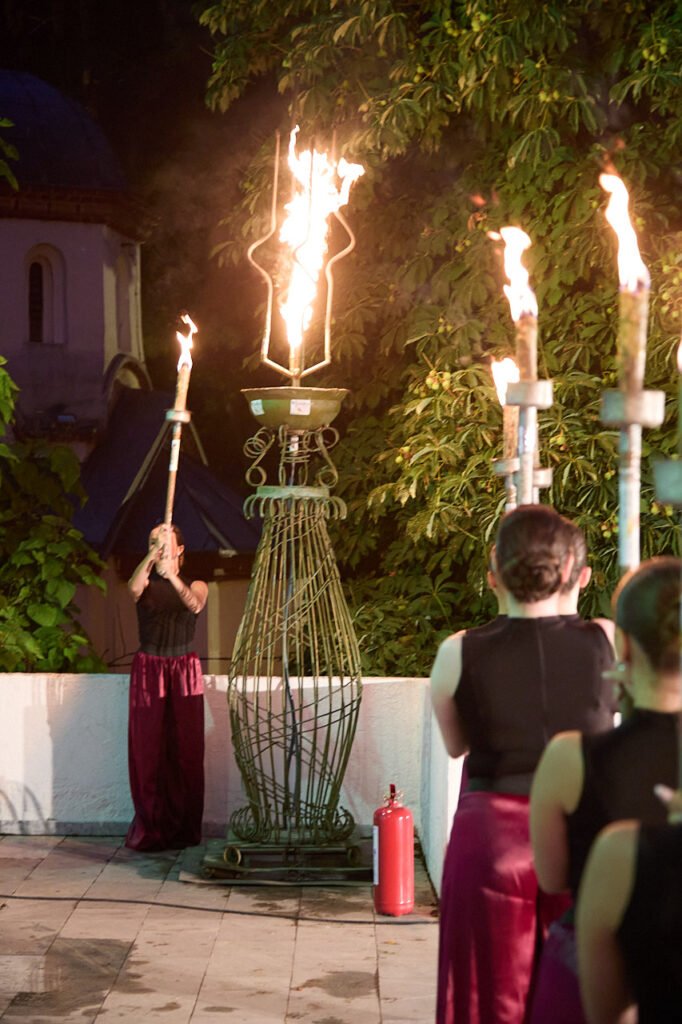
The 65th edition of the most prestigious poetry event in the world, the Struga Evenings of Poetry, began with the lighting of the festival fire and the reading of Konstantinova’s T`ga for the South tonight at the House of Poetry in Struga. Struga once again became home to poets from all poetic meridians, sending a message that poetry still has the power to unite, inspire and defend human dignity.
The festival was declared open by the patron of the event, the president of the Republic of Macedonia, Mrs. Gordana Siljanovska-Davkova, and the Minister of Culture and Tourism, Mr. Zoran Ljutkov, and the director of NUM Struga evenings of poetry, Mr. Nikola Kukunesh.
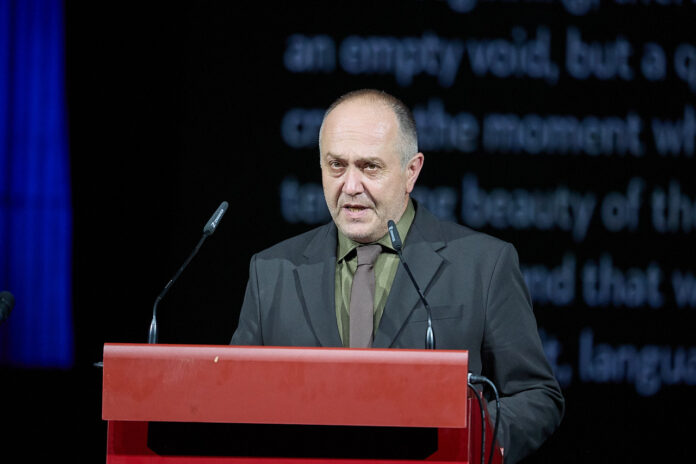
Wishing them a warm welcome in Struga, the director of NUM Struga evenings of poetry, Nikola Kukunesh, at the ceremonial opening in the House of Poetry, noted that in the era of digital globalization, we are faced with a new, silent, existential challenge and that big languages are a serious threat to small ones.
– Big languages, carried on the wings of technology, are a serious threat to small languages, which are fighting a lion’s battle to keep their breath. With the extinction of a small language, not only a few thousand words disappear from a dictionary. A unique way of looking at the world is dying. A unique shade of the sunset, which can only be named in that language, is erased, a specific sadness and an authentic joy evaporate. I don’t believe there is any disagreement about the fact that small languages are the guardians of unique codes related to the soul, which, if they disappear, no big language will be able to translate, replace or compensate them – underlined Kukunesh.
According to the director of the Struga evenings of poetry, the language survives only if we live it daily, create literature or translate it, fill the digital space with it, so that it does not remain an empty echo of the past, but pulsates as a living voice in the future.
– The Promethean goal of all of us who live and create in small linguistic environments is to preserve that flame and pass it on to future generations. Placing language in a strict framework, away from outside influences, does not offer an optimistic perspective. The language survives only if we live it daily, create literature or translate it, fill the digital space with it, so that it does not remain an empty echo of the past, but pulsates as a living voice in the future. And today, as in the past 65 years, we are here in honor of the Strugian brothers Dimitrija and Konstantin Miladinovci, on the 165th anniversary of the publication of the “Dictionary” – the capital work of the Macedonian revival. We are here again to bow to them and express our deepest respect, with a vow that we will not leave their work to oblivion. We learned from them that poetry can live anywhere, and from the “Struga evenings of poetry” that Struga is its home – Kukunesh added.
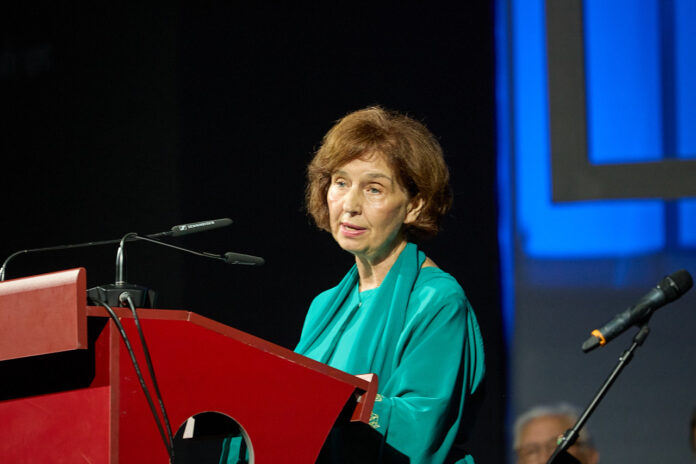
For the president of the country, Gordana Siljanovska-Davkova, being in Struga is a gift for the senses and a balm for the soul.
– Struga is the most poetic city on the planet, the city that lives from emotional outbursts and with them, in which songs create images of joy and sadness, crying and laughter, the singular becomes the plural, that is, work and culture. For 65 years, this poetic home connects meridians, unites and unites the world’s poetic strain with lovers and admirers of the beautiful word in the old but vital Struga rebellious republic of poets, who are fighting for a better and more humane life. For six and a half decades, we have been blessed to host masters of language and alchemists of thought, translating them into aesthetics and ethics – said Siljanovska-Davkova.
Struga, underlined, saw and she was seen by numerous top participants and laureates of the “Golden Wreath”, poetic relatives of Prlichev.
– Their names are sown in the Park of Poetry, together with the planted trees, as faithful witnesses of the limitlessness of poetry. Thanks to them and to her, we overcome the ephemerality of events and things that disturb and annoy us with the eternity of the spirit. And this year, here at the House of Poetry “Miladinovci Brothers”, we witness the simplicity and modesty of the magicians of the word, who recite, if only lead a battle of life and death, disturb or caress us, open universes, confront us with painful truths, throw us or save us from the waters of Dream, if only eels eager for the Sargasso Sea, teach us and encourage us to disobedience, freedom, defiance, sensitivity and wisdom – emphasized the president of the state and patron of the event.
Siljanovska-Davkova believes that poetry still has the power to change and even save the world despite the infestation of algorithms and cruel artificial intelligence. Art, he underlined, is a bellwether, and literature was and remains not only an aesthetic, but also a social rebellion.
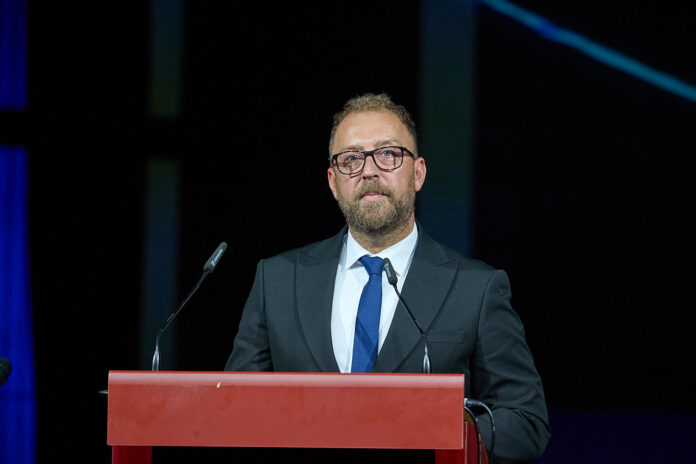
Tonight Struga, as underlined by the Minister of Culture and Tourism Zoran Ljutkov, again becomes a place where the word exceeds its literary form and gains the power of a spiritual event.
– The Struga evenings of poetry represent one of the most successful cultural stories of contemporary Europe. The weight of this manifestation does not lie in its duration, but in the influence it left on contemporary world poetry. Their true value lies in the fact that here, year after year, the dignity of diversity is confirmed. Poetry has always been one of the surest ways in which humanity speaks to its conscience. The verse preserves the fears and hopes of eras, the memories of nations and the eternal human search for meaning. Hence its lasting value: it does not offer ready-made truths, but expands the horizon of our understanding of the world and ourselves. That is why the Struga evenings of poetry are more than a literary event. They represent a testimony that culture still has the power to create closeness where there are differences and to build trust where there are distances – Lyutkov said.
Regarding the poetry of the laureate of the 65th Struga Poetry Evenings, Dutch poet Anneke Brasinga concluded that she explores the border between the visible and the invisible, between everyday life and the secret that lives behind it.
– In her verses, words do not describe the world. They question it. They do not offer ready answers, but open new horizons of thought. Brassinga belongs to those rare authors who manage to create a sense of eternity from an ordinary moment. Her poetry reminds us that man does not live only in the time measured by the clock, but also in the time created by memories, dreams and hope – underlined Ljutkov.
According to him, the awarding of the Golden Wreath to Anneke Brasinga carries additional symbolism. Macedonia and the Netherlands have been building friendship based on mutual respect, understanding and cooperation for decades.
– Tonight, those connections get a new expression in the space of culture, where peoples meet through their deepest spiritual experiences. Politics shapes relations between states, but culture creates their deeper meaning. It creates permanent bridges in the space of human experience – Ljutkov added.
About 70 poets, critics, translators and literary workers from the country and abroad are participating in the jubilee 65th Struga evenings of poetry, which are being held this year under the motto “Where poetry lives”. In addition to the winner of the “Golden Wreath” for 2026, Anneke Brassinga from the Netherlands, the winner of the “Bridges of Struga” award, Daniel Hinds from the United Kingdom, eminent poets from Macedonia, Greece, Turkey, Mexico, Spain, China, Italy, Mongolia…