Havana/The Antonio Guiteras thermoelectric plant left the national electrical system (SEN) again this Wednesday, just two days after synchronizing after a repair that was supposed to prolong the useful life of the deteriorated economizer of its boiler. It is the sixteenth disconnection of the plant so far this year.
The fault was detected during the afternoon and forced a controlled disconnection of the block to be scheduled, according to official journalist José Miguel Solís. The first indications again point to a failure in one of the economizer feeders, the same component that has caused several of the recent interruptions at the Matanzas plant.
The controlled output allows the unit to be stopped before the breakdown causes more serious damage, but once again leaves the electrical system without the largest unitary generation block in the country, in the middle of a day marked by a deficit of more than 2,000 megawatts.
Engineer Jorge Gómez Chávez, production director of the thermoelectric plant, explained that technicians were still evaluating the strategy they will follow to repair the damage. The economizer has already accumulated five failures and is severely eroded after almost four decades of operation.
The Guiteras synchronized on Monday afternoon, after being out of service for about a week
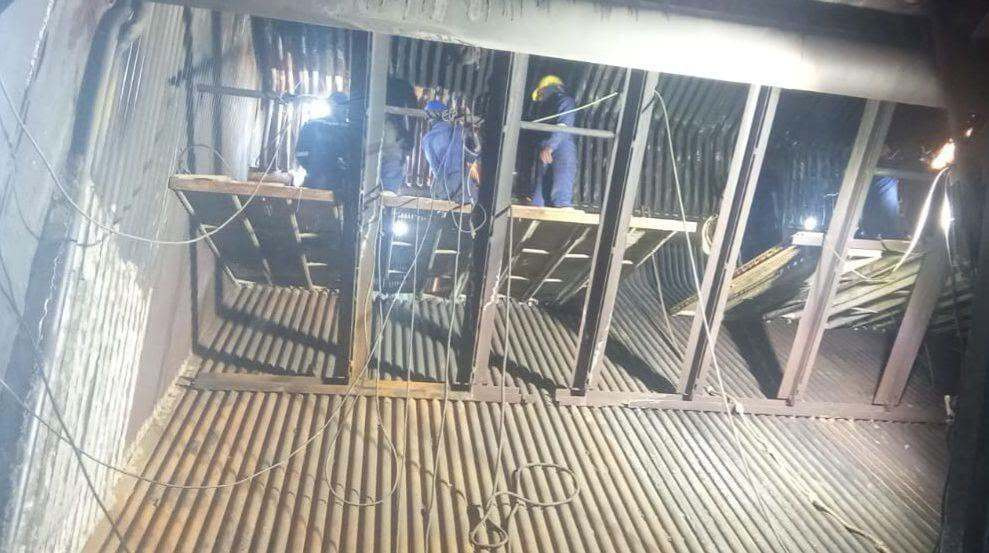
The new breakage is especially significant because it occurs after a repair that included the intervention of more than a hundred joints or welding beads. The specialists had checked the most vulnerable points with the intention of avoiding another immediate exit from the block, but the plant barely managed to stay connected for two days.
The Guiteras synchronized on Monday afternoon, after staying around one week out of service. Previous work also focused on the economizer, where losses and numerous deteriorated segments that could cause new leaks were detected.
Before his reinstatement, plant managers assured that hydraulic tests and radiographic controls had been carried out to verify the quality of the welds. However, this Wednesday’s breakdown confirms that partial repairs have not managed to stabilize a facility that has needed capital maintenance for years.
In just nine days, the thermoelectric plant has left the SEN twice and has required interventions in the boiler. Most of the recent disconnections are related to tube breaks, water leaks or failures in the economizer, a structure responsible for using the heat of the combustion gases to raise the temperature of the water before it enters the boiler.
Each exit requires you to wait for the boiler to cool, locate the damaged point, make the welds and submit them to tests before starting the start-up protocol again.
The deterioration of this component reduces the efficiency of the plant and increases the risk of leaks, due to the high pressures and temperatures at which the pipes work. In the case of Guiteras, erosion is aggravated by the use of Cuban crude oil, heavy and with a high sulfur content, in addition to the age of the equipment.
The plant began operating in 1988 and has not received capital maintenance since 2010. Its managers have acknowledged that a shutdown of several months would be needed to replace essential components and recover its capacity, but the Government avoids removing the block for so long for fear of protests, which usually intensify during the summer.
The consequence is a succession of emergency fixes that allow the unit to be temporarily returned to the system, although without resolving the structural deterioration. Each exit requires you to wait for the boiler to cool, locate the damaged point, make the welds and subject them to tests before starting the start-up protocol again.
In its part this Wednesday, prepared before the new breakdown was known, the Electrical Union had reported an availability of 1,175 megawatts compared to a demand of 2,650 at six in the morning. For peak demand hours, it predicted a deficit of 2,025 MW and an impact of up to 2,055 MW. The disconnection of Guiteras makes these forecasts even worse.
In addition to the Matanzas plant, several units of the Máximo Gómez, Carlos Manuel de Céspedes and Lidio Ramón Pérez thermoelectric plants remain out of service due to breakdowns. Added to these are the plants paralyzed for maintenance and more than a thousand megawatts not available due to lack of fuel.