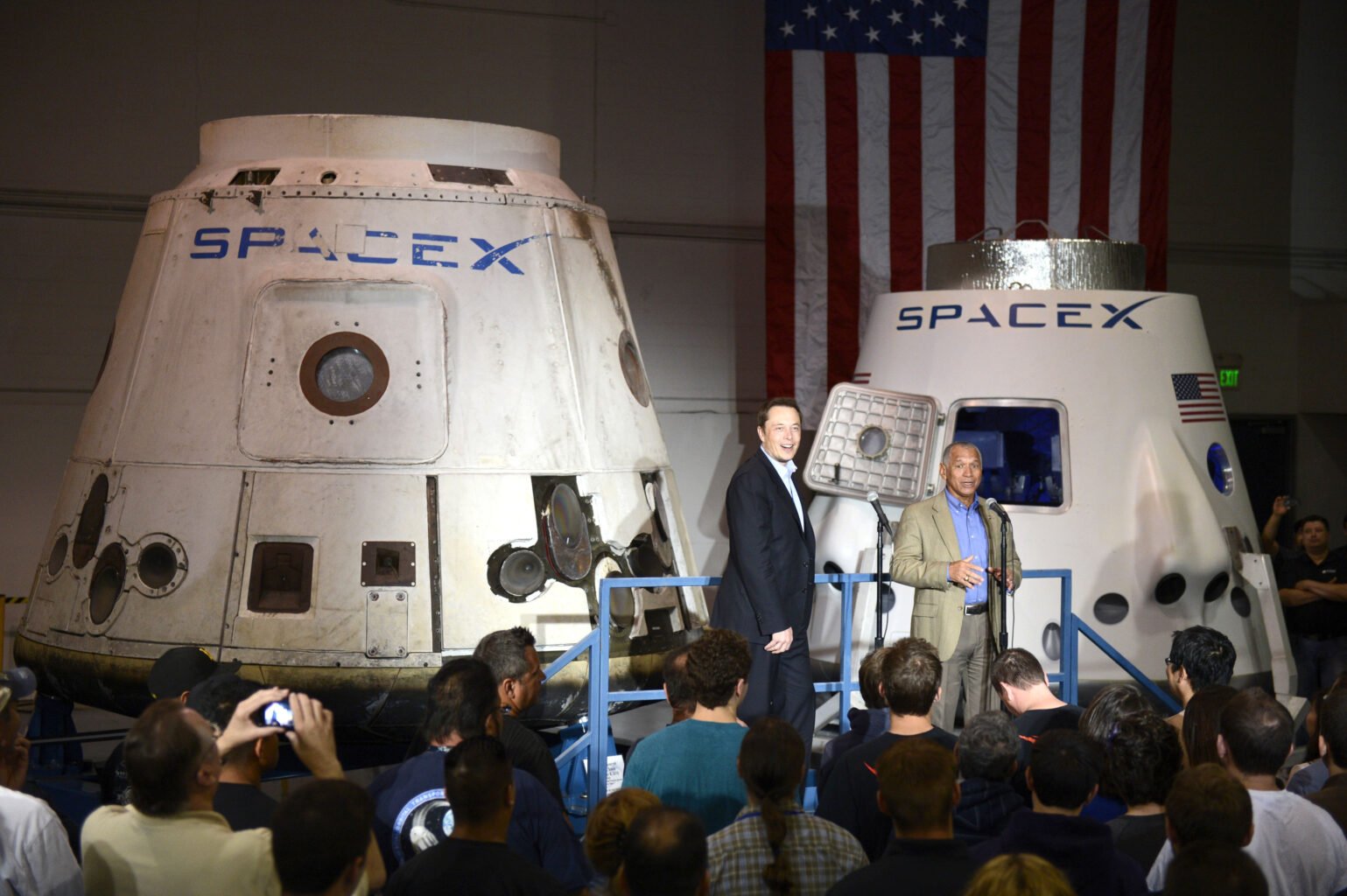

- Elon Musk’s ideas about using SpaceX to build the systems and technologies needed for multiplanetary life and to expand consciousness to the stars are truly surreal. But he convinced investors that there was a lot of money to be made in space. In doing so, Musk heralded the rapid expansion of modern capitalism into orbit and beyond
The extraordinary success of SpaceX’s initial public offering on Wall Street, which brought the company to a valuation of $2.1 trillion (2.1 trillion) at the end of the first day of trading, is a sign of investor confidence in the future of the space economy.
SpaceX promoter Elon Musk’s talk of building artificial intelligence data centers in space and colonizing Mars may seem fanciful. His ideas for using SpaceX to build the systems and technologies needed for multiplanetary life and to expand consciousness to the stars are truly surreal. But he convinced investors that there was a lot of money to be made in space. In doing so, Musk heralded the rapid expansion of modern capitalism into orbit and beyond. That he became the world’s first billionaire is probably less important than the fact that capitalism is ready to make its mark in space.
Since its inception in the 1950s, the space age has been the sole purview of governments. The construction of rockets, satellites, space shuttles, space stations in orbit, and planetary exploration were led by states. During the Cold War, space activity symbolized scientific achievement and national prestige in the all-out competition between Washington and Moscow. Reaching for the sky also meant using space for military purposes and gaining control over a new sphere. Catching up with the United States and the Soviet Union in space has become a national obsession for smaller powers as well.
As missile capabilities and presence in space became a key dimension of the great nuclear arms race between Washington and Moscow, they negotiated the Outer Space Treaty (UST) of 1967, which laid down certain rules for the global governance of the new domain. It prohibited the deployment of nuclear weapons in space; it prohibited the national appropriation of celestial bodies; make governments accountable for space activity; and under pressure from developing countries, declared that outer space belongs to “all mankind” and must be used only for peaceful purposes.
That world is disappearing before our eyes, which was bound to happen; the world of the 1960s is far behind us. By making governments responsible for space activities, the OCT simply recognized the expansive challenges of space-enabled access. With the acceleration of technological capabilities of commercial entities in the 20th and 21st centuries, private players have now become key actors.
In fact, private enterprise is becoming the main driver of innovation, investment and expansion. The center of gravity is shifting from governments to entrepreneurs, investors and corporations, especially American ones.
No company symbolizes this transformation more than SpaceX. In about two decades, Musk has done what governments and established aerospace firms have struggled to achieve for half a century. By innovating to make rockets cheaper and more reusable, SpaceX has significantly reduced the cost of reaching orbit. Access to space, once the privilege of governments, has now become a commercial service.
That led to SpaceX’s dominance in the global space rocket launch business. The company was responsible for nearly 51 percent of all global orbital launches and nearly 85 percent of US launches in 2025. Musk’s Starlink now also dominates the satellite communications market. As of this month, it has nearly 10,500 satellites in orbit and plans to deploy several thousand more as part of a constellation of 42,000. Through Starlink, SpaceX created a global communications network in orbit. Governments, militaries, businesses and individuals increasingly depend on a private satellite constellation for connectivity. During the war in Ukraine, the strategic importance of Starlink became evident to the whole world. As Musk looks beyond commercial and military communications and plans to build data centers in space, he talks about launching a million more satellites.
This is a big twist. For centuries, states built infrastructure and private actors used it. Now, private actors are increasingly building the space infrastructure that nations depend on. SpaceX is not alone: Amazon’s Kuiper project – recently rebranded as Amazon Leo – is aiming to build a competing satellite network. New companies are developing lunar landers, asteroid mining technologies, in-orbit servicing systems and commercial space stations. Eutelsat’s Unweb is another piece of private space infrastructure – and a rare example of a non-US company.
As new frontiers open, the issue of legal governance inevitably follows. Definitions of property rights and dispute resolution become critical. The era of European maritime expansion generated debates about sovereignty claims, freedom of navigation, trade with distant lands, and strategic rivalry. The universe is now approaching a similar moment, casting a shadow over the lofty sentiments of the Space Treaty.
The OST prohibits sovereign claims over the heavenly territory. However, it says remarkably little about the ownership of resources extracted from the Moon, asteroids, or other celestial bodies. Can a company own the lunar minerals it mines? Can it establish exclusive operating zones around its facilities? Can it build infrastructure whose value depends on a certain degree of asset protection? As many nations and companies rush to the Moon’s South Pole, are first movers getting an advantage over latecomers despite talks of equality under the OST? These questions have been largely theoretical until recently. Today they are becoming practical.
The United States has already moved to recognize the rights of companies to own the resources they extract from space. In today’s US law, private actors are categorically allowed to extract and own the “space resources” they recover (for example, from asteroids or the Moon), but the US explicitly rejects any claims of sovereignty or territorial ownership over the celestial bodies themselves and insists that this must remain consistent with the OST.
The US-promoted Artemis Accords, signed by dozens of countries, seek to establish principles for future lunar activities. Some international experts point out that the US approach remains contested – particularly the claim that extracting resources “not by nature” constitutes national appropriation.
Major countries involved in space projects are beginning to follow the example of the United States, but the scale and intensity of private sector participation varies considerably. However, none of them have the depth of the US capital markets and private sector innovation ecosystem.
China has built a fast-growing commercial ecosystem since reforming its space policy in the mid-2010s, where private firms operate under state guidance. Europe actively promotes space entrepreneurship through several funding tools, but remains far behind. Japan has begun to nurture private launch and satellite services, with startups entering under updated legislation. India has liberalized its space sector, giving rise to a dynamic startup environment, but has yet to provide a formal legal framework for expansive private equity growth. Russia is dominated by state-owned corporations, but is slowly opening its doors to the private sector.
Two small but strategically ambitious states – Luxembourg and the United Arab Emirates – have moved quickly to create national legal frameworks that explicitly favor private enterprise in space. Luxembourg, a financial and corporate center far larger than its size, passed a law in 2017 giving companies the right to own resources extracted from space. He backed it up with public investment funds, regulatory clarity and diplomatic outreach. The result is the move of a group of asteroid mining and satellite services firms to Luxembourg, turning the small country into an unexpected hub of the global space economy.