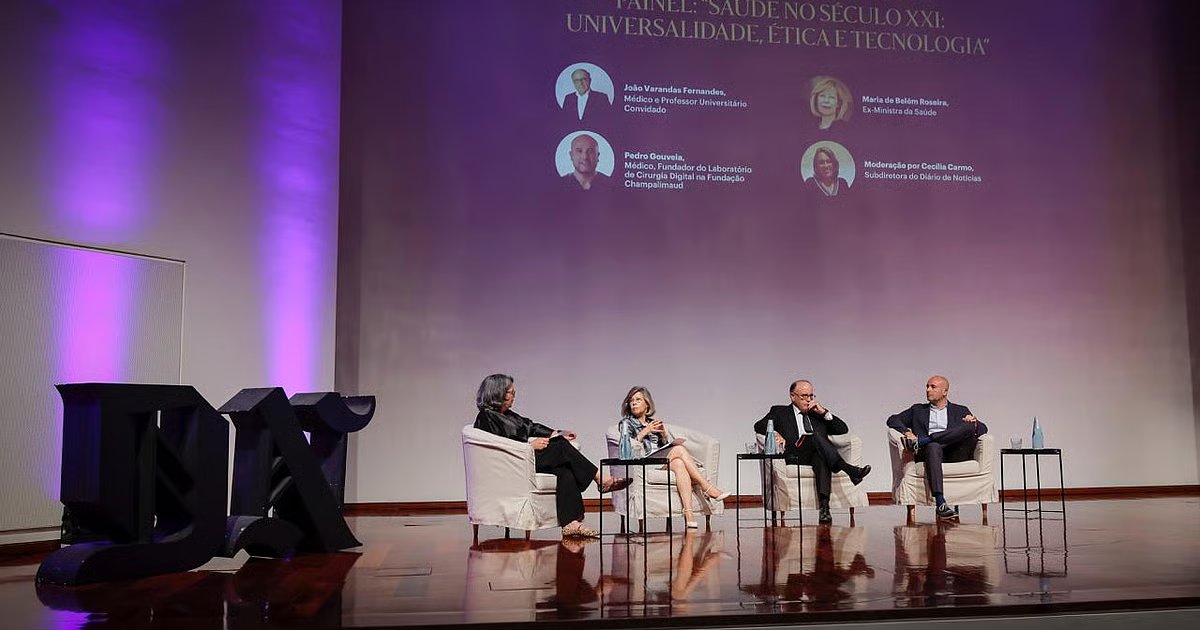
Empathy, ethics, integration of the public, social and private system and the advantage of using artificial intelligence in healthcare. These were the main topics covered in the panel that closed the morning at the DN Grand Conference, which takes place this Monday, June 15th, in the auditorium of the Champalimaud Foundation.
The theme “Health in the 21st century: universality, ethics and technology” was the motto for an exchange of ideas between João Varandas Fernandes, doctor and university professor, Maria de Belém Roseira, former Minister of Health, Pedro Gouveia, doctor and founder of the Foundation’s Digital Surgery Laboratory.
Agreeing that the digital transition is an important factor for the sector, it was also clear that there are situations in which Artificial Intelligence will not be able to replace the professional that João Varandas Fernandes called “the human doctor”. “The machine does not replace the human relationship, in healthcare empathy must be present, but we also know that in healthcare it often does not exist”, added the former Minister of Health.
Maria de Belém Roseira highlighted what she considers to be one of the problems the sector faces: “We have the desire to regulate everything in a heavy-handed way that is completely antagonistic to the speed of things.” And he gives as an example the fact that in health one of the bureaucratic points of public administration cannot be followed: the entry date. “What matters is the seriousness of the case and this has priority”, remembered.
João Varandas Fernandes reinforced the issue of ethics, remembering that the decision-making processes that accompany health technologies – whether digitalization, artificial intelligence or robotics – must follow ethical principles. Recalling the advances that the health sector has undergone in Portugal – “in the last five decades, we have increased average life expectancy by 14 years” -, defended joint work between the private, public and social sectors.
And he presented three principles that he considers important for good management in the sector. “First, there has to be health literacy. People need to be informed about what is happening in terms of health. And many times they are not. The second aspect is that, in addition to explaining what it is, patients have to be explained what this is about new technologies, what this is about AIwhat is this about digitalization, what is this about robotics. I think that a large part of the population doesn’t know what it is”, he began by explaining, concluding this idea with the defense that the healthcare system in Portugal should not be unique. “It should be a private, public and social healthcare system”, he stressed.
“The National Health Service is a fundamental, essential pillar that cannot retreat. Now, the other partners in health matters must enter, they must modulate, there must be no antagonism in relation to this matter”, he highlighted.
Technology at the service
Pedro Gouveia, doctor and founder of the Foundation’s Digital Surgery Laboratory, highlighted the importance of using new technologies, giving as an example breast cancer and a study carried out in Sweden in which two techniques were used: with a radiologist who carried out normal screening and another radiologist who used a softwareand the result was that the radiologist’s work was reduced by around 40% and 12% fewer so-called “interval cancers” were detected, which are those that appear between the usual screenings. “What does this mean? An improvement in terms of quality. We have fewer interval cancers and those that appear are 27% biologically less aggressive”he explained.
The head of the Digital Surgery Laboratory recalled that “when we talk about artificial incidence applied to health, It must be very clear that we are talking about medical devices in the form of software“. A possibility that was approved by the European Union and which, therefore, “can be implemented in Portugal tomorrow and is an excellent opportunity to show how women’s health can be improved at less cost, overnight, in a categorically positive way”.
The importance of empathy
The issue of the relationship between healthcare professionals and patients was also addressed in this panel, with emphasis on how this relationship is important in Portugal. “We really are different, empathy has to be present in every human relationship. machine does not replace human relationships, it should not, but we also have a lot of human relationships, also in healthand, which is also not empathetic, as we know, is it? Therefore, empathy has to be and must be there,” highlighted Maria de Belém Roseira.
João Varandas Fernandes agrees: “I’ve worked in the United States, in New York, in Barcelona. The health professionals there are colder, more distant. And we, here, are more affectionate and more, not in a right of peace, or godparents, in a good way, but we are more affectionate. “
In one of the points of his intervention, he drew attention to a topic that he considers important: investments in health, remembering that, in his opinion, the use of new technologies does not reduce this need, on the contrary.
“Technologies, increasingly, from what we perceive and from what we read and study, are increasingly more expensive. Because it is an open market, it is a European, American and Asian market, competitive for new technologies, and it will be increasingly more expensive. And, therefore, we have to be thinking about this”, he said.
Therefore, it argues that it is a “concern, in political terms, to pay special attention to investment in technologies in the health sector”.
At the end of the panel Pedro Gouveia recalled the need for doctors to be able to access and work on a patient’s data regardless of the hospital unit.. “The problem is that he can see the mirror of the data, but then cannot work on it. The problem is not technological, but it is audiovisual and digital”, he said. And he even left a challenge by remembering examples of colleges that have courses at the end of which students are not only doctors, they are also biomedical engineers, specialists in artificial intelligence.