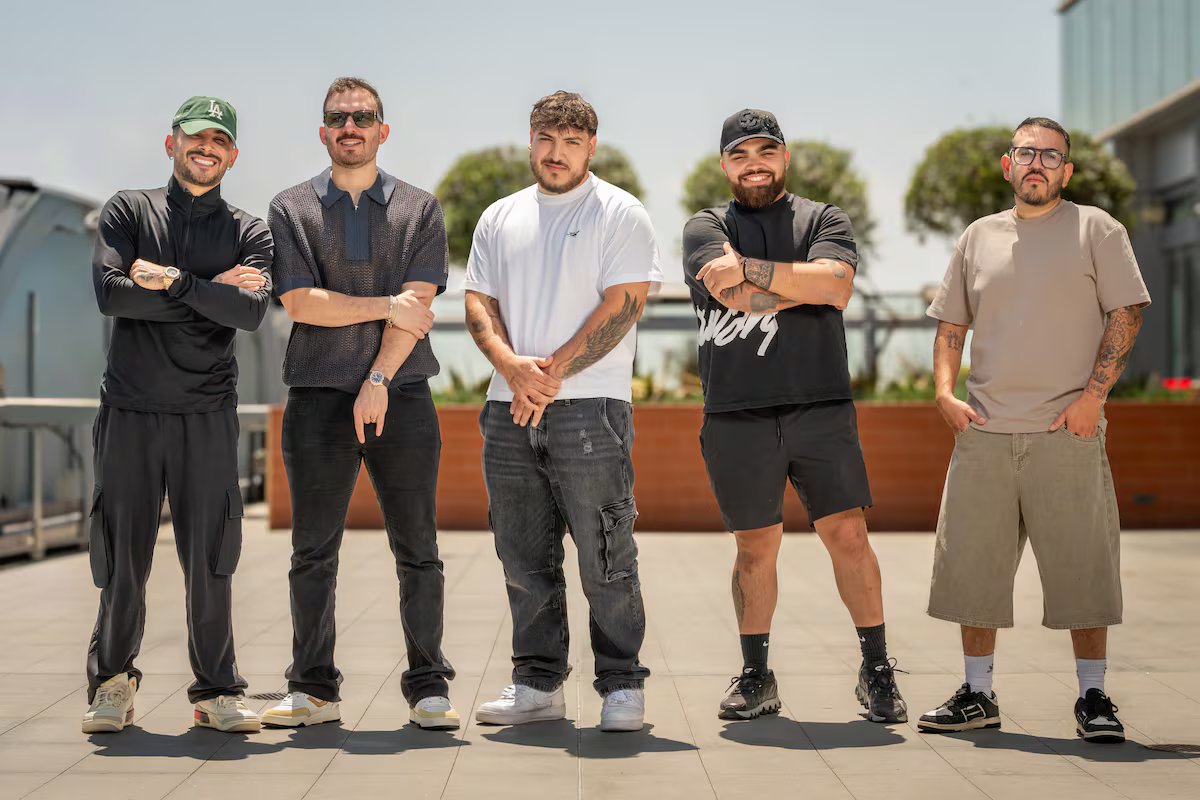
Until a few years ago, the true thermometer of the popularity of an artist or musical group was recording an acoustic concert for the series MTV Unplugged. Today, that seal of consecration was transferred to the Tiny Deskthe short concerts held behind an open desk at the US Public Radio (NPR) headquarters in Washington. Grupo Frontera arrived at that peculiar stage on April 24, 2025, performing five northern ballads in 20 minutes, a performance that allowed them to connect with a different audience. They rehearsed for six days to fulfill the commitment. “All the office workers see you,” recalls Alberto Acosta, guitarist of the group.
That day, however, the most enthusiastic audience was not in that news office, but in the NPR kitchen. Employees who prepare food and wash dishes could not enjoy their songs because they were in the middle of the workday. At the end of the setthe six members decided to go there to play the song The love of his life. It was a second Tiny Desk, improvised and intimate, that never appeared on NPR’s YouTube channel. “It was a dog,” summarizes Acosta.
This is a common scene for these musicians who have become a regional Mexican phenomenon. In any restaurant they arrive at, whether in Mexico or the United States, the same thing usually happens: a waiter approaches to ask them for a favor, to come to the kitchen to greet the workers. “Our audience is the race, the one who is in the pinch, the gardener,” says Juan Javier Cantú, the group’s accordionist. “In the industry, those who only do it for money and fame no longer work, because you are no longer connecting with your people,” he reflects.

Many of his followers are workers who go unnoticed by most: those who work in the private spaces of restaurants, erect buildings at construction sites or keep gardens impeccable in American cities. It is also a community that today lives under pressure due to the tightening of the immigration policies of the Donald Trump Administration and the increase in raids by the Immigration and Customs Enforcement Service (ICE).
The members of Border Group —a band born in Texas, just a hop from the US border with Mexico— say they are no strangers to this persecution. “We want all this to be fixed. Because what is happening in our country is something sad. We see it with our workers, with people close to us. It does hurt us,” says Cantú.
They see the negative effects of Trump’s heavy hand “closer than they think,” says the group’s singer, Adelaido. Payo Solis III. The band’s drummer, Carlos Guerrero, confirms it: “We who live there (in the border city of McAllen) see it every day. It’s sad, but we are in the fight and firm.”
Days after releasing his new EP With pain On May 28, the musicians spoke with EL PAÍS in a skyscraper in downtown Los Angeles, where they stayed while participating in activities related to the World Cup. They recorded a song linked to the tournament for a Hispanic television network. His time in the city was just a break after a tour of Central America and Mexico. In a few days they will leave for Europe to perform in Paris, London, Zurich, Barcelona and Madrid, before concluding the tour. Sad But Good Damn at home, United States. It is the most ambitious tour of their career and, for them, it is an example of the international reach that Mexican music has acquired. A phenomenon promoted by artists like Peso Pluma, Carin LeonNatanael Cano and Fuerza Régida.

“Mexican music is at a point where it is very accepted in many places. Before, artists of the genre were not seen filling stadiums or arenas. For our music to go so far, that we are about to tour Europe, is something that not everyone achieves. We take it with a lot of pride and with a lot of respect,” says Carlos Guerrero, the drummer.
From local parties to massive concerts
The rise of Grupo Frontera has been above all dizzying. In just six years, they went from entertaining quinceañera parties in the Rio Grande Valley, Texas, to massive concerts in which they sold out all the tickets. The turning point came in 2022, when their version of the song It doesn’t go away It went viral on social networks.
It wouldn’t be his limit. A year later they made the final leap to stardom with the song AN X100TO, which they recorded as a duet with the Puerto Rican star Bad Bunny. “I have one percent left / And I’ll use it just to tell you how sorry I am,” says the composition. Just look at the eleven digits below the video to understand the size of the hit: 1,111,614,547 views on YouTube and counting. “The collaboration with Bad Bunny helped us get more respect from the industry,” says Solís. The Puerto Rican invited them that same year to share the stage at Coachella, one of the most important music festivals in the world. It was another check what they did in their artistic career.
Fame, however, has not kept them from McAllen, the border city where they grew up. They describe it as a place that they can travel from end to end in just 15 minutes, a reality very different from that of the cities they now travel through. In their land they are still surrounded by neighbors who speak Spanish and who cross into Mexico daily to shop, go to medical appointments and taste the Aztec seasoning. Far from representing a barrier, that environment shaped their artistic identity and encouraged them to sing in the language of their parents, they say.
“Before we said: for Mexicans we are not so Mexican and for Americans we are not so American,” recalls Solís. “They asked us: How can you sing music in Spanish if you don’t speak Spanish? Well, that’s what Selena did. She didn’t speak Spanish perfectly, but she sang it. When we started, I improved the language.”
The reference to Selena Quintanilla is not coincidental. In the 1990s, the so-called “queen of Tex-Mex” paved the way from Texas for generations of artists raised between two cultures. He was one of the first figures to conquer audiences on both sides of the border, at a time when much of the regional Mexican music that was consumed in the United States came from the other side of the Rio Grande. Before her, Chalino Sánchez, from Los Angeles, had managed to connect with the migrant community through corridos. Later, artists and groups such as Lupillo Rivera, Jenni Rivera, Intocable and Gerardo Ortiz would come.
The growth of Grupo Frontera coincides with a time of uncertainty for that musical genre. In recent months, several artists have faced cancellation of their work visas, especially narcocorrido performers. The members of the group observe the situation with concern, although they trust that the situation will soon change, for the better. “What happens to the famous ‘freedom of expression’?” asks percussionist Julián Peña, drawing quotes in the air with his fingers. “You’re supposed to be free to sing and talk about whatever you want in the songs.”

Solís believes that the worst has happened. “At first it did feel heavier, both because of the visas and because of the people who were afraid to go to a concert (because of the ICE operatives). But I feel that everything is improving.” In times marked by the immigration debate and political tensions, these musicians believe that their cumbias fulfill a function that goes beyond entertainment. “It is giving strength to the entire community,” they say.
The list of collaborations of this group is extensive: ShakiraMaluma, Carlos Santana, Morat, Christian Nodal… They have traveled between bachata, country, R&B, reggaeton and electronic music. Their next objective is to reinforce their own artistic identity, says accordionist Juan Javier Cantú: “We want to demonstrate little by little that we are not just the artists of the featuring”.