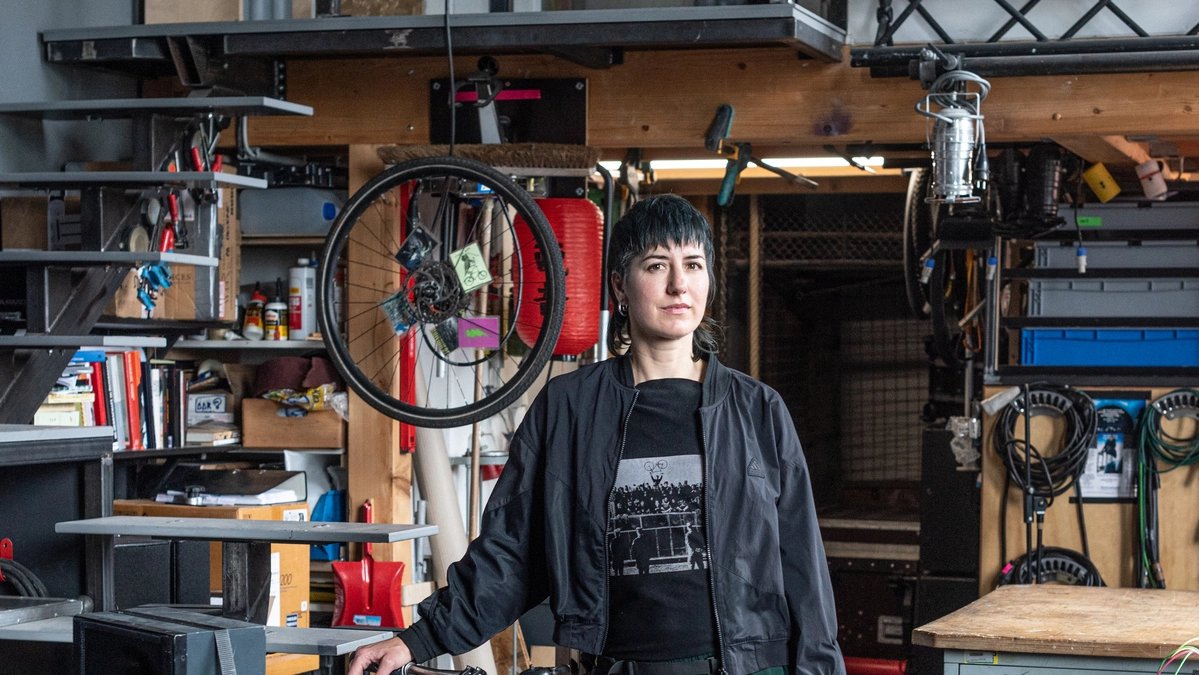
A nut snail is the first thing that Conny Zenk offers to her visitors in her studio community Kunstkanal. As a well-trained cyclist, she knows that cycling tours can prevent hypoglycemia. Then things quickly become technical in the conversation with the artist and bicycle activist, the reason for this is and is hanging in every corner of her workshop in the Association for Transdisciplinary Arts and Technologies: She has stored a bunch of bikes and sound systems here. For ten years, Zenk has used a combination of both as a vehicle for “Sound Rides,” in which she links the fields through which she moves: media art, performance in public spaces, music and bicycle culture.
Loudspeakers are strapped to a cargo bike, and there are more next to them. “These were the first small speakers,” she shows a structure. “We welded a bracket with which you could mount them on any bike. At some point it wasn’t loud enough, so we added a bass speaker.” We are the sound engineer Georg Hartl, who takes care of the audio systems, and a team for video, graphics and production. At their events, interdisciplinary artists come to the art channel, sound artists and sound bike drivers. From here they set off together, often to the nearby Prater and the spiral ramps of the Danube Island Bridges. “In the cycling spiral, everyone rides in circles, the sound comes from all directions, a beautiful moment.”

The sound rides have often had the Prater as their destination, and on the three rides on the theme of “Resonance and Resistance” Zenk heads to the Schlurs meeting points there. Hannah Mayr
Urban history is also a field that Zenk deals with. At the beginning of the 20th century there was the practice of “cycling,” she says. Six or more people performed choreographies, in a circle or a spiral. Around 1920, Viennese workers took to Heroes’ Square on their bikes, where they also danced in formations with bikes. It’s no coincidence that today, at Zenk’s bike performances, there are always six sound bikes at the start in addition to a radio bike with an antenna, which they also use to do choreographies: an interpretation of the historical round dance.

Zenk’s partner Georg Hartl takes care of the sound technology tinkering for the mobile sound systems. Christine Pichler
Zenk first came across a specific episode in contemporary history when she looked at early Viennese subcultures. That’s when she came across the “Schlurfs”, the Viennese youth culture during the Nazi era. She describes them as working-class youth who wore their hair longer from the 1930s to the 1950s: They styled it in a “swallowtail, a hairstyle with gel,” and dressed with a tie and a borsalino, the elegant Italian hat. The teenagers copied this from films. Above all, they listened to and played American jazz, which was considered degenerate art.

Conny Zenk’s sound rides repeatedly transform the bicycle spirals near the Danube Island into a concert arena. Hannah Mayr
“It was frowned upon, but not forbidden,” says Zenk. There were loopholes to maneuver through everyday life unlike the Hitler Youth. She has been intensively researching this subculture for a year, which resulted in a special sound ride project. Under the motto “Resonance and resistance. On the trail of the sound of the Viennese counterculture”, their bikes will become “swing bikes” this summer, with which they, participating artists and the audience can experience the places of the Schlurfs. Your first stop will be the Prater, which is close to the studio. Because that’s where the young people met and listened to records, the “St. Louis Blues”. Louis Armstrong or the fast-paced “Tiger Rag”.

In the art channel, Conny Zenk has a room for many bicycles, music systems and her research documents on the youth culture of the Schlurfs. Christine Pichler
Together with the social scientist Wanda Spahl, Zenk submitted the project as part of a call from the City of Vienna for contemporary forms of remembrance, and since then they have worked on a lot of archive material. In the studio she shows books, including the graphic novel “Schlurfkatzen”, which focuses on women in the scene. Zenk is particularly interested in the feminist perspective; until now it has been a blind spot. That’s why she now wants to tell the story of Franziska Votypka, “who was introduced to the scene in the Second Vienna Coffee House, a meeting place for the Schlurfs.” If many places were bugged, they could play jazz here uninhibited. Today the grass from the hockey pitch grows over it; back then the Prater was a wild open space.

The historic toboggan, the “Devil’s Slide”, continues to contribute to the Prater fun today; back then, the Schlurfs met in front of it and listened to jazz. Picasa
The project is intended to better anchor the Schlurfs in the city’s history – with a website, Vienna Wiki entries, and mediation for schools. To raise awareness of what it’s like to dress differently, to dance, to sing resistant songs. Zenk doesn’t want to romanticize the Schlurfs as anti-fascist heroes; their culture wasn’t political per se, but the jazz enthusiasts distanced themselves from the Nazis simply because of their non-conformist appearance and behavior. First and foremost, it should be about placing yourself in time through artistic interpretation. That’s why Zenk grabs one of her bikes during the interview and takes us into the Prater: to the Toboggan slide, to the ring game, to the stadium pool. The young people set up their portable gramophones there.

The bikes transform into mobile sound systems and provide sound to everyone riding in the group. Hannah Mayr
There will also be live performances on the first outing: Among other things, the composer Mario Bergamasco accompanies the bicycle train with the Construction Choir Collective to sing Schlurflieder, Anna Weidenholzer and Jopa Jotakin read texts, with a jazz-techno mix by Mona Matbou Riahi we continue to the Danube Island and a cycle spiral, which they transform into a new Café Schlurf to the music of Electric Indigo. On the second trip, you discover the story for yourself with augmented reality content, before the third tour takes you together to the tenth district, which is also an important place for the Schlurfs, says Zenk. There is still a lot to learn about their history.
“Resonance and Resistance”
“Soundrides”, concerts, performances in the Prater with Electric Indigo, Anna Weidenholzer, Mario Bergamasco, Mona Matbou Riahi, Construction Choir Collective and others on June 26th, meeting point Prater Hauptallee under the A23 at 6 p.m.
On August 15th, a digitally expanded tour with augmented reality content via smartphone under the title “Vienna Sonic Memories” will take you through the Prater from 3 p.m.
On August 28th the sound ride will move through Favoriten: meeting point at Arsenalsteg, 6 p.m.
Further information can be found on the Rad Performance website.